arzcode/shared-secrets

Shared Secrets
Share passwords and secrets from your Filament panel through self-destructing signed links, in the spirit of Password Pusher.
A panel user pastes a secret, picks how long it lives and how many times it can be viewed, and gets a signed link. The content is encrypted at rest and wiped as soon as it expires, runs out of views, is revoked or is deleted by its reader. A secret can also be targeted at a user of the site, who is notified and must log in to open it.
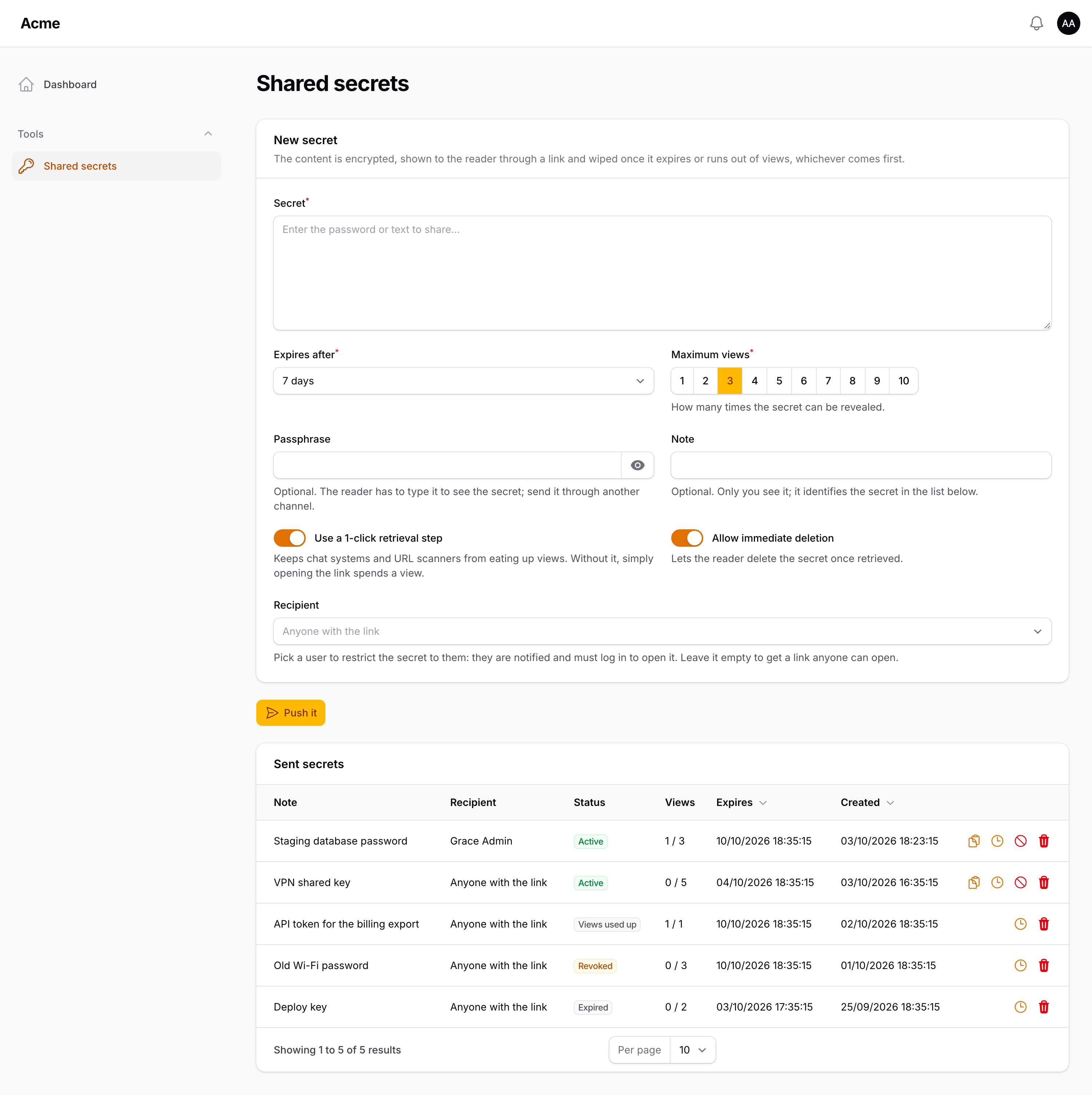
Screenshots
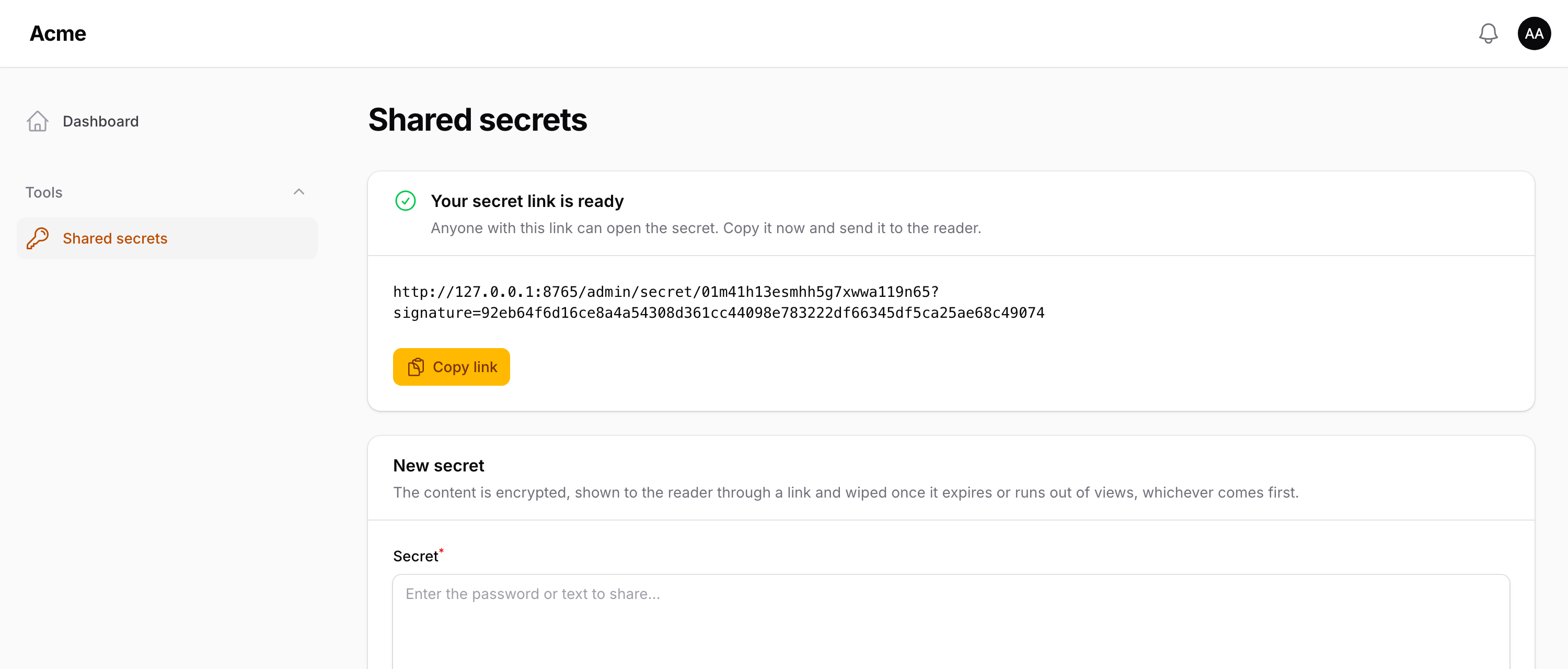
After pushing a secret, its link is shown in place, ready to copy:
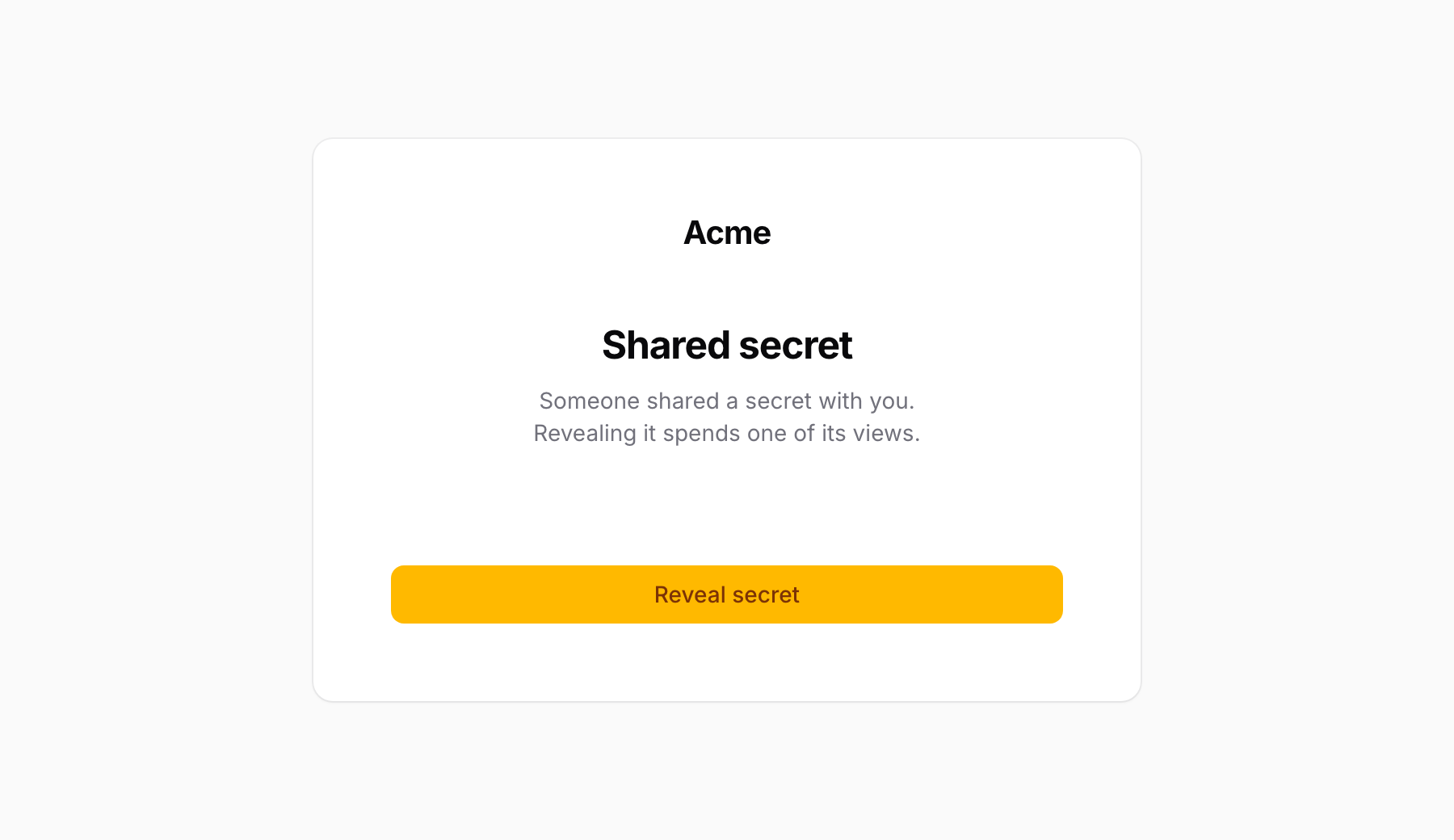
The reader opens the link and confirms before a view is spent:
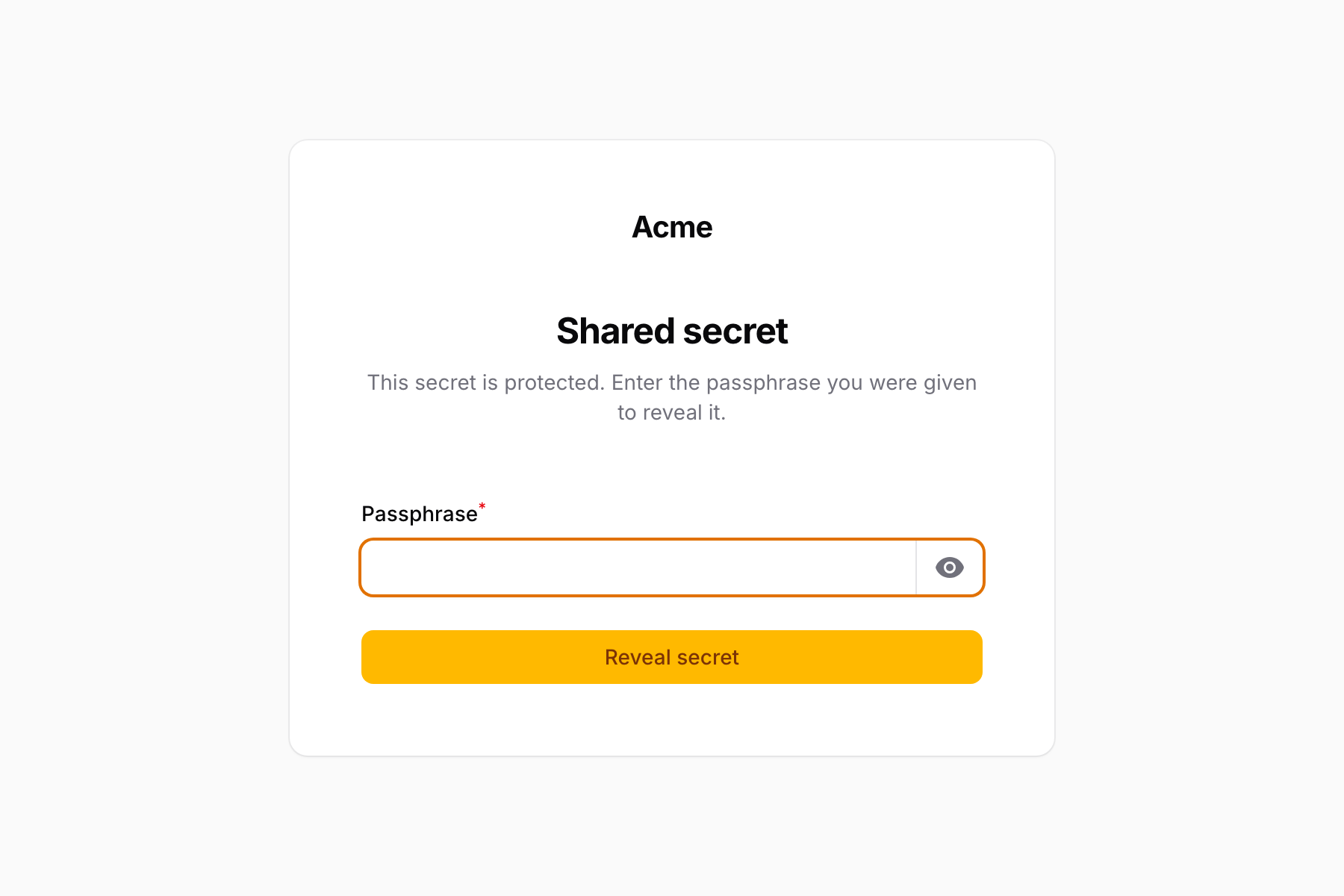
A secret can require a passphrase:
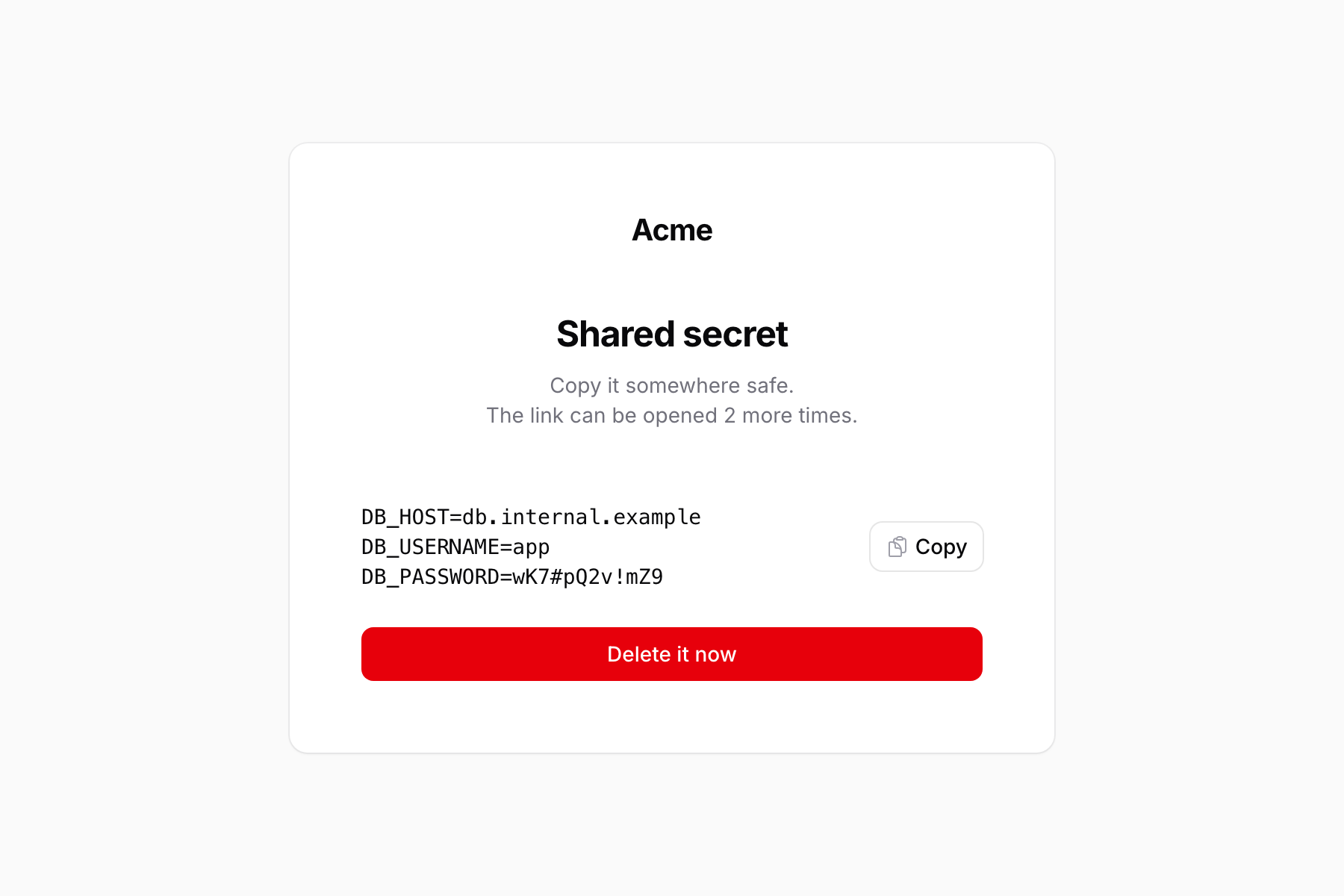
Once revealed, the reader can copy the secret, sees how many views are left and, when the sender allows it, can delete it straight away:
Requirements
- PHP 8.4+
- Laravel 12 or 13
- Filament 5.8+
Installation
composer require arzcode/shared-secrets
php artisan shared-secrets:install
The installer:
- publishes the migration (
create_shared_secrets_tables), - asks whether to publish the config file (
config/shared-secrets.php), - asks whether to run the migrations,
- asks, for each
app/Providers/Filament/*PanelProvider.php, whether to registerSharedSecretsPluginin it.
Re-running it is safe: it never publishes the migration or registers the plugin twice, and it leaves an existing config file alone.
To install by hand instead:
php artisan vendor:publish --tag=shared-secrets-migrations
php artisan vendor:publish --tag=shared-secrets-config
php artisan migrate
use Arzcode\SharedSecrets\SharedSecretsPlugin;

$panel->plugins([
    SharedSecretsPlugin::make(),
]);
Plugin options
SharedSecretsPlugin::make()
    ->navigationGroup(fn () => __('Tools'))          // string, enum or closure
    ->navigationSort(10)
    ->navigationIcon(Heroicon::OutlinedKey)
    ->authorize(fn (User $user) => $user->isAdmin()) // who may share secrets; default: every panel user
    ->viewAllSecrets(fn () => false)                 // list everyone's secrets instead of only your own
    ->recipients(true)                               // allow targeting a user of the site
    ->recipientQuery(fn ($query) => $query->where('active', true))
    ->revealPath('secret')                           // URL segment of the reader link, inside the panel path
    ->revealLogoHeight('6rem');                      // logo height on the reader page; null keeps the panel's
Lifetimes, the maximum number of views, passphrase throttling, the retention of closed secrets and the notification
channels are set in config/shared-secrets.php.
Languages
When your site describes its languages with a backed enum or an Eloquent model, point languages.source at it and the
push form offers a language selector. The reader page and the recipient's notifications are shown in the chosen
language; the values must be locales your application has translations for (en, es, pt_BR…).
'languages' => [
    'source'          => App\Enums\Language::class, // or App\Models\Language::class
    'value_attribute' => 'code',                     // model only: the column holding the locale
    'label_attribute' => 'name',                     // model only: the column shown in the select
    'fallbacks'       => ['ba' => 'ca']              // regional variants: where their missing strings come from
],
A regional variant usually only translates what differs from its base language. Without a fallbacks entry, its
missing strings come from the translator's current fallback, which a panel's locale middleware may have set to another
language. Mapped, the reader page and both notifications fill them in from the locale you name.
An enum is labelled with getLabel() when it implements Filament's HasLabel, with its case name otherwise. It ships as
null, which hides the selector.
Upgrading from 1.0.x: the language is stored in a new column, which is never touched until it exists. Until then the
language field is disabled and shows what to run: php artisan vendor:publish --tag=shared-secrets-migrations
and php artisan migrate.
How it works
- The link is
/{panel}/secret/{id}?signature=…. The signature proves the link was issued by your application; expiry and views are enforced from the database, so a spent link shows a "no longer available" page. - Targeted secrets only open for their recipient. Guests are sent to the login page of a panel the recipient can access and brought back afterwards; anyone else gets a 403. The recipient receives an email and, when a panel they can access shows database notifications, a notification in the panel.
- The 1-click retrieval step keeps chat previews and URL scanners from spending views. Without it, the page reveals the secret as soon as a browser loads it. Fetching the link never spends a view by itself, so a scanner that does not run JavaScript cannot use one up.
- A passphrase can be required. Wrong attempts are throttled per IP address and, past a limit from any address,
pause the secret for
passphrase.lockout_minutes. The secret is never wiped by wrong attempts. - The content is never shown again to its sender. An optional note, also encrypted, identifies a secret in the list; the activity log records every view with its time, user, IP address and browser.
- Pruning:
php artisan shared-secrets:prunewipes expired secrets and deletes the rows closed more thanprune_after_daysago. It is scheduled hourly unlessschedule.enabledis off.
Uninstalling
php artisan shared-secrets:uninstall
After a confirmation, it removes SharedSecretsPlugin from your panel providers without asking again. It then asks,
one by one and defaulting to "no", whether to drop the tables, delete the published migration, delete the published
config file and delete any published translations. It ends by running composer remove arzcode/shared-secrets.
Testing
composer test
composer analyse
composer format
Related Packages
Resource locking for Filament edit pages via Livewire heartbeat or broadcast.
Allow users to create & customize their own FilamentPHP pages composed of Livewi...
Version History
| Version | Released | PHP | Laravel | License |
|---|---|---|---|---|
| 1.1.0 | ^8.4 | ^12.0| | MIT | |
| 1.0.3 | ^8.4 | ^12.0| | MIT | |
| 1.0.2 | ^8.4 | ^12.0| | MIT | |
| 1.0.1 | ^8.4 | ^12.0| | MIT | |
| 1.0.0 | ^8.4 | ^12.0| | MIT |