heyosseus/sloppy

Static analysis for the debt AI coding agents leave behind, on any PHP project: 25 rules, git-diff review, coverage-aware reading order, PHPStan baseline-growth detection, a Rector and Pint fix pass, Pest expectations, CI annotations, agent rulesets and an MCP server. Extra rules and dashboards for Laravel. Deterministic, local, no LLM.
931 14
Install
composer require heyosseus/sloppy
Latest Version:v0.5.1
PHP:^8.3
License:MIT
Last Updated:Sep 14, 2026
Links: GitHub  ·  Packagist
Maintainer: Heyosseus

Sloppy reads your PHP with a real parser and reports the shapes that turn into maintenance cost: god methods, swallowed exceptions, likely N+1 queries, business logic in controllers, abstractions that never earned their keep.

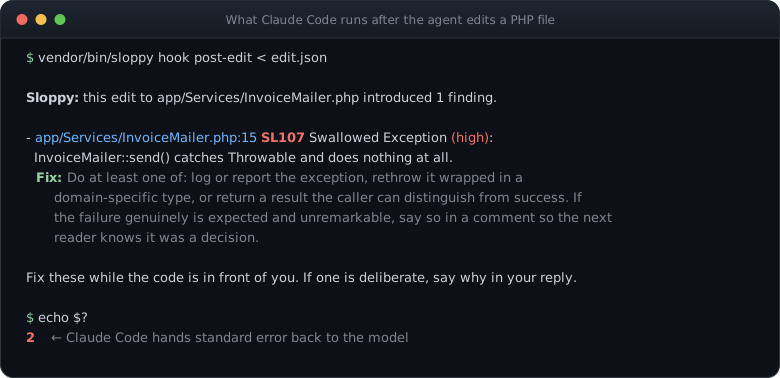
It ships 25 rules, a git-diff review mode and a baseline for existing projects; a CI command that reads your pipeline instead of asking you to describe it, with an official GitHub Action and a GitLab template; an automated fix pass that hands the mechanical findings to Rector and the formatting to Pint; a Pest plugin, so new debt fails in the same red-green loop as everything else; and, for the agents writing the code, a generated ruleset for CLAUDE.md and its equivalents plus an MCP server they can check their own work against.

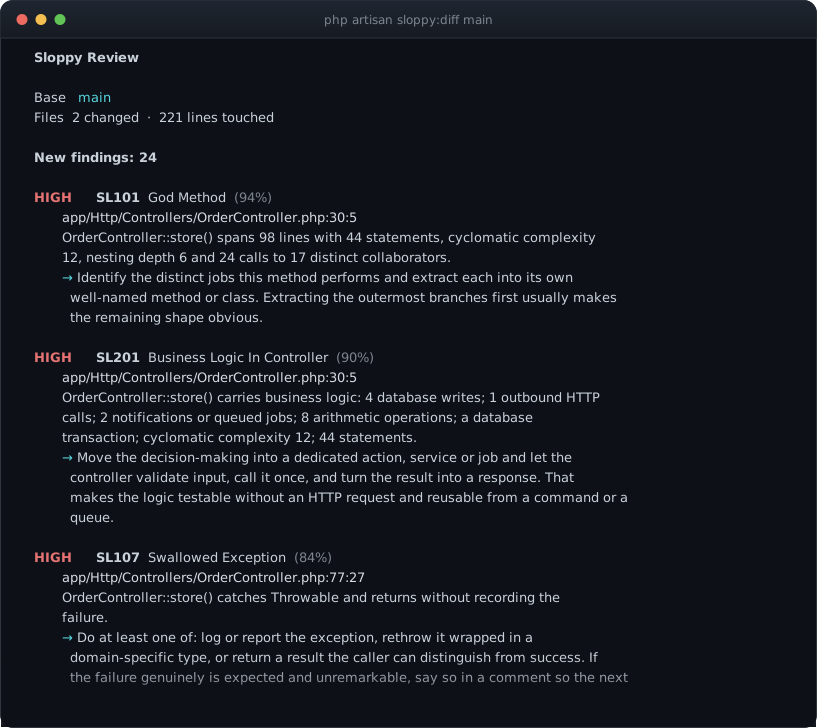
Every screenshot on this page is real output from the command in its caption.

It is not an AI detector

Nobody can reliably prove authorship from source code, and a tool that claimed to would be selling you a coin flip with a progress bar. Sloppy never guesses who or what wrote a line. It detects slop — patterns that correlate with fast, unreviewed output and with technical debt generally. A 200-line controller action that writes to four tables, calls a payment API and swallows a Throwable is a problem whether a person, an agent or a pair of them wrote it at 3am.

So every number is about the code, never about its author:

Sloppy says It means It does not mean
Confidence: 88% How sure the analyser is that the pattern it describes is really present Any probability that the code was AI-generated
Score: 67/100 A code-quality risk measure for the analysed paths "67% of this code is AI-generated"
SL107 Swallowed Exception This catch block does nothing observable with the failure An accusation about who wrote it

Sloppy is deterministic and local. Your source never leaves the machine, and the same code always produces the same report — which is what makes it usable as a gate.

Install

composer require --dev heyosseus/sloppy

php artisan sloppy          # Laravel
vendor/bin/sloppy           # any PHP project

The service provider is discovered automatically. Publish the config when you want to tune it:

php artisan vendor:publish --tag=sloppy-config

Or without adding a dependency

Deciding whether a tool is worth a composer.json entry is easier once you have seen what it says about your code. Two ways to run it against a project that has never heard of it:

# Once per machine, for every project on it
composer global require heyosseus/sloppy
sloppy                                    # run it from anywhere inside a project

# Or a single file, no Composer resolution at all
curl -L -o sloppy.phar https://github.com/heyosseus/sloppy/releases/latest/download/sloppy.phar
chmod +x sloppy.phar
./sloppy.phar

Both work with no configuration file. Sloppy finds the project by walking up to the nearest composer.json, and analyses the PSR-4 source roots declared there when there is no config/sloppy.php to say otherwise — so src/ on a framework-free project and app/ on a Laravel one are both found on their own. Pass --project when the directory it picked is not the one you meant.

Everything works this way except the php artisan sloppy:* commands themselves, which need the package installed in the project. sloppy fix still drives Rector and Pint, because it resolves them from the analysed project's vendor/bin rather than its own.

Each release attaches sloppy.phar.sha256 alongside the binary, if you want to check it:

curl -L -o sloppy.phar.sha256 https://github.com/heyosseus/sloppy/releases/latest/download/sloppy.phar.sha256
sha256sum -c sloppy.phar.sha256

Requirements: PHP 8.3+. Laravel 12 or 13 for the Artisan commands and the SL2xx rules; everything else runs anywhere.

Which command do I want?

php artisan sloppy:help      # or: vendor/bin/sloppy guide

Eleven commands, and the moment each one belongs to. Both names run the same code, so use whichever your project has.

Every day
sloppy sloppy scan Analyse the project and rank what is worth reading first
sloppy:diff sloppy diff Report what a change introduced, against a git revision
sloppy:review sloppy review The same change, ordered by risk rather than by file
sloppy:baseline sloppy baseline Accept what is already there, so only new findings fail
sloppy:watch sloppy watch Keep the score on screen, redrawing as files change
sloppy:help sloppy guide This list
In a pipeline
sloppy:ci sloppy ci Analyse a change the way the surrounding CI system reports it
sloppy:fix sloppy fix Hand the fixable findings to Rector, then format with Pint
sloppy:health sloppy health The score and what is dragging it down, from a cached snapshot
For agents
sloppy:rules sloppy rules Write this project's rules into CLAUDE.md, AGENTS.md and friends
sloppy:mcp sloppy mcp Serve scan, diff, rules and health over MCP

For one command's options, sloppy help <command> or php artisan sloppy:<command> --help.

Contents

Scan a project

php artisan sloppy                  # the configured paths
php artisan sloppy --path=app/Services
php artisan sloppy --rule=SL101 --rule=SL107
php artisan sloppy --min-confidence=80
php artisan sloppy --explain        # include each rule's "why this matters"

The screenshot at the top of this page is that command run against a small application written badly on purpose. It ships as tests/Fixtures/Sloppy, so you can reproduce it.

Anatomy of a finding

One file, seven findings, the whole report:

php artisan sloppy --path=app/Services/ReportingService.php

Every finding carries the same five things: where it is, what was measured, how sure the analyser is, why the pattern is often a problem, and what to do about it. The last one is the point — a finding you cannot act on is noise with a line number.

Review a change

The most useful command if you work with coding agents:

php artisan sloppy:diff             # working tree vs HEAD
php artisan sloppy:diff HEAD~1      # vs the previous commit
php artisan sloppy:diff main        # everything this branch changed

It separates what your change introduced from what it merely inherited, and only new findings can fail the build.

php artisan sloppy:diff main

Three things worth knowing about how it works:

  • It reviews the working tree, not just commits. Uncommitted and untracked files are included, so an agent's new class is reviewed before it is committed rather than after.
  • Findings are matched by fingerprint, not by line number. Adding an import at the top of a file does not turn every existing finding in it into a new one.
  • Cross-file rules still see the whole project. Rules only run on changed files, but the project index is built from everything, so SL303 can still tell that an interface has exactly one implementation in a file the diff never touched.

Adopt on an existing codebase

Turning Sloppy on for the first time should not mean fixing everything first. Record what is there today, commit the file, and gate on what comes next:

php artisan sloppy:baseline

php artisan sloppy:baseline, then php artisan sloppy

Baseline entries are keyed on rule, file and a rule-supplied fingerprint — usually a class and member name — and deliberately not on line numbers, so a baseline survives ordinary editing. If a finding occurs more often than the baseline recorded, the extra occurrences are new.

--force replaces an existing baseline; --rule= baselines only some rules.

Does it just complain about everything?

That is the failure mode of every analyser, so Sloppy runs its whole rule set over its own source in CI:

php artisan sloppy --path=src

One finding, and it is a real one: NodeHelper is a large class. Splitting it into five so that rules import three of them to ask three questions would be exactly the ceremony this package exists to discourage, so the decision is recorded in tests/Feature/SelfCheckTest.php with its reasoning — and that test fails on any new finding about Sloppy's own code. Four others it found were genuine, and they were fixed.

The other half of the answer is tests/Fixtures/Good: deliberately ordinary Laravel code, with a test asserting that all 25 rules report zero findings on it at a score of 100.

What to read first

sloppy:diff answers did this change make it worse? sloppy:review answers the question you have immediately afterwards: of everything this change touched, what deserves reading?

vendor/bin/sloppy review origin/main
php artisan sloppy:review origin/main
  Sloppy review

  161 file(s) changed, 12,198 lines  ·  score 5 → 12 (+7)

  Read in this order
    1. app/Actions/Product/CloneProductToTenantAction.php   risk 70.5
         new SL111 Copy-Paste Drift  (76%, risk 9.9, in hunk)
         new SL102 God Class  (73%, risk 9.5, in hunk)
         new SL111 Copy-Paste Drift  (68%, risk 8.8, in hunk)
         new SL204 Query Inside Loop  (84%, risk 4.4, in hunk)
         and 9 more in this file, 2 x SL104, 7 x SL204
    2. app/Filament/Imports/B2bCatalogImporter.php   risk 48.0
         new SL102 God Class  (91%, risk 11.8, in hunk)
         new SL101 God Method  (76%, risk 9.9, in hunk)

  Skim
    4 file(s), risk under 5
      app/Support/TenantFrontend.php  risk 3.4

  No attention needed
    132 file(s) changed with no findings

  Resolved by this change
    3 finding(s) no longer reported
      2 x SL101 God Method
      1 x SL204 Query Inside Loop

Three tiers, so you know where to stop. Same analysis, same score and the same exit code as sloppy:diff — only the presentation differs, so adopting the reading order changes no build outcome.

in hunk is the part no other tool can do. A god method your change created and a god method it merely stood next to are not the same finding. Telling them apart needs the diff's hunks at rule time, and nothing else in this space has them.

Risk

Risk and the slop score answer different questions, and conflating them leads a team to chase the wrong one.

Slop score Risk
Question How is this codebase? What should I read next?
Normalised Yes, by size No, absolute
Aware of your change No Yes
Moves a baseline Yes Never
risk = severity_weight × (confidence / 100) × novelty × proximity × reach × exposure

reach     = 1 + log10(1 + blast_radius) × reach_weight
novelty   = new 1.0 | inherited 0.25
proximity = inside a changed hunk 1.0 | elsewhere in a touched file 0.3
exposure  = 1 + (1 − coverage) × exposure_weight | 1.0 when no coverage report

Every factor defaults to 1.0 when it cannot be measured, which is what makes the model safe to extend: a project with no coverage report ranks exactly as it did before exposure existed.

Reach is logarithmic on purpose. A class with two hundred callers is not two hundred times more urgent than one with a single caller; the tenth caller costs less new attention than the first. One usage yields 1.30, ten yields 2.04, a hundred yields 3.00 — a 2.3× spread across two orders of magnitude, which is roughly the spread a reviewer actually feels.

A file's risk is the raw sum of its findings, not their density. A file with twelve findings should be read before a file with one, even if it is longer. Density is the right measure for quality and the score already provides it; total is the right measure for attention.

Every weight lives under sloppy.risk and every one is documented in config/sloppy.php. Set reach_weight to 0.0 to rank on severity and confidence alone.

Show me the arithmetic

Add --explain-risk to any command and every derived number prints its own working:

vendor/bin/sloppy scan --explain-risk
    108  HIGH     SL102  God Class  (91% confidence)
         NodeHelper spans 1021 lines with 59 methods…
         → Group the members that change together…
         risk  10.0 (high) × 0.91 (confidence) × 1.00 (novelty unknown) × 1.00 (whole file) × 2.45 (27 usages) = 22.27

A tool that weights findings owes you its weights. A number you can watch it derive is not a magic number.

Slop score

A single deterministic number for the analysed paths:

penalty  = Σ  weight(severity) × confidence / 100
units    = max(1, analysedLines / lines_per_unit)
density  = penalty / units
coverage = min(1, Σ affectedLines / analysedLines)
score    = 100 − min(100, density × penalty_multiplier × (1 + coverage))
  • Step 1 makes a finding we are half sure about cost half as much.
  • Step 2 normalises by codebase size, so a large application is not punished merely for being large.
  • Step 4 doubles the penalty when findings blanket the codebase and barely moves it when they are localised.

Default weights are critical: 20, high: 10, medium: 4, low: 1.5, info: 0.5. Weights, the multiplier, lines_per_unit and the band thresholds are all configurable under sloppy.score. Same input, same score — always.

Because the score is a density, a small codebase full of findings bottoms out quickly: the 472-line demo application in the first screenshot scores 0. That is the arithmetic working, not a verdict on 472 lines of anything.

Severity and confidence

They answer different questions, and both appear on every finding.

Severity — how much this matters if it is real. critical, high, medium, low, info. Set by the rule, overridable per rule in config. This is what fail_on compares against.

Confidence — how sure the analyser is that the pattern it describes is actually present, 0–100. A 300-line method is a measurement, so confidence is high. A possible N+1 depends on eager loading the analyser may not be able to see, so confidence is lower. Abstraction inflation is a heuristic, so it never reports above 78.

No rule ever reports 100% confidence. These are heuristics, and a heuristic that claims certainty is lying.

Rules

25 rules ship. Every one has tests proving both that it fires on the pattern and that it stays quiet on ordinary Laravel code.

PHP and general

ID Rule Severity Category What it looks for
SL101 God Method High Complexity Methods that are excessively long, branchy or chatty across several independent measurements.
SL102 God Class High Complexity Classes that are large across several dimensions at once: size, method count, injected dependencies and the number of collaborators they talk to.
SL103 Excessive Nesting Medium Complexity Methods whose conditionals, loops and try blocks nest deeper than the configured limit.
SL104 Duplicate Logic Medium Duplication Methods whose bodies are structurally identical to another method in the project.
SL105 Dead Private Method Medium Dead code Private methods with no visible caller anywhere in the declaring file.
SL106 Unused Constructor Dependency Medium Dependencies Constructor-injected dependencies that are never read anywhere in the class.
SL107 Swallowed Exception High Error handling Catch blocks that neither rethrow, report, log nor otherwise react to the failure they caught.
SL108 Redundant Condition Low Readability Conditions re-tested immediately inside themselves, repeated within one if/elseif chain, duplicated across a boolean operator, or written as a literal true/false.
SL109 Narrative Comment Low Readability Short comments whose every meaningful word already appears in the statement directly below them.
SL110 Defensive Programming Noise Low Readability A method that guards the same subject the same way twice, with the same outcome and no reassignment in between.
SL111 Copy-Paste Drift High Duplication A method body nearly identical to a sibling's, where the one difference looks like an unfinished copy rather than a deliberate variation -- a missing guard, a flipped comparison, the wrong class constructed. Heuristic: the majority is more likely to be right, not automatically right.

Laravel

ID Rule Severity Category What it looks for
SL201 Business Logic In Controller High Laravel Controller actions that combine several business concerns: database writes, calculations, transactions, outbound calls and branching.
SL202 Inline Validation Low Laravel Large inline validation rule sets inside controllers, where a FormRequest would carry them better.
SL203 Possible N+1 Medium Performance Relationship access inside a loop where the iterated collection does not appear to eager load that relation.
SL204 Query Inside Loop Medium Performance Query builder or Eloquent queries executed inside a loop.
SL205 Collection Instead Of Database Query Medium Performance A full table load followed immediately by a collection operation the database could have performed.
SL206 Excessive Controller Dependencies Medium Dependencies Controllers whose constructor injects more collaborators than the configured limit.
SL207 Excessive Service Dependencies Medium Dependencies Service, action and manager classes whose constructor injects more collaborators than the configured limit.
SL208 Direct External API Call Medium Laravel Outbound HTTP requests made directly from controllers, models, form requests or middleware.
SL209 Model Doing Too Much Medium Laravel Eloquent models that make outbound calls, dispatch notifications or jobs, or contain long business workflows.
SL210 Suspicious Model::all() Medium Performance Model::all() whose result is iterated in the same method, or which is called from inside a loop.

Architecture

These three are advisory. They report that an abstraction is not earning its keep for the current usage, which is a judgement about today's code and not a rule against repositories or interfaces.

ID Rule Severity Category What it looks for
SL301 Abstraction Inflation Medium Architecture Concepts wrapped in several layers where at least one layer is trivial, singly implemented or singly used.
SL302 Empty Wrapper Class Medium Architecture Classes whose public methods almost all forward their arguments unchanged to a single injected collaborator.
SL303 Single-Use Abstraction Low Architecture Small interfaces and abstract classes that have exactly one implementation and at most one calling file.

Suppression

An analyser being silenced is not a style question. These two are about the moment somebody decided to stop being told about a problem rather than fix it.

ID Rule Severity Category What it looks for
SL501 Unexplained Suppression Medium Suppression @phpstan-ignore, @psalm-suppress, @mago-expect, @noinspection, phpcs:ignore or @SuppressWarnings written with no reason after it. Not suppression density: a defended suppression is a reviewed decision, and flagging those would train people to delete the explanation rather than the ignore.
SL502 Baseline Growth Medium Suppression Entries this change added to phpstan-baseline.neon or psalm-baseline.xml. Diff mode only — "grew" needs two revisions. Compared per source path, so regenerating a baseline reports nothing.

Signals from the tools you already run

Sloppy never runs PHPStan, Psalm, Pint or Rector. It reads what they leave behind and treats it as evidence about a change — which is the one thing those tools cannot do for each other, because none of them knows what changed.

Two rules decide where a signal is allowed to go, and together they are why the numbers stay comparable:

Tracked in git Not tracked
Example phpstan-baseline.neon build/logs/clover.xml
Same answer on a fresh CI clone? Yes No — it exists only after a test run
May move the score? Only if also computable from the tree alone Never
May move risk? Yes Yes

The score is a function of the tree alone. Anything that needs a second revision to compute may be reported and ranked, but never scored.

So SL501 moves the score — the suppression is sitting there in the file. SL502 does not: it exists only relative to a base revision, and scoring it would make sloppy scan and sloppy diff main report different scores for the same working tree. It still counts against --fail-on, because a build may legitimately refuse a change that silenced three errors.

Coverage

Point Sloppy at a clover or cobertura report and a changed file your tests never execute rises in the reading order:

sloppy review main --coverage=build/logs/clover.xml --explain-risk
4.0 (medium) × 0.85 (confidence) × 1.00 (new) × 1.00 (in hunk) × 1.00 (reach unmeasured) × 1.50 (untested) = 5.10

The path can also come from sloppy.risk.coverage — it lives in the risk block because risk is the only thing it feeds — and with neither set Sloppy checks build/logs/clover.xml, coverage.xml, build/coverage/clover.xml, coverage/clover.xml and build/logs/cobertura.xml. Clover and Cobertura are told apart by content, because CI configurations name these anything at all.

The baseline files SL502 watches are a rule option, beside SL501's suppression vocabulary:

'rules' => [
    'SL502' => ['files' => ['phpstan-baseline.neon', 'psalm-baseline.xml']],
],

Coverage never changes the slop score. A file nobody tested is not a file with a defect in it; it is a file where a defect would survive, which is a statement about what to read first.

Coverage reports go stale, and a stale one silently reorders a review. Sloppy does not guess at that: sloppy health and --explain-risk print the report's path and the date it was written, and leave the judgement to you. A staleness heuristic would be a number that cannot show its arithmetic, which is the one thing every number in this package can do.

ext-xml is suggested, not required. Without it coverage is skipped and nothing else changes.

Configuration

Everything lives in config/sloppy.php. There is deliberately no second configuration format to keep in sync.

return [
    'enabled' => env('SLOPPY_ENABLED', true),

    'paths' => ['app'],

    'exclude' => [
        'vendor', 'storage', 'bootstrap/cache', 'node_modules', 'public',
        'database/migrations', 'database/factories', 'database/seeders',
        '*.blade.php',
    ],

    // Lowest severity that fails the command, or null to never fail.
    'fail_on' => 'high',

    // Drop findings below this confidence before reporting anything.
    'min_confidence' => 0,

    'baseline' => '.sloppy-baseline.json',

    'rules' => [
        // Every rule is on unless it says otherwise here.
        'SL109' => ['enabled' => false],

        // Prefer lowering a severity to switching a rule off: the finding
        // stays visible without failing the build.
        'SL301' => ['severity' => 'low'],

        'SL101' => ['max_lines' => 120, 'max_complexity' => 20],
        'SL206' => ['max_dependencies' => 6],
        'SL210' => ['ignore_models' => ['Country', 'Currency', 'Setting']],
    ],
];

Exclusions match whole path segments at any depth, so vendor excludes both vendor/… and packages/foo/vendor/…. Entries containing * are matched as globs.

The published config file documents every option of every rule with its default. Start by reading that rather than this table.

Tuning a noisy first run

In order of bluntness:

  1. min_confidence: 75 — keep only findings the analyser is fairly sure about.
  2. 'SL109' => ['severity' => 'info'] — keep the finding, stop it mattering.
  3. php artisan sloppy:baseline — accept today's debt, gate on tomorrow's.
  4. 'SL109' => ['enabled' => false] — last resort.

JSON output

php artisan sloppy --format=json
php artisan sloppy:diff --format=json

The shape is a published contract. schema is bumped when a field changes meaning; within a schema version keys are only ever added. Findings come out in the analyser's canonical order, so two runs over the same code produce byte-identical output that is safe to diff in CI.

Standard output carries the report and nothing else, so it pipes:

vendor/bin/sloppy scan --format=json | jq '.findings[] | select(.severity == "high")'

Anything written for the reader rather than for the machine -- the project root and configuration source, the count of findings a baseline is hiding, progress -- goes to standard error. In a terminal you see it as usual; in a pipe it stays out of the way. Redirect it with 2>/dev/null if you want it gone entirely.

This is the report behind the screenshot above, abridged to one finding:

{
  "schema": 1,
  "tool": "sloppy",
  "score": {
    "value": 67,
    "band": "needs_attention",
    "label": "Needs attention",
    "penalty": 18.68,
    "penalty_density": 18.68
  },
  "summary": {
    "files": 1,
    "lines": 65,
    "findings": 7,
    "by_severity": { "critical": 0, "high": 0, "medium": 5, "low": 2, "info": 0 }
  },
  "findings": [
    {
      "rule": "SL106",
      "name": "Unused Constructor Dependency",
      "category": "dependencies",
      "severity": "medium",
      "confidence": 88,
      "file": "app/Services/ReportingService.php",
      "line": 12,
      "end_line": 12,
      "column": 9,
      "message": "ReportingService injects $logger but never uses $this->logger.",
      "explanation": "An unused dependency still has to be constructed and resolved, and it misleads the next reader about what the class actually needs. ...",
      "suggestion": "Remove $logger from the constructor, and from any container binding or test that builds this class by hand.",
      "fingerprint": "ReportingService::$logger",
      "identity": "a6166b140b3256d6",
      "metrics": { "dependency": "Psr\\Log\\LoggerInterface", "promoted": true }
    }
  ],
  "errors": {}
}

identity is the stable hash baselines and diff mode match on. errors maps whatever could not be processed to why — a relative path for a file that would not parse, or "SL101 in app/Foo.php" for a rule that threw.

Diff mode returns the same envelope with mode: "diff", a base, a changed_files list, score.base / score.current / score.delta, and findings split into new, existing and resolved.

Editors and code scanning

Sloppy speaks three formats that put findings where you already look, so it does not need a dashboard of its own.

Format Goes to
--format=sarif GitHub code scanning, VS Code, JetBrains IDEs
--format=github Inline annotations on a pull-request diff
--format=markdown A pull-request comment body

SARIF

vendor/bin/sloppy scan --format=sarif > sloppy.sarif

SARIF 2.1.0 is what code-scanning tooling already reads, which is the answer to why not SonarQube without running a server. Findings appear in the Security tab, and in your editor's problems panel, from one file.

GitHub deduplicates findings across runs using partialFingerprints, and Sloppy's finding identity is exactly the right shape for it: a stable hash of rule, file and a rule-supplied fingerprint that excludes the line number, so adding an import at the top of a file does not resurrect every finding beneath it or re-notify you about all of them.

      - name: Analyse
        run: vendor/bin/sloppy scan --format=sarif --fail-on=never > sloppy.sarif

      - uses: github/codeql-action/upload-sarif@v3
        with:
          sarif_file: sloppy.sarif

--fail-on=never is deliberate there: let the upload happen, and let code scanning decide what blocks a merge.

Inline annotations

      - name: Annotate the diff
        run: vendor/bin/sloppy scan --format=github

No redirection — the workflow commands are meant to be seen by the runner on standard output, which is why github is the one machine-readable format you do not pipe to a file.

A pull-request comment

      - name: Comment
        run: |
          vendor/bin/sloppy review origin/${{ github.base_ref }}             --format=markdown > review.md
          gh pr comment ${{ github.event.number }} --body-file review.md
        env:
          GH_TOKEN: ${{ secrets.GITHUB_TOKEN }}

Exit codes

Code Meaning
0 Analysis completed and nothing breached fail_on
1 Analysis completed and found something at or above fail_on
2 Analysis could not run: bad configuration, no git repository, unreadable baseline

The distinction between 1 and 2 matters. A pipeline that conflates them either ignores real findings or fails on a typo in a config file without telling you which.

CI

One command, and it works out the rest:

php artisan sloppy:ci        # or: vendor/bin/sloppy ci

sloppy ci reads the environment it is running in and does what that environment wants:

Where it runs What it does
A GitHub pull request Compares against the target branch and annotates the changed lines
A GitHub push Analyses the whole project
GitLab Writes a Code Quality report GitLab renders in the merge request
Anywhere else Prints the ranked console report

It also writes the ranked report to the GitHub job summary, and hands the numbers back as step outputs so a later step can comment, gate a deploy or publish a badge without running anything twice.

Everything is overridable: --base, --format, --report=<file>, --fail-on, --scan, --no-summary, --path, --rule, --min-confidence.

GitHub Action

Three lines of YAML:

- name: Run Sloppy Agent Review
  uses: heyosseus/sloppy-action@v1
  with:
    diff-branch: main

In full, with the parts you might want:

name: sloppy

on: pull_request

permissions:
  contents: read
  pull-requests: read

jobs:
  review:
    runs-on: ubuntu-latest
    steps:
      - uses: actions/checkout@v4

      - id: sloppy
        uses: heyosseus/sloppy-action@v1
        with:
          fail-on: high          # critical, high, medium, low, info or never
          paths: app src         # optional, space separated
          report: sloppy.json    # optional machine-readable copy

      - run: echo "Score ${{ steps.sloppy.outputs.score }} (${{ steps.sloppy.outputs.new-findings }} new)"

The action fetches the base branch itself -- actions/checkout clones one commit by default, and diff mode needs the branch the pull request targets, or it would report inherited findings as if the author had written them.

Inputs: diff-branch, paths, rules, fail-on, min-confidence, format, report, scan, summary, working-directory, php-version, version. Outputs: score, score-delta, findings, new-findings, resolved-findings, status, mode.

The action is this repository's own action.yml, so uses: heyosseus/sloppy@v1 works too if you prefer not to depend on a second repository.

GitLab CI

Include the shipped template and the findings appear in the merge request's Code Quality widget, beside the lines they are about:

include:
  - remote: 'https://raw.githubusercontent.com/heyosseus/sloppy/main/resources/ci/gitlab-ci.yml'

variables:
  SLOPPY_FAIL_ON: high

The report covers the whole project on purpose: GitLab works out which findings a merge request introduced by comparing the report against the target branch's, and handing it a diff would break the comparison it is already doing for you.

Fix what can be fixed

Sloppy does not rewrite your code. Rector and Pint already do that well, and what Sloppy knows that they do not is which of their rules this project currently needs:

php artisan sloppy:fix --dry-run     # show what would change
php artisan sloppy:fix               # rewrite, then format

It generates a Rector configuration scoped to the files that actually have findings, runs it, formats the rewritten files with Pint, and then tells you what is left:

  12 of 31 finding(s) have an automated fix. Wrote rector-sloppy.php.
  rector finished.
  pint finished.
  19 finding(s) need a person: SL101 x4, SL102 x1, SL104 x9, SL111 x5.
  Findings 31 -> 19. Score 68/100 -> 84/100.

Scoping matters: the generated configuration lists only the files that have findings, so a fix pass on a large project does not rewrite the whole of app/ to prove a point about six files.

What it can fix, and what it will not pretend to

Six rules map onto Rector rules that genuinely fix them:

Rule Fixed by
SL103 Excessive Nesting ChangeNestedIfsToEarlyReturn, ChangeNestedForeachIfsToEarlyContinue, CombineIf
SL105 Dead Private Method RemoveUnusedPrivateMethod
SL106 Unused Constructor Dependency RemoveUnusedConstructorParam, RemoveUnusedPromotedProperty, RemoveUnusedPrivateProperty
SL107 Swallowed Exception ThrowWithPreviousException, RemoveDeadTryCatch
SL108 Redundant Condition RemoveAlwaysTrueIfCondition, RemoveAlwaysElse, SimplifyIfReturnBool
SL110 Defensive Programming Noise SimplifyIfNotNullReturn, RemoveAlwaysTrueIfCondition

Rector's ...Rector class suffix is omitted above for width; the generated configuration names each class in full.

The rest are left alone on purpose, and the report says why at the point you would have asked:

Rule Why no tool fixes it
SL101 God Method splitting a long method is a design decision, not a rewrite
SL102 God Class which responsibility leaves the class is a design decision
SL104 Duplicate Logic the shared code has to be named before it can be extracted
SL109 Narrative Comment deleting a comment automatically risks deleting the one that mattered
SL111 Copy-Paste Drift only you know whether the drift between the copies was deliberate

No automated rewrite splits a god method into the three methods it wanted to be, and one that tried would produce three worse ones. A fix command that claimed otherwise would cost you more time than it saved.

Running it your way

Flag What it does
--dry-run Write nothing; print what would change
--rule=SL107 Fix only these rules, repeatable
--no-rector Write the configuration and stop, for review before it runs
--no-pint Skip the formatting pass, if your project formats another way
--keep-config Leave rector-sloppy.php on disk instead of deleting it
--rector-config= Name the generated file something else
--path=app/Domain Fix only these paths, repeatable
--min-confidence=80 Ignore findings the analyser is less sure about

Neither tool is a dependency of this package. Without them you still get the configuration and a message naming the one to install -- Sloppy's own job is knowing which of their rules this project currently needs, and that answer is useful whether or not you let it run them. To generate the configuration alone, without an analysis pass around it:

vendor/bin/sloppy --format=rector > rector-sloppy.php

In your test suite

Sloppy ships a Pest plugin, so new debt fails in the same red-green loop as everything else about the code. There is nothing to register: the expectations are autoloaded with the package, and exist as soon as composer require --dev heyosseus/sloppy has run.

it('has zero AI slop on the current branch', function (): void {
    expectCleanSloppyDiff('main');
});

it('keeps the whole of app/Domain clean', function (): void {
    expectCleanSloppyScan(paths: ['app/Domain']);
});

it('does not let the score slip', function (): void {
    expectSloppyScoreAtLeast(80);
});

Failures name the file, the line and the rule:

This change introduced 1 finding(s) against main:
  app/Services/Billing.php:41  SL101 God Method (high) -- Billing::charge() spans 96 lines ...

All three take the same narrowing arguments, so a test can be as specific as the rule it is protecting:

Expectation Fails when Returns
expectCleanSloppyDiff($base) the working tree introduced findings against $base DiffReport
expectCleanSloppyScan() the analysed paths contain findings at all AnalysisResult
expectSloppyScoreAtLeast($min) the slop score has fallen below a floor AnalysisResult
expectCleanSloppyScan(
    failOn: 'high',
    paths: ['app/Domain'],
    rules: ['SL101', 'SL107'],
    minConfidence: 80,
);

Each expectation returns the report it built, so a test can go further:

$report = expectCleanSloppyDiff('main', failOn: 'critical');

expect($report->resolved)->not->toBeEmpty();

A note on where to put the gate. expectCleanSloppyDiff('main') and sloppy ci ask the same question of the same analyser, so pick the one whose feedback arrives when you can still act on it: the expectation fails on the machine that wrote the code, seconds after it was written, while the pipeline fails after the push. Teams that want both usually keep the test narrow -- one package, one threshold -- and let CI cover the whole project.

Watch while you work

The most useful moment to know what a change cost is while it is still being made — which is the moment nobody stops to run a command. sloppy watch leaves the answer on screen:

php artisan sloppy:watch      # Laravel
sloppy watch                  # any PHP project
  72/100  Needs attention
  ██████████████░░░░░░

  complexity      14  ████████████
  laravel          9  ████████
  duplication      4  ███

  Read first
  1 SL101 God Method             app/Services/ReportingService.php:40
› 2 SL107 Swallowed Exception    app/Models/Order.php:112
  3 SL204 Possible N+1           app/Http/Controllers/InvoiceController.php:88

  61 files · changed ReportingService.php · 1.2s
  ↑↓ move  ↵ open  r rescan  q quit

Put it beside the agent writing the code. Every save redraws the score, the breakdown and what to read first. ↑↓ moves through the findings, opens the selected one at its line in $VISUAL or $EDITOR, r forces a rescan and q leaves — restoring the terminal exactly as it was found.

Three things worth knowing:

  • A tick is not an approximation. It re-parses only the file that moved, then runs every rule over the whole project, so the numbers are identical to sloppy scan of the same tree. Reporting on fewer files would be faster and would make SL303 and the duplication rules quietly wrong.
  • It watches by polling, not by filesystem events. No extension is needed and it behaves the same everywhere. Changes are matched on modification time and length, so the rare edit that changes neither is what r is for.
  • Keyboard control needs a terminal that can give up a keypress. PHP has no way to put a Windows console into raw mode, so there sloppy watch is a monitor: it still redraws on every change, and the footer says Ctrl+C to quit rather than offering keys that would never arrive. Redirected into a file or a pipe there is no terminal at all, and the command says so and exits rather than looping forever — sloppy health --json is the pipeable one.

Options are the ones sloppy health takes — --path, --rule, --min-confidence, --top — plus --interval for the poll interval in milliseconds (default 250).

Filament and NativePHP

Both read the same cached health snapshot, so a dashboard never waits for an analysis:

// A Filament panel
use Heyosseus\Sloppy\Integrations\Filament\SloppyPlugin;

$panel->plugin(SloppyPlugin::make());
// A NativePHP menu bar
use Heyosseus\Sloppy\Integrations\NativePhp\DesktopHealth;

MenuBar::create()->label(app(DesktopHealth::class)->menuLabel());   // "! 72/100"

Keep the snapshot warm from the scheduler, and every surface stays current:

Schedule::command('sloppy:health --fresh')->hourly();

The same snapshot is available as JSON for anything else:

php artisan sloppy:health --json

Filament is not a dependency of this package. Neither is NativePHP: the desktop integration hands you strings, and your app decides what to do with them.

Rules for coding agents

The cheapest finding is the one that never gets written. sloppy:rules writes this project's rules where the agents already look, before they write anything:

php artisan sloppy:rules                              # CLAUDE.md
php artisan sloppy:rules --format=cursor --format=agents
php artisan sloppy:rules --format=copilot --format=windsurf
php artisan sloppy:rules --stdout                     # print instead

Each format knows the file its tool reads, so --output is only for the unusual case:

--format= Writes
claude (default) CLAUDE.md
cursor .cursorrules
agents AGENTS.md
copilot .github/copilot-instructions.md
windsurf .windsurfrules
markdown sloppy-rules.md
json sloppy-rules.json

The Markdown formats merge into whatever is already there. json has no marked block to merge into, so it refuses to overwrite an existing file unless you pass --force.

The file describes your configuration -- your paths, your threshold, the rules you turned off, the ones skipped because you do not use their framework -- and gives each rule a line an agent can act on:

### SL107 Swallowed Exception

- Category: Error handling, severity: high
- Flags: A catch block that discards the exception ...
- Why it costs: A swallowed exception turns a bug into a silent wrong answer ...
- Write it this way instead: Handle the failure or let it travel. If you catch,
  log the exception as the previous one and rethrow something meaningful --
  never return null in place of an answer.

Existing files are respected: the generated rules go inside a marked block, appended the first time and replaced in place afterwards, with everything outside the markers left exactly as your team wrote it. Regenerate it from the scheduler or a git hook and your team's own notes survive every run.

Your custom rules teach the agents too

A custom rule is not a second-class citizen here. When the ruleset is generated, a rule with no shipped advice falls back to its own description(), so whatever that method returns is what lands in CLAUDE.md in front of the model:

public function description(): string
{
    // This sentence is what the agent reads. Write it as an instruction.
    return 'Domain classes must not call facades. Inject the dependency '
        .'through the constructor instead, so the class can be tested '
        .'without booting the framework.';
}

Written as a label -- "no facades in domain" -- it tells the agent a rule exists. Written as an instruction, it tells the agent what to write instead, which is the difference between a rule that gets tripped and a rule that gets followed. See Custom rules for the class itself.

MCP server

Agents that speak the Model Context Protocol can check their own work:

vendor/bin/sloppy-mcp          # or: php artisan sloppy:mcp

Register it with your editor or agent, for example in .mcp.json:

{
  "mcpServers": {
    "sloppy": {
      "command": "vendor/bin/sloppy-mcp",
      "args": []
    }
  }
}

Four tools:

Tool What it answers
sloppy_scan What is wrong with these files, right now
sloppy_diff What did this change introduce, as opposed to inherit
sloppy_rules What does this project flag, and what should I write instead
sloppy_health What shape is this codebase in, before I touch it

The server's own instructions tell the agent to call sloppy_diff before reporting a task finished, which is the moment the finding is cheapest to fix.

Custom rules

Extend BaseRule and register the class. Options come from sloppy.rules.<ID>, keyed by whatever id() returns.

namespace App\Sloppy;

use Heyosseus\Sloppy\Analysis\AnalysisContext;
use Heyosseus\Sloppy\Analysis\Category;
use Heyosseus\Sloppy\Analysis\Severity;
use Heyosseus\Sloppy\Ast\NodeHelper;
use Heyosseus\Sloppy\Rules\BaseRule;
use PhpParser\Node\Expr\StaticCall;

final class NoFacadesInDomainRule extends BaseRule
{
    public function id(): string
    {
        return 'APP001';
    }

    public function name(): string
    {
        return 'Facade In Domain';
    }

    public function description(): string
    {
        return 'Flags Laravel facades used inside the domain layer.';
    }

    public function explanation(): string
    {
        return 'The domain layer is meant to be testable without the framework booted.';
    }

    public function category(): Category
    {
        return Category::Architecture;
    }

    protected function defaultSeverity(): Severity
    {
        return Severity::Medium;
    }

    public function analyze(AnalysisContext $context): iterable
    {
        if (! str_contains($context->relativePath(), 'app/Domain/')) {
            return;
        }

        foreach (NodeHelper::find($context->ast(), StaticCall::class) as $call) {
            $class = NodeHelper::staticCallClass($call);

            if ($class === null || ! str_contains($class, 'Illuminate\Support\Facades')) {
                continue;
            }

            yield $this->report(
                context: $context,
                at: $call,
                message: sprintf('%s is used in the domain layer.', NodeHelper::baseName($class)),
                suggestion: 'Inject the underlying service instead.',
                confidence: $this->intOption('confidence', 90),
                fingerprint: NodeHelper::baseName($class),
            );
        }
    }
}
// config/sloppy.php
'custom_rules' => [
    App\Sloppy\NoFacadesInDomainRule::class,
],

'rules' => [
    'APP001' => ['confidence' => 80],
],

AnalysisContext gives you the parsed file and a project-wide index; write rules against those rather than reading files yourself, so each file is parsed once per run. NodeHelper carries the shared AST vocabulary — class classification, metrics, chain walking — so a rule contains only the detection it is named after.

Rules must be deterministic and side-effect free: no disk writes, no network, no clock. A rule that throws is caught, recorded in errors, and does not stop the run.

Where a custom rule shows up

Once registered, it is a rule like any other: it scores, it appears in diffs and CI reports, it can be baselined, and sloppy:rules writes it into the agent ruleset -- see Your custom rules teach the agents too for why description() deserves a sentence rather than a label.

One honest exception: sloppy fix will not fix it. The mapping from a rule to the Rector rules that rewrite it lives in resources/rector-rules.php inside this package and is not extendable from your project, so a custom rule's findings are always reported as needing a person. That is the truthful answer rather than a limitation worth hiding -- a fix pass that silently skipped your rule while claiming to have run would be worse than one that says so.

What Sloppy is not

Sloppy complements the tools you already run; it does not replace any of them.

Tool Answers
PHPStan / Psalm Is this type-correct?
Pint / PHP_CodeSniffer Is this formatted consistently?
Pest / PHPUnit Does this behave correctly?
Rector Can this be transformed mechanically?
Sloppy Is this shaped like code somebody will regret?

There is no overlap by design. If PHPStan can prove it, Sloppy stays out of it.

Outside Laravel the ten SL2xx rules are skipped and the report says so — sloppy.framework pins the decision if autodetection gets it wrong.

False positives

A static analyser that constantly complains gets switched off, so this is the priority the whole rule set is tuned around:

  • Multiple signals. SL101 and SL102 need several independent measurements to be over the line, not one.
  • Hedged language. "Possible N+1", "may be unnecessary for the current usage" — where certainty is impossible, the wording says so and the confidence drops.
  • Framework awareness. Relations, scopes, accessors, casts and boot() hooks are what models are for, and are never counted against them. A class that exists to make HTTP calls is not flagged for making HTTP calls.
  • Escape hatches everywhere. Magic methods, dynamic property access, attributes, reflection, compact(), subclasses — anything that could reach a member indirectly makes the relevant rule step back rather than guess.
  • A regression test for silence. tests/Fixtures/Good is ordinary Laravel code, and a test asserts all 25 rules report zero findings on it. If a change to any rule breaks that test, the rule is wrong.

Found a false positive? That is a bug worth reporting, not a threshold to work around.

Testing

composer test

That runs, in order: Rector (dry run), Pint, PHPStan at level 8, 100% type coverage, then the suite with a 99% line-coverage floor. See CONTRIBUTING.md.

Roadmap

The deterministic analyser came first, then attention, then the surfaces that carry it: a GitHub Action and a GitLab template, sloppy fix over Rector and Pint, a Pest plugin, Filament and NativePHP, generated rulesets for coding agents, and an MCP server.

Still ahead:

  • Inline pull request comments, not only annotations
  • sloppy:explain for a longer write-up of one finding
  • HTML reports
  • Project architecture policies
  • Optional, explicitly opt-in AI assistance for explaining or fixing hard findings

The deterministic analyser will always work with no API key, no network and no model. Anything AI-assisted will be opt-in, separate, and never required to get a report.

License

MIT. See LICENSE.md.

Related Packages

octane-doctor/octane-doctor

Octane readiness scanner for Laravel: detect long-lived worker risks, explain ea...

39 1
pekral/php-skeleton

Modern PHP package skeleton with strict quality rules, PHPStan max level, Pest t...

3 0
kwaku/laravel-test-mcp

MCP server for running Laravel Pest and PHPUnit tests from AI assistants like Cl...

1,078 1