oybek-daniyarov/laravel-trpc
| Install | |
|---|---|
composer require oybek-daniyarov/laravel-trpc |
|
| Latest Version: | v0.2.0-beta |
| PHP: | ^8.3 |
| License: | MIT |
| Last Updated: | Apr 10, 2026 |
| Links: | GitHub · Packagist |
Laravel tRPC



Generate a fully typed TypeScript client from your Laravel routes — with request types, response types, and optional React Query/Inertia helpers.
Quick Example
import { createApi } from '@/api';

const api = createApi({
    baseUrl: process.env.NEXT_PUBLIC_API_URL!,
});

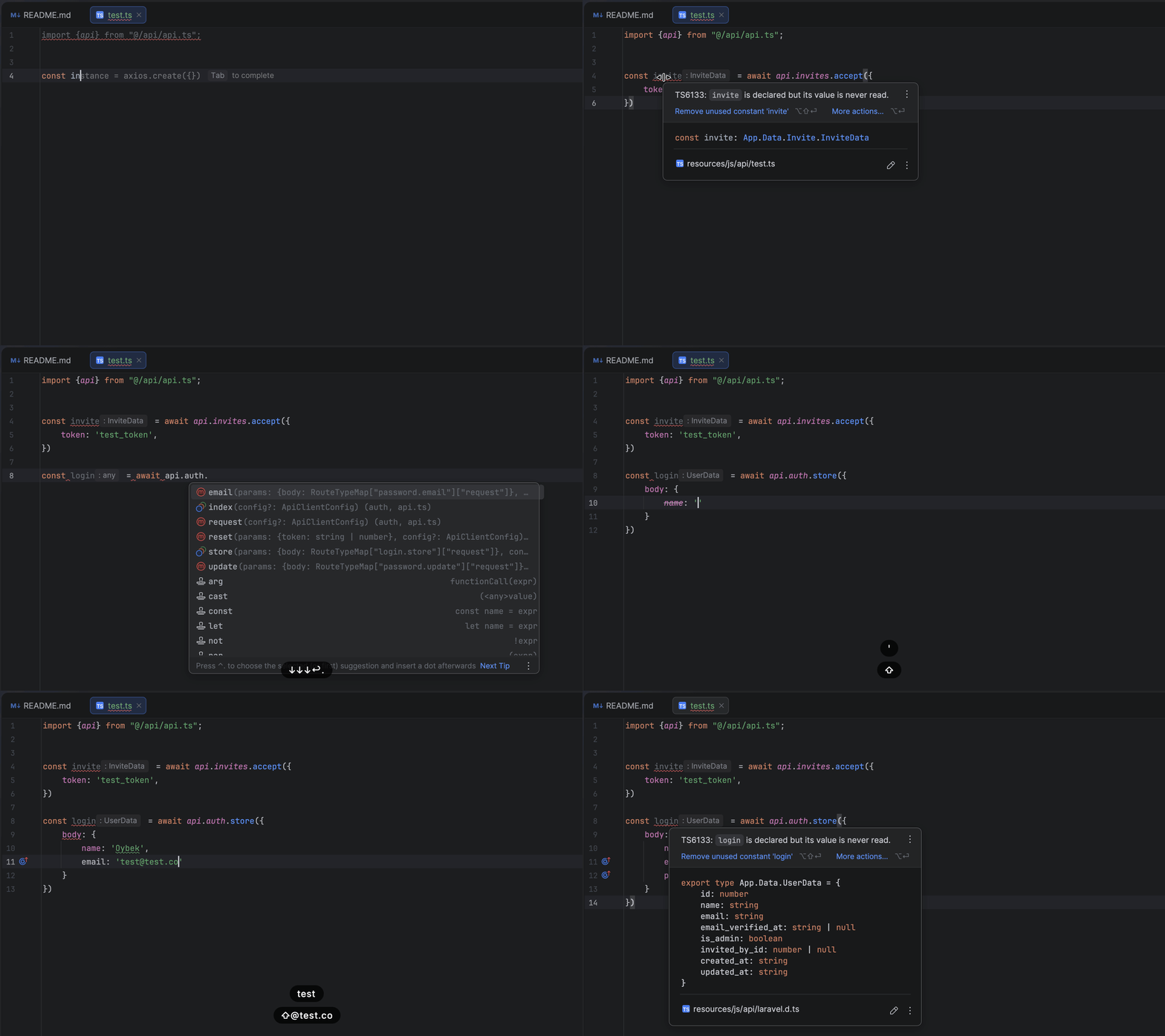
// Full autocomplete and type safety
const users = await api.users.index();
const user = await api.users.show({ user: 1 });
const newUser = await api.users.store({
    body: { name: 'John', email: 'john@example.com', password: 'secret' }
});
What This Is (and Isn't)
What it is: A Laravel-first generator that inspects your routes and produces a TypeScript client with fully typed inputs and outputs.
What it isn't: This is not a server-side implementation of the tRPC protocol. It doesn't require a Node.js tRPC router. It generates a typed HTTP client for your existing Laravel routes.
Runtime model: Generation happens at build time via php artisan trpc:generate. The output is a small TypeScript client that calls your HTTP endpoints — no runtime reflection on the PHP side.
Status
Beta (0.x). The public API and generated output structure may change between minor versions. For production use:
- Pin to exact versions in
composer.json - Review generated output diffs on upgrade
- Follow the CHANGELOG for breaking changes
Features
- Full Type Safety: Request bodies, responses, URL parameters, and query strings are all typed
- Zero Runtime Overhead: Types are generated at build time, no runtime reflection
- Framework Integrations: Built-in support for React Query and Inertia.js
- Grouped API Client: Object-based API (
api.users.show()) with full autocomplete - Postman Export: Generate Postman collections from your routes
Example Project
See it in action — a Laravel API with Inertia.js frontend, fully typed end-to-end:
🔗 github.com/oybek-daniyarov/empty-space
Table of Contents
- Example Project
- Requirements
- Installation
- Quick Start
- TypedRoute Attribute
- Generate & Use
- Generated Files
- Output Contract
- Configuration
- Middleware & Authentication
- Error Handling
- Type Helpers
- React Query Integration
- Inertia.js Integration
- API Client Configuration
- Command Options
- Customizing Stubs
- Known Limitations
- Troubleshooting
- Versioning
- Backstory
Requirements
- PHP 8.3+
- Laravel 11.x or 12.x
- spatie/laravel-data
- spatie/laravel-typescript-transformer
Installation
composer require spatie/laravel-data spatie/laravel-typescript-transformer
composer require oybek-daniyarov/laravel-trpc
Publish the config file:
php artisan vendor:publish --tag=trpc-config
Quick Start
1. Define Data Classes
use Spatie\LaravelData\Data;
use Spatie\TypeScriptTransformer\Attributes\TypeScript;

#[TypeScript]
class UserData extends Data
{
    public function __construct(
        public int $id,
        public string $name,
        public string $email,
    ) {}
}

#[TypeScript]
class CreateUserData extends Data
{
    public function __construct(
        public string $name,
        public string $email,
        public string $password,
    ) {}
}
2. Add TypedRoute Attribute to Controllers
use OybekDaniyarov\LaravelTrpc\Attributes\TypedRoute;

class UserController extends Controller
{
    #[TypedRoute(response: UserData::class, isPaginated: true)]
    public function index()
    {
        return UserData::collect(User::paginate());
    }

    #[TypedRoute(response: UserData::class)]
    public function show(User $user)
    {
        return UserData::from($user);
    }

    #[TypedRoute(request: CreateUserData::class, response: UserData::class)]
    public function store(CreateUserData $data)
    {
        return UserData::from(User::create($data->toArray()));
    }

    #[TypedRoute(request: UpdateUserData::class, response: UserData::class)]
    public function update(User $user, UpdateUserData $data)
    {
        $user->update($data->toArray());
        return UserData::from($user);
    }

    #[TypedRoute]
    public function destroy(User $user)
    {
        $user->delete();
        return response()->noContent();
    }
}
TypedRoute Attribute
The #[TypedRoute] attribute explicitly declares request and response types for your API endpoints. When applied, it takes priority over static analysis for type detection.
Parameters
| Parameter | Type | Description |
|---|---|---|
request |
class-string|null |
Request body Data class (for POST/PUT/PATCH) |
query |
class-string|null |
Query parameters Data class (for GET requests) |
response |
class-string|null |
Response Data class |
errorResponse |
class-string|null |
Error response Data class (defaults to ValidationError) |
isCollection |
bool |
Response is an array of items (Array<T>) |
isPaginated |
bool |
Response is paginated (PaginatedResponse<T>) |
Examples
Basic response type:
#[TypedRoute(response: UserData::class)]
public function show(User $user)
{
    return UserData::from($user);
}
Request and response types:
#[TypedRoute(request: CreateUserData::class, response: UserData::class)]
public function store(CreateUserData $data)
{
    return UserData::from(User::create($data->toArray()));
}
Query parameters (for GET with filters/search):
#[TypedRoute(query: UserFilterData::class, response: UserData::class, isPaginated: true)]
public function index(UserFilterData $filters)
{
    return UserData::collect(
        User::filter($filters)->paginate()
    );
}
Paginated response:
#[TypedRoute(response: UserData::class, isPaginated: true)]
public function index()
{
    return UserData::collect(User::paginate());
}
// TypeScript: PaginatedResponse<UserData>
Collection response (non-paginated array):
#[TypedRoute(response: UserData::class, isCollection: true)]
public function all()
{
    return UserData::collect(User::all());
}
// TypeScript: Array<UserData>
No response body (204 No Content):
#[TypedRoute]
public function destroy(User $user)
{
    $user->delete();
    return response()->noContent();
}
// TypeScript: void
Custom error response:
#[TypedRoute(
    request: CreateUserData::class,
    response: UserData::class,
    errorResponse: CreateUserErrorData::class
)]
public function store(CreateUserData $data)
{
    // ...
}
Query vs Request
- Use
requestfor body data (POST, PUT, PATCH requests) - Use
queryfor URL query parameters (GET requests with filters, search, pagination)
// GET /api/users?status=active&sort=name
#[TypedRoute(query: UserFilterData::class, response: UserData::class, isPaginated: true)]
public function index(UserFilterData $filters) { }

// POST /api/users (body: { name: "John", email: "john@example.com" })
#[TypedRoute(request: CreateUserData::class, response: UserData::class)]
public function store(CreateUserData $data) { }
Generate & Use
Generate TypeScript Client
php artisan trpc:generate
4. Use in TypeScript
import { api } from '@/lib/api';

// Full autocomplete and type safety
const users = await api.users.index();
const user = await api.users.show({ user: 1 });
const newUser = await api.users.store({
    body: { name: 'John', email: 'john@example.com', password: 'secret' }
});
await api.users.update({ user: 1, body: { name: 'Jane' } });
await api.users.destroy({ user: 1 });
Generated Files
The generator produces a tree-shakeable folder structure:
resources/js/api/
├── core/                 # Core infrastructure
│   ├── types.ts          # HttpMethod, ApiError, PaginatedResponse, ValidationError
│   ├── fetch.ts          # Low-level fetch wrapper with full type safety
│   ├── helpers.ts        # Type helpers (RequestOf, ResponseOf, ParamsOf, QueryOf)
│   └── index.ts          # Core barrel exports
├── {group}/              # Per-resource folders (users/, posts/, etc.)
│   ├── routes.ts         # Group-specific route definitions
│   ├── api.ts            # createUsersApi() factory
│   ├── queries.ts        # createUsersQueries() factory (optional)
│   ├── mutations.ts      # createUsersMutations() factory (optional)
│   └── index.ts          # Group barrel exports
├── routes.ts             # Aggregated route definitions
├── api.ts                # createApi() factory combining all groups
├── queries.ts            # createQueries() factory (optional)
├── mutations.ts          # createMutations() factory (optional)
├── url-builder.ts        # Type-safe URL builder
├── client.ts             # Method-specific client (client.get(), etc.)
├── inertia.ts            # Inertia.js helpers (optional)
├── react-query.ts        # React Query utilities (optional)
├── index.ts              # Main barrel exports
└── README.md             # Generated documentation
Tree-Shaking
Import only what you need for optimal bundle size:
// Per-resource import (tree-shakeable) - only imports users code
import { createUsersApi } from '@/api/users';

// Or combined API - imports all resources
import { createApi } from '@/api';
Output Contract
The generator produces a stable folder structure:
resources/js/api/
├── core/             # Core infrastructure (always generated)
│   ├── types.ts      # ApiError, PaginatedResponse, ValidationError
│   ├── fetch.ts      # Low-level fetch wrapper
│   ├── helpers.ts    # Type helpers (RequestOf, ResponseOf, etc.)
│   └── index.ts      # Core exports
├── {group}/          # Per-resource folders (e.g., users/, posts/)
│   ├── routes.ts     # Route definitions for this group
│   ├── api.ts        # createUsersApi() factory
│   ├── queries.ts    # createUsersQueries() (if react-query enabled)
│   └── index.ts      # Group exports
├── routes.ts         # Aggregated routes from all groups
├── api.ts            # createApi() factory
├── queries.ts        # createQueries() factory (optional)
├── url-builder.ts    # Type-safe URL builder
├── client.ts         # Method-specific client
├── inertia.ts        # Inertia.js helpers (optional)
├── react-query.ts    # React Query utilities (optional)
├── index.ts          # Barrel exports
└── README.md         # Generated documentation
Naming Conventions
- Route names map directly to TypeScript keys:
users.index→api.users.index() - Groups are derived from the first segment of the route name
- Parameters use Laravel's route parameter names:
{user}→{ user: number }
Configuration
// config/trpc.php
return [
    // Output directory for generated files
    'output_path' => resource_path('js/api'),

    // API route prefix filter
    'api_prefix' => 'api',

    // Route collection mode: 'api', 'web', 'all', 'named', 'attributed'
    'route_mode' => 'api',

    // Exclude patterns
    'exclude_patterns' => [
        'debugbar.*',
        'horizon.*',
        'telescope.*',
    ],

    // Output files to generate
    'outputs' => [
        'routes' => true,
        'types' => true,
        'helpers' => true,
        'url-builder' => true,
        'fetch' => true,
        'client' => true,
        'index' => true,
        'readme' => true,
        'grouped-api' => true,
        'inertia' => true,
        'react-query' => false,
        'queries' => false,
        'mutations' => false,
    ],
];
Configuration Reference
| Option | Type | Default | Description |
|---|---|---|---|
output_path |
string | resource_path('js/api') |
Directory for generated TypeScript files |
api_prefix |
string | 'api' |
API route prefix for filtering |
version |
string | 'v1' |
API version identifier |
route_mode |
string | 'api' |
Route collection mode (see below) |
include_patterns |
array | [] |
Route patterns to include |
exclude_patterns |
array | [...] |
Route patterns to exclude |
exclude_methods |
array | ['options', 'head'] |
HTTP methods to skip |
preset |
string|null | null |
Framework preset: 'inertia', 'api', 'spa' |
outputs |
array | [...] |
Files to generate |
auto_typescript_transform |
bool | true |
Auto-run typescript:transform |
laravel_types_path |
string|null | null |
Path to laravel.d.ts |
Route Modes
| Mode | Description |
|---|---|
'api' |
Only routes starting with api_prefix (default) |
'web' |
Only routes NOT starting with api_prefix |
'all' |
All routes (use with include/exclude patterns) |
'named' |
Only routes with names |
'attributed' |
Only routes with #[TypedRoute] attribute |
Presets
Use presets to quickly enable common output configurations:
// config/trpc.php
return [
    'preset' => 'spa', // 'inertia', 'api', or 'spa'
];
| Preset | Enables | Use Case |
|---|---|---|
'inertia' |
Core files + Inertia helpers | Laravel + Inertia.js apps |
'api' |
Core files + React Query + Mutations | API-first / SPA with React Query |
'spa' |
Core files + Inertia + React Query + Mutations | Full-featured SPA |
null |
Custom (configure outputs manually) |
Fine-grained control |
Presets override the outputs array. To customize individual outputs, set preset to null and configure outputs directly.
Postman Configuration
'postman' => [
    'output_path' => storage_path('app/postman'),
    'collection_name' => env('APP_NAME', 'API').' Collection',
    'base_url' => '{{base_url}}',
    'auth_type' => 'bearer', // 'bearer', 'apikey', or null
    'default_headers' => [],
],
Middleware Configuration
Control how middleware appears in the generated TypeScript output:
'middleware' => [
    // Exclude middleware from generated output (supports wildcards)
    'exclude' => [
        'Stancl\Tenancy\*',
        'App\Http\Middleware\TrustProxies',
    ],

    // Transform FQCNs to short class names (default: true)
    'short_names' => true,
],
Before (with short_names: false and no exclusions):
middleware: ['api', 'Stancl\\Tenancy\\Middleware\\InitializeTenancyByDomain', 'auth:sanctum'] as const,
After (with short_names: true and Tenancy excluded):
middleware: ['api', 'auth:sanctum'] as const,
| Middleware Input | Short Name Output |
|---|---|
Stancl\Tenancy\Middleware\InitializeTenancyByDomain |
InitializeTenancyByDomain |
App\Http\Middleware\RateLimiter:api |
RateLimiter:api |
auth:sanctum |
auth:sanctum (unchanged) |
web |
web (unchanged) |
Middleware & Authentication
The generated routes include middleware information, allowing you to build auth-aware UIs.
Generated Route Data
Each route includes middleware and authentication info:
// In routes.ts
export const routes = {
    'users.index': {
        path: 'api/users',
        method: 'get',
        params: [],
        middleware: ['auth:sanctum', 'verified'] as const,
        authenticated: true,
    },
    'auth.login': {
        path: 'api/auth/login',
        method: 'post',
        params: [],
        middleware: [] as const,
        authenticated: false,
    },
} as const;
Type Helpers for Auth Routes
Filter routes by authentication requirement:
import type { AuthenticatedRoutes, PublicRoutes } from '@/api';

// Only routes that require authentication
type ProtectedRoutes = AuthenticatedRoutes;
// 'users.index' | 'users.store' | 'users.update' | ...

// Only routes that don't require authentication
type OpenRoutes = PublicRoutes;
// 'auth.login' | 'auth.register' | ...
Checking Auth Before API Calls
import { routes, type RouteName } from '@/api';

function isAuthRequired(name: RouteName): boolean {
    return routes[name].authenticated;
}

// Use in components
function ApiButton({ route, children }: { route: RouteName; children: React.ReactNode }) {
    const { isAuthenticated } = useAuth();

    if (routes[route].authenticated && !isAuthenticated) {
        return <LoginPrompt />;
    }

    return <button onClick={() => callApi(route)}>{children}</button>;
}
Accessing Middleware Array
import { routes } from '@/api';

// Get middleware for a route
const middleware = routes['users.index'].middleware;
// ['auth:sanctum', 'verified']

// Check for specific middleware
const requiresVerification = middleware.includes('verified');
Error Handling
Built-in Error Types
The generated types.ts includes standard Laravel error types:
// Base API error (thrown by fetch wrapper)
interface ApiError {
    readonly message: string;
    readonly status: number;        // HTTP status code
    readonly statusText?: string;   // HTTP status text
    readonly errors?: Record<string, string[]>;  // Validation errors
}

// Specific error types
interface ValidationError { message: string; errors: Record<string, string[]>; }
interface NotFoundError { message: string; }
interface UnauthorizedError { message: string; }
interface ForbiddenError { message: string; }
interface ServerError { message: string; exception?: string; trace?: [...]; }
Custom Error Types with errorResponse
Define custom error Data classes for specific routes:
// Define a custom error type
#[TypeScript]
class CreateUserErrorData extends Data
{
    public function __construct(
        public string $message,
        public ?string $email_suggestion,  // Custom field
        public ?array $password_requirements,
    ) {}
}

// Use in controller
#[TypedRoute(
    request: CreateUserData::class,
    response: UserData::class,
    errorResponse: CreateUserErrorData::class  // Custom error type
)]
public function store(CreateUserData $data)
{
    // If validation fails, return custom error structure
    if (User::where('email', $data->email)->exists()) {
        return response()->json([
            'message' => 'Email already taken',
            'email_suggestion' => $data->email . '.new',
        ], 422);
    }

    return UserData::from(User::create($data->toArray()));
}
Using Error Types in TypeScript
import type { ErrorOf, ApiError } from '@/api';
import { api } from '@/lib/api';

// Get the error type for a specific route
type CreateUserError = ErrorOf<'users.store'>;
// CreateUserErrorData (custom) or ValidationError (default)

// Handle errors with proper typing
async function createUser(data: CreateUserData) {
    try {
        return await api.users.store({ body: data });
    } catch (e) {
        const error = e as ApiError;

        console.log(error.status);     // 422
        console.log(error.message);    // "Email already taken"
        console.log(error.errors);     // { email: ["Email already taken"] }

        // For custom error fields, cast to specific type
        if (error.status === 422) {
            const customError = error as unknown as CreateUserError;
            console.log(customError.email_suggestion);
        }
    }
}
Error Handling with React Query
import { useMutation } from '@tanstack/react-query';
import type { ErrorOf, ApiError } from '@/api';

function CreateUserForm() {
    const mutation = useMutation({
        mutationFn: (data: CreateUserData) => api.users.store({ body: data }),
        onError: (error: ApiError) => {
            if (error.status === 422 && error.errors) {
                // Show field-specific errors
                Object.entries(error.errors).forEach(([field, messages]) => {
                    setFieldError(field, messages[0]);
                });
            } else if (error.status === 401) {
                redirectToLogin();
            }
        },
    });

    // ...
}
Type Helpers
Extract types from route names for use in your components:
import type { RequestOf, ResponseOf, ParamsOf, QueryOf, ErrorOf } from '@/api';

// Request body type
type CreateUserPayload = RequestOf<'users.store'>;

// Response type
type UserResponse = ResponseOf<'users.show'>;

// URL parameters type
type UserParams = ParamsOf<'users.show'>; // { user: number }

// Query parameters type
type UserQuery = QueryOf<'users.index'>; // { page?: number, per_page?: number }

// Error type (custom or ValidationError)
type StoreUserError = ErrorOf<'users.store'>;
React Query Integration
Enable in config:
'outputs' => [
    'react-query' => true,  // Core utilities (queryKey, createQueryOptions)
    'queries' => true,      // Resource-based query hooks (usersQueries, etc.)
    'mutations' => true,    // Resource-based mutation hooks (usersMutations, etc.)
],
Generated Files
| File | Description |
|---|---|
react-query.ts |
Low-level utilities: queryKey, createQueryOptions, createInfiniteQueryOptions |
queries.ts |
Resource-based query factories organized by API resource (e.g., usersQueries, postsQueries) |
mutations.ts |
Resource-based mutation factories organized by API resource (e.g., usersMutations, postsMutations) |
Setup
Before using queries and mutations, create configured instances in a setup file:
// lib/api.ts
import { createApi, createQueries, createMutations } from '@/api';

const api = createApi({
    baseUrl: process.env.NEXT_PUBLIC_API_URL ?? '',
    headers: { 'X-App-Version': '1.0.0' },
});

export const queries = createQueries(api);
export const mutations = createMutations(api);
export { api };
Then import from your setup file in components:
import { api, queries, mutations } from '@/lib/api';
Resource-Based Queries (queries.ts)
The queries.ts file generates query factories for each API resource, providing:
- Pre-configured
queryOptions()andinfiniteQueryOptions()for each GET endpoint - Type-safe query keys with
keysobject for cache management - Automatic infinite query support for paginated endpoints
import { useQuery, useInfiniteQuery, useQueryClient } from '@tanstack/react-query';
import { queries } from '@/lib/api';

// Simple query
const { data: user } = useQuery(queries.users.show({ user: 1 }));

// Paginated endpoints automatically use infinite queries
const { data, fetchNextPage, hasNextPage } = useInfiniteQuery(
    queries.users.index({ query: { per_page: 20 } })
);

// Query keys for cache invalidation
const queryClient = useQueryClient();
queryClient.invalidateQueries({ queryKey: queries.users.keys.all });        // ['users']
queryClient.invalidateQueries({ queryKey: queries.users.keys.show({ user: 1 }) }); // ['users', 'show', { user: 1 }]
Low-Level Utilities (react-query.ts)
For more control, use the low-level utilities:
import { useQuery } from '@tanstack/react-query';
import { queryKey, createQueryOptions } from '@/api';

// Create query options manually
const { data } = useQuery(
    createQueryOptions('users.show', {
        path: { user: 1 },
        staleTime: 5000,
    })
);

// Query keys for cache management
const key = queryKey('users.show', { path: { user: 1 } });
// ['users.show', { user: 1 }]
Full Example
import { useQuery, useMutation, useQueryClient } from '@tanstack/react-query';
import { queries, api } from '@/lib/api';

function UserProfile({ userId }: { userId: number }) {
    const { data, isLoading } = useQuery(queries.users.show({ user: userId }));
    const queryClient = useQueryClient();

    const updateUser = useMutation({
        mutationFn: (data: { name: string }) =>
            api.users.update({ user: userId, body: data }),
        onSuccess: () => {
            queryClient.invalidateQueries({
                queryKey: queries.users.keys.show({ user: userId })
            });
        },
    });

    if (isLoading) return <div>Loading...</div>;

    return (
        <div>
            <h1>{data?.name}</h1>
            <button onClick={() => updateUser.mutate({ name: 'New Name' })}>
                Update
            </button>
        </div>
    );
}
Infinite Queries for Pagination
Paginated endpoints automatically generate infiniteQueryOptions:
import { useInfiniteQuery } from '@tanstack/react-query';
import { queries } from '@/lib/api';

function UserList() {
    const { data, fetchNextPage, hasNextPage, isFetchingNextPage } = useInfiniteQuery(
        queries.users.index({ query: { per_page: 20 } })
    );

    return (
        <div>
            {data?.pages.flatMap(page => page.data).map(user => (
                <div key={user.id}>{user.name}</div>
            ))}
            {hasNextPage && (
                <button
                    onClick={() => fetchNextPage()}
                    disabled={isFetchingNextPage}
                >
                    {isFetchingNextPage ? 'Loading...' : 'Load More'}
                </button>
            )}
        </div>
    );
}
Resource-Based Mutations (mutations.ts)
The mutations.ts file generates type-safe mutation factories for POST, PUT, PATCH, and DELETE endpoints:
import { useMutation, useQueryClient } from '@tanstack/react-query';
import { createApi, createMutations, createQueries } from '@/api';

const api = createApi({ baseUrl: process.env.NEXT_PUBLIC_API_URL ?? '' });
const mutations = createMutations(api);
const queries = createQueries(api);

function CreateUserButton() {
    const queryClient = useQueryClient();

    const createUser = useMutation({
        ...mutations.users.store(),
        onSuccess: () => {
            queryClient.invalidateQueries({ queryKey: queries.users.keys.all });
        },
    });

    // TypeScript enforces body is REQUIRED for store route
    return (
        <button
            onClick={() => createUser.mutate({
                body: { name: 'John', email: 'john@example.com' }
            })}
            disabled={createUser.isPending}
        >
            Create User
        </button>
    );
}

function DeleteUserButton({ userId }: { userId: number }) {
    const queryClient = useQueryClient();

    const deleteUser = useMutation({
        ...mutations.users.destroy(),
        onSuccess: () => {
            queryClient.invalidateQueries({ queryKey: queries.users.keys.all });
        },
    });

    // TypeScript allows NO body for destroy route (only path params)
    return (
        <button onClick={() => deleteUser.mutate({ user: userId })}>
            Delete
        </button>
    );
}
Mutation keys for cache management:
mutations.users.keys.all      // ['users', 'mutation']
mutations.users.keys.store()  // ['users.store']
mutations.users.keys.update() // ['users.update']
mutations.users.keys.destroy() // ['users.destroy']
Inertia.js Integration
import { router } from '@inertiajs/react';
import { route, visit, formAction } from '@/api/inertia';

// Generate type-safe URLs
const url = route('users.show', { user: 123 });

// Navigate with type safety
visit('users.show', { user: 123 });
visit('users.index', null, { query: { page: 2 } });

// Form actions
function CreateUserForm() {
    return (
        <form {...formAction('users.store')}>
            <input name="name" />
            <input name="email" type="email" />
            <button type="submit">Create</button>
        </form>
    );
}
API Client Configuration
Basic Setup
Create a configured API instance and export it for use throughout your app:
// lib/api.ts
import { createApi } from '@/api';

export const api = createApi({
    baseUrl: process.env.NEXT_PUBLIC_API_URL ?? '',
    headers: { 'X-App-Version': '1.0.0' },
});
Usage
import { api } from '@/lib/api';

// Simple usage
const users = await api.users.index();

// With custom headers (per-request)
const users = await api.users.index({
    headers: { 'X-Custom': 'value' },
});

// With path params
const user = await api.users.show({ user: 1 });

// With path params and per-request options
const user = await api.users.show({ user: 1 }, {
    headers: { 'X-Request-Id': 'abc123' },
});

// With body (POST/PUT/PATCH)
const newUser = await api.users.store({ body: { name: 'John', email: 'john@example.com' } });
Per-Request Options
All API methods accept an optional RequestOptions object as the last parameter:
interface RequestOptions {
    headers?: Record<string, string>;  // Custom headers for this request
    next?: NextCacheOptions;           // Next.js cache configuration
    mobile?: MobileOptions;            // Mobile/React Native options
    signal?: AbortSignal;              // Abort signal
}
Next.js App Router
Server Components
// lib/api.server.ts
import { createApi } from '@/api';
import { cookies } from 'next/headers';
import { cache } from 'react';

// Cache per request (React cache for deduplication)
export const getServerApi = cache(async () => {
    const cookieStore = await cookies();
    const token = cookieStore.get('token')?.value;

    return createApi({
        baseUrl: process.env.API_URL!,
        headers: token ? { Authorization: `Bearer ${token}` } : {},
    });
});
// app/users/page.tsx
import { getServerApi } from '@/lib/api.server';

export default async function UsersPage() {
    const api = await getServerApi();

    // With Next.js cache tags for revalidation
    const users = await api.users.index({
        next: { tags: ['users'], revalidate: 60 }
    });

    return <UserList users={users.data} />;
}
Server Actions
// app/actions/users.ts
'use server';

import { getServerApi } from '@/lib/api.server';
import { revalidateTag } from 'next/cache';

export async function createUser(data: CreateUserData) {
    const api = await getServerApi();
    const user = await api.users.store({ body: data });

    revalidateTag('users');
    return user;
}

export async function deleteUser(userId: number) {
    const api = await getServerApi();
    await api.users.destroy({ user: userId });

    revalidateTag('users');
    revalidateTag(`user-${userId}`);
}
Route Handlers
// app/api/users/route.ts
import { createApi } from '@/api';
import { NextRequest, NextResponse } from 'next/server';

export async function GET(request: NextRequest) {
    const api = createApi({
        baseUrl: process.env.API_URL!,
        headers: {
            Authorization: request.headers.get('Authorization') ?? '',
        },
    });

    const users = await api.users.index();
    return NextResponse.json(users);
}
React Query Integration
With Configured API (Recommended)
Use createQueries to bind queries to a configured API instance:
// lib/api.ts
import { createApi, createQueries, createMutations } from '@/api';

const api = createApi({
    baseUrl: process.env.NEXT_PUBLIC_API_URL ?? '',
    headers: { 'X-App-Version': '1.0.0' },
});

export const queries = createQueries(api);
export const mutations = createMutations(api);
export { api };
// components/UserProfile.tsx
'use client';

import { useQuery, useMutation, useQueryClient } from '@tanstack/react-query';
import { queries, api } from '@/lib/api';

export function UserProfile({ userId }: { userId: number }) {
    const queryClient = useQueryClient();

    const { data: user, isLoading } = useQuery(
        queries.users.show({ user: userId })
    );

    const updateMutation = useMutation({
        mutationFn: (data: UpdateUserData) =>
            api.users.update({ user: userId, body: data }),
        onSuccess: () => {
            queryClient.invalidateQueries({
                queryKey: queries.users.keys.show({ user: userId })
            });
        },
    });

    if (isLoading) return <div>Loading...</div>;

    return (
        <div>
            <h1>{user?.name}</h1>
            <button onClick={() => updateMutation.mutate({ name: 'New Name' })}>
                Update
            </button>
        </div>
    );
}
Command Options
# Generate TypeScript definitions (default)
php artisan trpc:generate

# Generate Postman collection only
php artisan trpc:generate --postman

# Generate both TypeScript and Postman collection
php artisan trpc:generate --format=all

# Custom output directory (overrides config)
php artisan trpc:generate --output=resources/js/generated

# Override API prefix for route filtering
php artisan trpc:generate --api-prefix=api/v2

# Skip running typescript:transform automatically
php artisan trpc:generate --skip-typescript-transform

# Generate Postman collection with environment file
php artisan trpc:generate --postman --postman-env

# Overwrite files without confirmation
php artisan trpc:generate --force

# Custom base URL for generated client
php artisan trpc:generate --base-url=https://api.example.com
Command Options Reference
| Option | Description |
|---|---|
--output=PATH |
Override the output directory from config |
--api-prefix=PREFIX |
Override the API route prefix filter |
--skip-typescript-transform |
Skip auto-running typescript:transform |
--postman |
Generate Postman collection only (shorthand for --format=postman) |
--postman-env |
Also generate Postman environment file |
--format=FORMAT |
Output format: typescript (default), postman, or all |
--force |
Overwrite existing files without confirmation |
--base-url=URL |
Set default base URL for the generated TypeScript client |
Customizing Stubs
Publish the stub templates:
php artisan vendor:publish --tag=trpc-stubs
Templates will be copied to resources/views/vendor/trpc/.
Known Limitations
- Route model binding: Parameters are typed as
number | stringby default. Custom types require explicit#[TypedRoute]configuration. - Union/polymorphic responses: Not automatically detected. Use a single response Data class or document via
#[TypedRoute(response: ...)]. - Middleware inference: Auth detection relies on common middleware names (
auth,auth:*). Custom auth middleware may not be detected. - Closure routes: Routes without controller methods cannot have types extracted automatically.
Troubleshooting
"No API routes found"
- Ensure your routes use the configured
api_prefix(default:api) - Check that routes are registered before running the command
- Try
php artisan route:listto verify routes exist
Generated types are unknown
- Add
#[TypeScript]attribute to your Data classes - Run
php artisan typescript:transformfirst - Check that
laravel.d.tsexists in your output directory
TypeScript errors after regeneration
- Clear your TypeScript cache:
rm -rf node_modules/.cache - Ensure your
tsconfig.jsonincludes the output directory - Check for circular dependencies in your Data classes
Route names are duplicated
- The generator appends
_1,_2suffixes for duplicate names - Use unique route names or configure
route_name_mappingsin config
Versioning
This package follows Semantic Versioning:
- Patch (0.1.x): Bug fixes, no changes to generated output shape
- Minor (0.x.0): New features, may add fields to generated output
- Major (x.0.0): Breaking changes to generated output structure or API
During the 0.x beta period, minor versions may include breaking changes. These will be clearly documented in the CHANGELOG.
Backstory
I built this to solve a real problem: getting a strongly typed TypeScript client from Laravel routes without manual type duplication.
I used AI tooling (Claude Code) to accelerate development — it helped with boilerplate, iteration, and exploration. The architecture and direction were mine; the implementation was collaborative.
The package has 250+ passing tests, PHPStan level 8 analysis, and is used in production projects. I'm sharing it because it works and saves time.
Found a bug? Open an issue. I'll fix it.
License
MIT License. See LICENSE for details.
Credits
- Oybek Daniyarov
- Claude by Anthropic — the AI that wrote the code
- Spatie for laravel-data and typescript-transformer
- Laravel team for Wayfinder, which inspired some of the thinking here
Related Packages
Laravel named routes for SPA frontends: per-tier lazy loading via an HTTP metada...
PHP package for Laravel to type Eloquent models, routes, Spatie Settings with au...
Automatically generate TypeScript types and validation schemas from Laravel Mode...
Version History
Pre-releases (12)
| Version | Released | PHP | Laravel | License |
|---|---|---|---|---|
| v0.2.0-beta | ^8.3 | ^11.0| | MIT | |
| v0.1.10-beta | ^8.3 | ^11.0| | MIT | |
| v0.1.9-beta | ^8.3 | ^11.0| | MIT | |
| v0.1.8-beta | ^8.3 | ^11.0| | MIT | |
| v0.1.7-beta | ^8.3 | ^11.0| | MIT | |
| v0.1.6-beta | ^8.3 | ^11.0| | MIT | |
| v0.1.5-beta | ^8.3 | ^11.0| | MIT | |
| v0.1.4-beta | ^8.3 | ^11.0| | MIT | |
| v0.1.3-beta | ^8.2 | ^11.0| | MIT | |
| v0.1.2-beta | ^8.2 | ^11.0| | MIT | |
| v0.1.1-beta | ^8.2 | ^11.0| | MIT | |
| v0.1.0-beta | ^8.2 | ^11.0| | MIT |