sanchescom/laravel-rest
| Install | |
|---|---|
composer require sanchescom/laravel-rest |
|
| Latest Version: | 1.6.1 |
| PHP: | ^8.2 |
| License: | MIT |
| Last Updated: | Sep 17, 2026 |
| Links: | GitHub · Packagist |
Laravel Rest
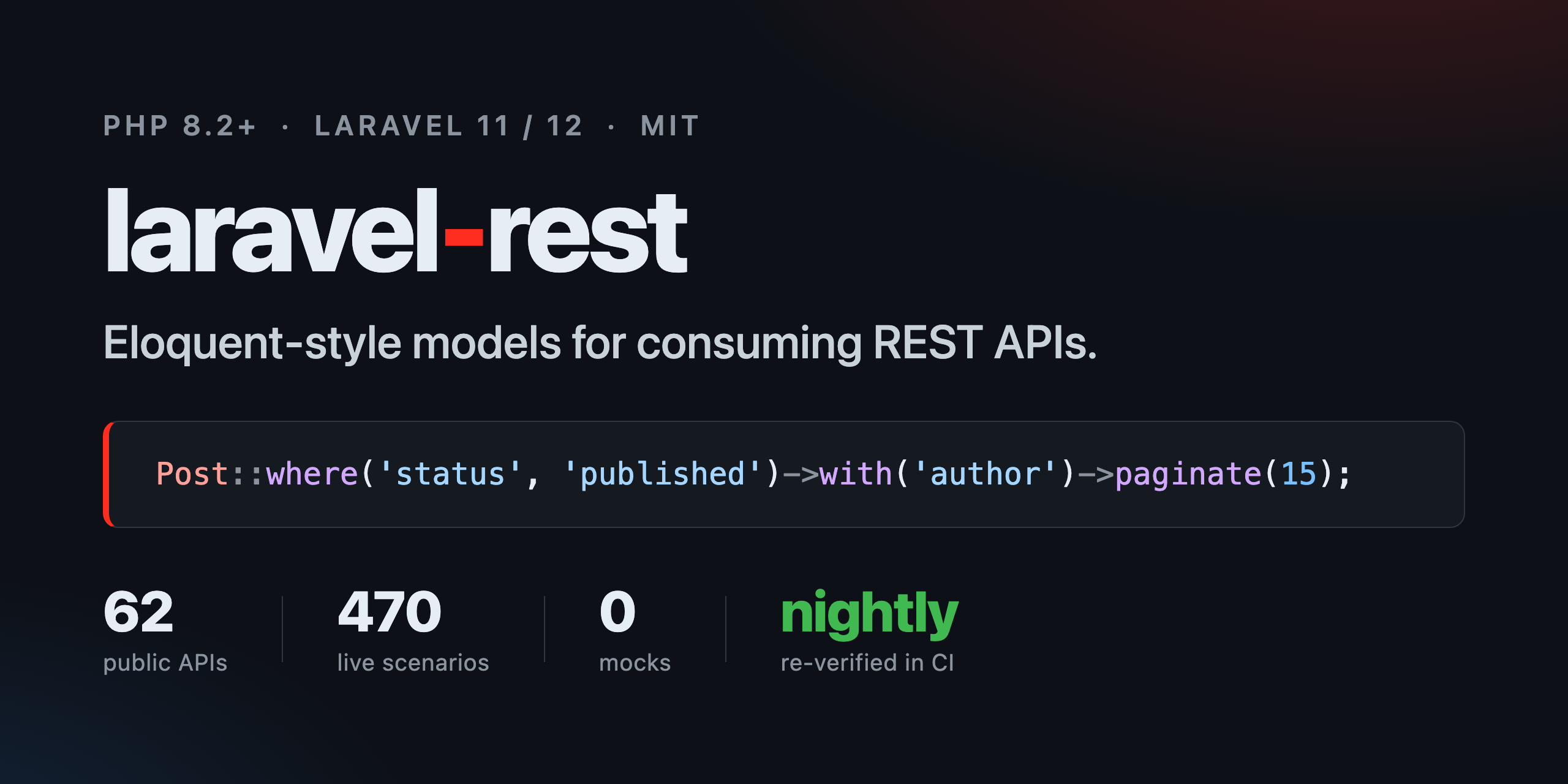





Eloquent-like models and collections for consuming REST APIs.
Define a model, point it at an endpoint, and work with remote resources the way
you work with Eloquent: User::get(), User::get($id), User::post([...]),
$user->put(), User::delete($id).
class Post extends Model
{
    protected ?string $endpoint = 'posts';

    public function author(): BelongsTo
    {
        return $this->belongsTo(User::class, 'user_id');
    }
}

Post::where('status', 'published')->orderBy('created_at')->with('author')->paginate(15);
No request class per endpoint, no DTO per response — one model per resource, and the query builder writes the URLs. Every feature is verified against 62 real public APIs with 470 scenarios, so the awkward shapes (totals in headers, cursor pagination, errors inside HTTP 200) are documented rather than discovered in production — see Live Verification.
Table of Contents
- Requirements · Installation · Quick Start
- Configuration · Defining Models
- Error Handling · Pagination
- Query Builder
- Adapting to API Conventions — parameter names, sort styles, filter styles, presets, casing, headers, error keys, PATCH, envelopes, standalone, all together
- Caching · Relations
- Authentication · Retry · Model Events
- Testing Your Application · Usage Outside Laravel
- Capability Matrix · Upgrading · Contributing
Requirements
- PHP 8.2+
- Laravel 11 or 12
[!NOTE] Laravel 11 reached end of life in 2026 (no more security fixes). The package still supports and tests it, but new projects should target Laravel 12.
Installation
composer require sanchescom/laravel-rest
The service provider is registered automatically via package auto-discovery — no manual registration needed.
Quick Start
A model is a class pointed at an endpoint. Everything below runs for real against JSONPlaceholder:
<?php

use Sanchescom\Rest\Model;

class Post extends Model
{
    // endpoint is inferred from the class name: "posts"
    protected array $casts = ['id' => 'int', 'userId' => 'int'];
}
// config/rest.php
'clients' => [
    'placeholder' => [
        'provider' => 'guzzle',
        'base_uri' => 'https://jsonplaceholder.typicode.com/',
    ],
],
$post  = Post::get(1);                  // GET posts/1        -> Post
$posts = Post::get();                   // GET posts          -> Collection<Post>
$mine  = $posts->where('userId', 1);    // in-memory collection filter (server-side: see Query Builder)
$page  = $posts->paginate(10);          // LengthAwarePaginator

$some  = Post::getMany([3, 1, 2]);      // concurrent requests, results in [3, 1, 2] order

$new   = Post::post(['title' => 'Hi', 'userId' => 1]);   // POST posts
$upd   = Post::put(1, ['title' => 'Updated']);           // PUT posts/1
Post::delete(1);                                          // DELETE posts/1

// ...or update/delete through an instance using its own primary key:
$post = Post::get(2);
$post->title = 'Changed';
$post->put();                           // PUT posts/2
$post->delete();                        // DELETE posts/2

Post::get(987654);                      // 404 -> throws ModelNotFoundException
Configuration
Publish the config file:
php artisan vendor:publish --tag=rest-config
Configure one or more clients in config/rest.php:
<?php

return [
    'default' => env('REST_CLIENT', 'localhost'),

    'clients' => [
        'localhost' => [
            'provider' => 'guzzle',
            'base_uri' => 'https://localhost/',
            'options' => [
                'headers' => [
                    'Accept' => 'application/json',
                ],
            ],
        ],
        'billing' => [
            'provider' => 'guzzle',
            'base_uri' => 'https://billing.example.com/api/',
            'options' => [
                'headers' => [
                    'Authorization' => 'Bearer '.env('BILLING_TOKEN'),
                ],
            ],
        ],
    ],
];
[!NOTE]
base_urimust end with a trailing slash, and endpoints must not start with one — that is how Guzzle resolves relative URIs.
Defining Models
<?php

use Sanchescom\Rest\Model;

class User extends Model
{
    /** Client name from config/rest.php; null uses the default client. */
    protected ?string $client = null;

    /** Endpoint; defaults to the snake-cased plural of the class name ("users"). */
    protected ?string $endpoint = 'users';

    /** Key that wraps payloads in responses (e.g. {"data": ...}); null for bare payloads. */
    protected ?string $dataKey = 'data';

    /** Whitelist of fillable attributes; empty array allows everything. */
    protected array $fillable = ['id', 'first_name', 'last_name', 'email'];

    /** Attribute casts applied on read: int|float|bool|string. */
    protected array $casts = ['id' => 'int'];

    /** Per-model HTTP client options merged over the configured ones. */
    protected array $options = [];
}
Error Handling
Every 4xx/5xx response throws a typed exception; you never get a silent null:
| Status | Exception |
|---|---|
| 404 | Sanchescom\Rest\Exceptions\ModelNotFoundException |
| 422 | Sanchescom\Rest\Exceptions\ValidationException (->errors()) |
| 500+ | Sanchescom\Rest\Exceptions\ServerException |
| other 4xx | Sanchescom\Rest\Exceptions\RequestException |
All of them extend Sanchescom\Rest\Exceptions\RestException and expose the
request context: $e->uri, $e->status, $e->body.
use Sanchescom\Rest\Exceptions\ValidationException;

try {
    User::post(['email' => 'not-an-email']);
} catch (ValidationException $e) {
    $errors = $e->errors();
}
Pagination
Server-side
paginate() requests one page and builds a LengthAwarePaginator from the
response metadata; simplePaginate() returns a Paginator for APIs that do
not report a total.
$posts = Post::where('status', 'active')->paginate(15);        // page from ?page=
$posts = Post::orderBy('id')->simplePaginate(15, 'p', 3);      // explicit page name and page
Tell the client where the metadata lives — a preset or explicit dot paths:
'clients' => [
    'crm' => [
        'base_uri'   => 'https://crm.example.com/api/',
        'pagination' => 'laravel',   // total: meta.total, next: links.next
        // 'pagination' => 'django',  // total: count,      next: next
        // 'pagination' => 'jsonapi', //                    next: links.next
        // 'pagination' => [
        //     'style'    => 'offset',          // 'page' (default) or 'offset'
        //     'total'    => 'meta.count',
        //     'has_more' => 'meta.has_more',   // alternative to 'next'
        // ],
    ],
],
A model can override the client with protected array|string|null $pagination.
Items are read through $dataKey as usual, and page parameter names follow the
client's query conventions (e.g. page[number], page_size).
paginate()requires atotalpath and throwsRestExceptionwhen it is not configured or missing from the response.simplePaginate()usesnext, thenhas_more(stricttrue);nexttakes precedence when both are configured, and an explicit'next' => nullclears a preset'snextpath sohas_moreapplies. With neither configured it assumes more pages when a full page came back — an exactly-full last page then shows one extra empty page, and a server that caps the page size belowperPagestops reporting more pages after page one.- Both replace any earlier
page()/limit()/offset()on the query. - Enveloped responses (the
laravelanddjangopresets) need the model's$dataKey(e.g.'data','results') to find the items; without it the whole response body is hydrated as items. - Under
Rest::fake()the pagination config is kept, but query conventions are not, so faked requests send plainpage/limit/offsetnames — writeassertSentexpectations accordingly.
Iterating all pages
lazy() returns a LazyCollection that requests one page at a time (100
models per request by default) and stops on an empty page or when the
pagination metadata reports no more pages — the same rules as
simplePaginate(). Nothing is requested until you iterate, and iterating
again repeats the requests.
foreach (Post::where('status', 'active')->lazy() as $post) {
    // ...
}

// Mirror an API resource into a local table
Post::lazy(50)->chunk(500)->each(
    fn ($posts) => DbPost::upsert($posts->map->toArray()->values()->all(), ['id']),
);
Keep the chunk size at or below the API's maximum page size: without next
or has_more configured, a short page ends the iteration. If the API ignores
the page parameter and sends the same page again, lazy() throws a
RestException instead of looping forever.
In memory
$paginator = User::get()->paginate(15); // slices an already-fetched collection
Query Builder
Filter, sort, and paginate without writing query strings by hand.
[!IMPORTANT]
Post::where(...)->get()filters on the server — the conditions are compiled into the query string and the API returns only matching records.Post::get()->where(...)filters the already-loaded collection in memory — it fetches everything first. For anything beyond trivial datasets, prefer the builder form.
// Plain grammar (default) — ?status=active&sort=-created_at&limit=20
$posts = Post::where('status', 'active')
    ->orderBy('created_at', 'desc')
    ->limit(20)
    ->get();

// Pagination
Post::page(2)->limit(15)->get();   // ?page=2&limit=15
Post::offset(30)->limit(15)->get(); // ?offset=30&limit=15

// Extra / non-standard params
Post::withQuery(['include' => 'author'])->get();

// Membership filter — ?status=draft,review (rendered per grammar)
Post::whereIn('status', ['draft', 'review'])->get();
// whereIn('status', []) sends an empty filter (status=) — guard empty lists yourself

// Convenience
Post::where('status', 'draft')->first(); // first item of the collection
Post::where('userId', 1)->count();       // count of matching items
Other query conventions (JSON:API, Django, custom names) — the preferred way is a one-word preset or a small config array on the client; see Adapting to API Conventions:
'clients' => [
    'myapi' => [
        'provider' => 'guzzle',
        'base_uri' => 'https://api.example.com/',
        'query'    => 'jsonapi',   // filter[field]=..., page[size]=..., page[number]=...
    ],
],
For a truly custom query language, implement Sanchescom\Rest\Query\Grammar
yourself and register the class per client ('grammar' => MyGrammar::class)
or per model (protected ?string $grammar = MyGrammar::class). A grammar
class always takes precedence over the 'query' config.
Adapting to API Conventions
Every REST API names its parameters differently. Some call it page_size,
others call it page[size]. Some prefix descending sorts with -, others
append :desc. The 'query' key in any client config covers all of these
without touching the calling code. For truly exotic conventions, implement
Sanchescom\Rest\Query\Grammar (or AuthInterface / ClientInterface) — but
in the common case a config array is all you need.
1. Renaming Parameters
The names map translates the library's canonical parameter names (limit,
offset, page, sort) to whatever the API expects. Dot notation in the
value produces a nested array that Guzzle serialises as param[sub]:
// config/rest.php
'clients' => [
    'catalog' => [
        'provider' => 'guzzle',
        'base_uri'  => 'https://api.example.com/v2/',
        'query' => [
            'names' => [
                'limit'  => 'page.size',    // page[size]=...
                'page'   => 'page.number',  // page[number]=...
                'offset' => 'page.offset',  // page[offset]=...
            ],
        ],
    ],
],
Article::page(2)->limit(25)->get();
// GET articles?page[size]=25&page[number]=2
2. Sort Styles
Four styles are available. Pick the one that matches your API:
dash (default) — prefix descending fields with -, comma-separate:
'query' => ['sort' => 'dash'],
Product::orderBy('price', 'desc')->orderBy('name')->get();
// GET products?sort=-price,name
suffix — append a separator (default :) followed by the direction:
'query' => ['sort' => 'suffix'],              // uses ':' separator
'query' => ['sort' => 'suffix', 'sort_suffix' => '|'],  // custom separator
Product::orderBy('price', 'desc')->orderBy('name')->get();
// GET products?sort=price:desc,name:asc
// (or price|desc,name|asc with the custom separator)
separate — two distinct parameters for field and direction (only the
first orderBy is sent; additional calls are ignored). When sort_names is
omitted, defaults are: field param sort, direction param direction:
'query' => [
    'sort'       => 'separate',
    'sort_names' => ['field' => 'sort_by', 'direction' => 'sort_dir'],
],
Product::orderBy('price', 'desc')->get();
// GET products?sort_by=price&sort_dir=desc
array — an associative array keyed by field name:
'query' => ['sort' => 'array'],
Product::orderBy('price', 'desc')->orderBy('name')->get();
// GET products?sort[price]=desc&sort[name]=asc
3. Filter Styles
Three filter styles cover the most common conventions. The operator (third
argument of where()) is an arbitrary string passed through to the API —
use whatever vocabulary your API defines (gte, lte, like, in, …):
plain (default) — bare equality, operator in brackets for everything else:
'query' => ['filters' => 'plain'],
Order::where('status', 'shipped')->where('total', 'gte', 100)->get();
// GET orders?status=shipped&total[gte]=100
brackets — JSON:API-style filter[field]:
'query' => ['filters' => 'brackets'],
Order::where('status', 'shipped')->where('total', 'gte', 100)->get();
// GET orders?filter[status]=shipped&filter[total][gte]=100
django — Django REST Framework style with double-underscore lookups:
'query' => ['filters' => 'django'],
Order::where('status', 'shipped')->where('total', 'gte', 100)->get();
// GET orders?status=shipped&total__gte=100
4. Presets
Two presets are built in. Pass a string to activate one:
// JSON:API preset — brackets filters, dash sort, page[size]/page[number]/page[offset]
'query' => 'jsonapi',

// Django DRF preset — django filters, dash sort, ordering/page_size
'query' => 'django',
// Preset with overrides — start from jsonapi and change just the sort style
'query' => [
    'preset' => 'jsonapi',
    'sort'   => 'suffix',
],
// jsonapi preset in action
Article::where('published', true)->orderBy('created_at', 'desc')->page(2)->limit(15)->get();
// GET articles?filter[published]=true&sort=-created_at&page[size]=15&page[number]=2

// django preset in action
Article::where('published', true)->orderBy('created_at', 'desc')->limit(15)->get();
// GET articles?published=true&ordering=-created_at&page_size=15
5. Field Casing
The casing option normalises every field name that appears in where() and
orderBy() calls before it hits the wire. Useful when your PHP code uses
camelCase but the API expects snake_case:
'query' => ['casing' => 'snake'],   // camel → snake
'query' => ['casing' => 'camel'],   // snake → camel
// 'casing' => 'snake'
Report::where('reportDate', '2024-01-01')->orderBy('totalRevenue', 'desc')->get();
// GET reports?report_date=2024-01-01&sort=-total_revenue
6. Dynamic Headers
Model-level headers — always sent for every request from this model:
class Tenant extends Model
{
    protected ?string $client   = 'platform';
    protected ?string $endpoint = 'tenants';

    /** @var array<string, string> */
    protected array $headers = [
        'X-Tenant-ID' => 'acme',
    ];
}

// GET tenants   (headers: X-Tenant-ID: acme)
Tenant::get();
Per-chain withHeaders() — merges over the model-level headers; chain
value wins on key conflicts:
Tenant::withHeaders([
    'X-Tenant-ID'      => 'betacorp',   // overrides the model default
    'Accept-Language'  => 'fr-FR',
])->where('active', true)->get();
// GET tenants?active=true   (headers: X-Tenant-ID: betacorp, Accept-Language: fr-FR)
[!NOTE] Under
Rest::fake()the inline resolver ignores theoptionsargument passed toclient(), so headers are not forwarded to the fake. The fake sees bare requests with no custom headers. Similarly, the standaloneClientResolverignores theoptionsargument — wire headers directly into theClientInterfaceinstance you register instead.
7. Configuring the Errors Key
By default, ValidationException::errors() looks for the 'errors' key in
the response body. Set errors_key (dot notation supported) to point at a
different location:
'clients' => [
    'myapi' => [
        'provider'   => 'guzzle',
        'base_uri'   => 'https://api.example.com/',
        'errors_key' => 'meta.validation_errors',
    ],
],
// Response body from the API:
// {
//   "message": "Unprocessable",
//   "meta": {
//     "validation_errors": {"email": ["already taken"]}
//   }
// }

try {
    User::post(['email' => 'taken@example.com']);
} catch (\Sanchescom\Rest\Exceptions\ValidationException $e) {
    $e->errors(); // ['email' => ['already taken']]
}
8. PATCH Updates
By default put() sends a PUT request. Switch to PATCH per client:
'clients' => [
    'myapi' => [
        'provider'      => 'guzzle',
        'base_uri'      => 'https://api.example.com/',
        'update_method' => 'patch',
    ],
],
User::put(42, ['email' => 'new@example.com']);
// PATCH users/42   {"email":"new@example.com"}
9. Request Envelopes
Some APIs require the POST/PUT body to be nested under a key:
class Invoice extends Model
{
    protected ?string $endpoint       = 'invoices';
    protected ?string $requestDataKey = 'data';  // write envelope
    protected ?string $dataKey        = 'data';  // read unwrap key
}
Invoice::post(['number' => 'INV-001', 'total' => 500]);
// POST invoices
// Body: {"data":{"number":"INV-001","total":500}}

Invoice::get(1);
// GET invoices/1
// Response: {"data":{"id":1,"number":"INV-001","total":500}}
// → Invoice with attributes {id:1, number:"INV-001", total:500}
[!NOTE]
$requestDataKeywraps write bodies (POST/PUT/PATCH).$dataKeyunwraps read responses (GET). They are independent — you can set one without the other.
10. Standalone Resolver — Setting Query Config
Outside Laravel you can configure ConfigurableGrammar directly on
ClientResolver instead of relying on the config file:
use Sanchescom\Rest\ClientResolver;
use Sanchescom\Rest\Clients\GuzzleClient;
use Sanchescom\Rest\Model;

$resolver = new ClientResolver;
$resolver->addClient('catalog', GuzzleClient::fromConfig([
    'base_uri' => 'https://api.example.com/',
]));
$resolver->setDefaultClient('catalog');
$resolver->setQueryConfig('catalog', 'jsonapi');   // preset string

Model::setClientResolver($resolver);

// Or with a full config array:
$resolver->setQueryConfig('catalog', [
    'preset' => 'jsonapi',
    'sort'   => 'suffix',
]);
11. Putting It All Together
A realistic client config combining several conventions, plus a model that uses a write envelope:
// config/rest.php
'clients' => [
    'commerce' => [
        'provider'      => 'guzzle',
        'base_uri'      => 'https://api.commerce.example/v3/',
        'update_method' => 'patch',
        'errors_key'    => 'errors.fields',
        'query' => [
            'preset'  => 'jsonapi',  // brackets filters, dash sort, page[size]/page[number]
            'sort'    => 'suffix',   // override sort to suffix style
            'casing'  => 'snake',    // normalise camelCase PHP fields to snake_case on the wire
        ],
        'auth' => [
            'driver' => 'bearer',
            'token'  => env('COMMERCE_TOKEN'),
        ],
    ],
],
class Order extends Model
{
    protected ?string $client         = 'commerce';
    protected ?string $endpoint       = 'orders';
    protected ?string $dataKey        = 'data';
    protected ?string $requestDataKey = 'data';

    /** @var array<string, string> */
    protected array $headers = ['X-Store-ID' => 'eu-west-1'];
}
// List — filters, sort, pagination, casing all applied automatically
Order::where('status', 'pending')
     ->where('totalAmount', 'gte', 50)
     ->orderBy('createdAt', 'desc')
     ->page(2)
     ->limit(20)
     ->get();
// GET orders?filter[status]=pending&filter[total_amount][gte]=50
//            &sort=created_at:desc&page[size]=20&page[number]=2
// Headers: Authorization: Bearer <token>, X-Store-ID: eu-west-1

// Per-chain header override for a specific locale
Order::withHeaders(['Accept-Language' => 'de-DE'])
     ->where('status', 'pending')
     ->get();
// GET orders?filter[status]=pending
// Headers: Authorization: Bearer <token>, X-Store-ID: eu-west-1, Accept-Language: de-DE

// Create — body wrapped in 'data'
Order::post(['customerEmail' => 'alice@example.com', 'totalAmount' => 99.90]);
// POST orders
// Body: {"data":{"customerEmail":"alice@example.com","totalAmount":99.9}}

// Validation error — errors extracted from nested key
try {
    Order::post(['customerEmail' => 'bad']);
} catch (\Sanchescom\Rest\Exceptions\ValidationException $e) {
    // Response: {"errors":{"fields":{"customer_email":["invalid email"]}}}
    $e->errors(); // ['customer_email' => ['invalid email']]
}
Caching
laravel-rest can cache GET responses so that repeat reads within a TTL window cost zero HTTP round-trips. Caching is opt-in per model or per chain; write operations always pass through and automatically invalidate the model's cache on success. Both get() and getMany() are cached; write methods always go to the API.
Quick start — Laravel app
Publish the config and enable the cache store you want (any configured Laravel cache store works):
// config/rest.php
'cache' => [
    'store' => null,   // null = default Laravel store; 'redis', 'memcached', etc.
    'ttl'   => 300,    // default TTL in seconds used by withCache() without args
],
Set 'cache' => false to skip store wiring entirely (no Model::setCacheStore
call is made at boot).
Then enable caching on the models you want cached:
class Post extends Model
{
    protected ?int $cacheTtl = 60; // seconds; null (default) = caching disabled
}
Per-chain opt-in and opt-out
Any chain can override the model setting:
// Enable caching for one chain (uses model $cacheTtl, or default TTL if not set)
Post::withCache()->get();

// Use a specific TTL just for this chain
Post::withCache(30)->get();

// Force a fresh hit even if the model has $cacheTtl
Post::withoutCache()->get();
Page-flip scenario — zero HTTP on repeat
Because cache keys encode client | model | version | uri | compiled-query,
every unique page is cached independently. Flipping back to a page that was
already fetched costs nothing:
$page1a = Post::withCache()->page(1)->get(); // HTTP request
$page2  = Post::withCache()->page(2)->get(); // HTTP request
$page1b = Post::withCache()->page(1)->get(); // cache hit — zero HTTP
Write-through invalidation
Successful post, put, and delete calls bump the model's internal cache
version, making all previously cached entries for that model stale. The next
read transparently refetches from the API.
Cancelled writes (a creating/updating/deleting listener returning false)
do not bump the version.
Post::post(['title' => 'New']);  // POST + flushCache() on success
Post::put(1, ['title' => 'Hi']); // PUT  + flushCache() on success
Post::delete(1);                 // DELETE + flushCache() on success
You can also flush explicitly at any time (O(1) version bump — does not iterate cache keys):
Post::flushCache(); // safe no-op when no store is configured
[!WARNING] External mutations are invisible. If another service creates, updates, or deletes records via the same API, this package has no way to know. Keep
$cacheTtlshort enough for your consistency requirements, or callPost::flushCache()when you know a mutation happened externally.
Fail loud — no silent cache misses
If caching is requested (via $cacheTtl or withCache()) but no store has
been configured, the builder throws a RestException immediately rather than
silently falling back to a live request:
Model::setCacheStore(null);
CachedPost::get(); // throws RestException: "no cache store configured"
Standalone use (outside Laravel)
Wire the store directly — any PSR-16 CacheInterface works:
use Symfony\Component\Cache\Adapter\FilesystemAdapter;
use Symfony\Component\Cache\Psr16Cache;
use Sanchescom\Rest\Model;

Model::setCacheStore(
    new Psr16Cache(new FilesystemAdapter),
    defaultTtl: 120,
);

// Now any model with $cacheTtl or withCache() will use the file cache
Post::withCache(60)->get(1);
psr/simple-cache is a suggested dependency; install it alongside whichever
PSR-16 adapter you choose.
Request memoization
Identical GET requests inside one application request can hit the API once. It is off by default:
// config/rest.php
'memoize' => (bool) env('REST_MEMOIZE', false),

// or at runtime
Rest::memoize();
$comments = Comment::where('postId', 1)->get();

foreach ($comments as $comment) {
    echo $comment->author->name; // one request per distinct author, not per comment
}
- Successful responses are remembered by client, model, URI, query and headers; every call still returns new model instances.
- A successful
post()/put()/delete()forgets the written model's entries;Post::flushCache()andRest::flushMemo()clear them manually. - Invalidation is per model class: other classes — including ones sharing
the same endpoint — keep their entries. Call
Rest::flushMemo()after writes with server-side side effects or writes made through a raw client. withoutCache()skips memoization too, andlazy()never memoizes.- A memo hit is served before the response cache, so the cache store is not touched.
- The service provider resets memoization when an Octane request, task or tick starts and before each queue job. In FPM it lives for one request anyway.
[!WARNING] Keep it off (or call
Rest::flushMemo()) in long-running Artisan commands that poll an API for changes — they are one "request" for their whole run. They also keep every memoized response in memory until they finish.
Testing with fakes
Rest::fake() and caching compose correctly. The fake is the inner client;
CachingClient wraps it. Use Rest::assertSentCount() to prove cache hits
(only the first call is forwarded to the fake):
use Sanchescom\Rest\Rest;
use Sanchescom\Rest\Model;

// ArrayCache is a test double from this package's tests/ — in your app wire any PSR-16 store instead
Model::setCacheStore(new \Sanchescom\Rest\Tests\Support\ArrayCache);

Rest::fake(['posts' => Rest::response([['id' => 1]])]);

Post::withCache()->page(1)->get();
Post::withCache()->page(2)->get();
Post::withCache()->page(1)->get(); // cache hit

Rest::assertSentCount(2); // page1 + page2 — page1 repeat was served from cache

Rest::restore();
Model::setCacheStore(null);
Relations
Three relation types, all lazy-loaded and per-instance cached on first access:
class Post extends Model
{
    // FK filter: GET comments?postId=1
    public function comments(): \Sanchescom\Rest\Relations\HasMany
    {
        return $this->hasMany(Comment::class);
    }

    // Nested URL: GET posts/1/thumbnail
    public function thumbnail(): \Sanchescom\Rest\Relations\HasOne
    {
        return $this->hasOne(Thumbnail::class)->nested();
    }

    // Parent lookup: GET users/{post->userId}
    public function author(): \Sanchescom\Rest\Relations\BelongsTo
    {
        return $this->belongsTo(User::class);
    }
}

$post = Post::get(1);
$post->comments;          // Collection<Comment>  — loaded once, cached
$post->thumbnail;         // ?Thumbnail
$post->author;            // ?User

// Relations also chain onto the builder:
$post->comments()->where('approved', true)->get();
Foreign-key name defaults to camelCase class name + Id
(postId for Post, userId for User). Pass the key explicitly to
override: $this->hasMany(Comment::class, 'post_id').
Eager loading
Load relations for a whole result set at once instead of one request per model when a relation is first read:
$posts = Post::with(['comments.author', 'author'])->get();
$posts = Post::with(['comments' => fn (Builder $query) => $query->orderBy('createdAt', 'desc')])->paginate(20);

$posts->load('comments');   // on an already fetched collection
with() works with get(), get($id), first(), getMany(),
paginate(), simplePaginate() and every page of lazy(). Loaded relations
are cached on each model, so reading $post->comments afterwards sends
nothing.
By default each relation loads concurrently — one request per parent
(comments?postId=1, comments?postId=2, …) or per distinct foreign key
(users/7, users/8), sent together. That works with any API.
When an endpoint accepts a membership filter, mark the relation with
batch() to load it in one request:
public function comments(): HasMany
{
    return $this->hasMany(Comment::class)->batch();   // GET comments?postId=1,2,3
}

public function author(): BelongsTo
{
    return $this->belongsTo(User::class)->batch();    // GET users?id=7,8
}
- The filter is rendered by the client's grammar:
postId=1,2,3(plain),filter[postId]=1,2,3(JSON:API) orpostId__in=1,2,3(django). Set'in' => 'array'in thequeryconfig to sendpostId[0]=1&postId[1]=2. CustomGrammarclasses must handle theinoperator. limit()orpage()inside a batched constraint limit the whole batch, not each parent — and so does the API's own page size: one batch is one request, so children past the first page are not loaded. Live-verified on Open5e, where three documents with 124 spells between them came back with 50 (the API's page size) spread across the three parents. Use concurrent mode, or alimit()constraint sized to the API, when parents can have many children.- Nested URL relations (
nested()) cannot be batched. - Batched loading groups by the foreign key (hasMany/hasOne) or primary key (belongsTo) found in each response item, so those fields must be present in the API response.
- In concurrent mode a missing belongsTo target (404) aborts the whole load, as lazy access would; batched mode leaves it null.
Authentication
Configure an auth block inside a client entry:
// Bearer token
'auth' => ['driver' => 'bearer', 'token' => env('API_TOKEN')],

// HTTP Basic
'auth' => ['driver' => 'basic', 'username' => '…', 'password' => '…'],

// Arbitrary header(s) — name must match what the API expects exactly
'auth' => [
    'driver'  => 'header',
    'headers' => ['X-API-Key' => env('API_KEY')],
],

// Custom driver — any class implementing AuthInterface
'auth' => ['driver' => \App\Auth\HmacAuth::class, 'secret' => env('HMAC_SECRET')],
Custom drivers receive the full auth config array as the constructor
argument and must implement Sanchescom\Rest\Auth\AuthInterface.
An InvalidArgumentException is thrown immediately on boot for unknown
drivers or missing required keys, not at request time.
Retry
Add a retry block to a client config:
'retry' => [
    'times'              => 3,       // max attempts (excluding the first)
    'delay'              => 100,     // base delay in ms
    'multiplier'         => 2.0,     // exponential multiplier
    'statuses'           => [429, 500, 502, 503, 504],
    'respect_retry_after' => true,   // honour Retry-After response header
],
Connection errors (ConnectException) are always retried regardless of
statuses. There is no circuit breaker or jitter — reach out or open a PR if
you need either.
Model Events
Six hooks fire around write operations. Returning false from a creating,
updating, or deleting listener cancels the operation (post/put return
null; delete returns false):
Post::creating(function (Post $post): bool|void {
    if ($post->title === '') {
        return false; // cancel
    }
});

Post::created(function (Post $post): void {
    Cache::forget('posts');
});

Post::updating(fn (Post $post) => /* return false to cancel */ null);
Post::updated(fn (Post $post) => null);
Post::deleting(fn (Post $post) => /* return false to cancel */ null);
Post::deleted(fn (Post $post) => null);
Laravel event dispatcher bridge — if you set a dispatcher on the model,
created, updated, and deleted also dispatch
Sanchescom\Rest\Events\ModelCreated,
Sanchescom\Rest\Events\ModelUpdated, and
Sanchescom\Rest\Events\ModelDeleted (each carries the model as a public
$model property):
use Illuminate\Events\Dispatcher;

Model::setEventDispatcher(app(Dispatcher::class));
Clear listeners between tests with Post::flushEventListeners().
Testing Your Application
Rest::fake() is the primary testing path. It swaps the entire HTTP layer
with a fake that records every request and lets you assert against it.
use Sanchescom\Rest\Rest;

Rest::fake([
    'posts/*' => Rest::response(['id' => 1, 'title' => 'Hello']),
    'posts'   => Rest::response(['id' => 2, 'title' => 'Created']),
]);

$post = Post::get(1);                  // GET posts/1  -> {'id': 1, ...} from the fake
Post::post(['title' => 'Created']);    // POST posts   -> {'id': 2, ...} from the fake

Rest::assertSentCount(2);

Rest::assertSent(function ($request) {
    return $request->method() === 'GET' && $request->uri() === 'posts/1';
});

Rest::assertNotSent(function ($request) {
    return $request->method() === 'DELETE';
});

// Inspect all recorded requests
$requests = Rest::recorded(); // list<RecordedRequest>

// Restore the real resolver in teardown
Rest::restore();
RecordedRequest exposes method(), uri(), query(), and data().
Patterns in the map use Str::is() matching (wildcards with *). Responses
with a 4xx/5xx status code cause the fake to throw the same typed exception as
the real client would.
[!IMPORTANT]
Restuses PHPUnit'sAssertinternally. It is a test-context class — do not callRest::assertSent*orRest::recorded()in production code.
Advanced alternative: extend('mock') for full Guzzle handler control:
use GuzzleHttp\Client;
use GuzzleHttp\Handler\MockHandler;
use GuzzleHttp\HandlerStack;
use GuzzleHttp\Psr7\Response;
use Sanchescom\Rest\Clients\GuzzleClient;

config()->set('rest.default', 'testing');
config()->set('rest.clients.testing', ['provider' => 'mock']);

app('rest')->extend('mock', function () {
    $mock = new MockHandler([
        new Response(200, [], '{"data":[{"id":1}]}'),
    ]);

    return new GuzzleClient(new Client([
        'handler' => HandlerStack::create($mock),
        'base_uri' => 'https://api.test/',
        'http_errors' => false,
    ]));
});

$users = User::get(); // served from the mock
Usage Outside Laravel
The package works without a booted Laravel app (only paginate() and config
publishing need one). Wire the resolver yourself:
use Sanchescom\Rest\ClientResolver;
use Sanchescom\Rest\Clients\GuzzleClient;
use Sanchescom\Rest\Model;

$resolver = new ClientResolver([
    'placeholder' => GuzzleClient::fromConfig([
        'base_uri' => 'https://jsonplaceholder.typicode.com/',
        'options' => ['headers' => ['Accept' => 'application/json']],
    ]),
]);
$resolver->setDefaultClient('placeholder');

Model::setClientResolver($resolver);

Post::get(1); // works — no Laravel container involved
Capability Matrix
See docs/capabilities.md for a full breakdown of what is supported, what is not, and how to extend it.
Every feature is also verified against real public APIs with different
structures (page / offset / cursor pagination, different envelopes, filter and
sort dialects, error formats) — 62 APIs and 470 scenarios, with each feature
confirmed on at least three of them. The per-feature matrix and the full list
of reproduced limitations live in Live Verification,
regenerated with composer live:catalog && composer live:report and run nightly
in CI.
Roadmap
See ROADMAP.md for planned features (server-side pagination, eager loading, multipart bodies, OAuth2, and more).
Upgrading
See UPGRADE.md for breaking-change notes between every major/minor version.
Contributing
Please read CONTRIBUTING.md for details on our code of conduct, and the process for submitting pull requests to us.
Versioning
We use SemVer for versioning. For the versions available, see the tags on this repository.
Authors
- Efimov Aleksandr - Initial work - Sanchescom
See also the list of contributors who participated in this project.
License
This project is licensed under the MIT License - see the LICENSE.md file for details.
Related Packages
A powerful Laravel package that enables Eloquent-like models to interact seamles...
A query builder for Laravel that parses the request and uses Eloquent ORM to que...
Version History
| Version | Released | PHP | Laravel | License |
|---|---|---|---|---|
| 1.6.1 | ^8.2 | ^11.0| | MIT | |
| 1.6.0 | ^8.2 | ^11.0| | MIT | |
| 1.5.0 | ^8.2 | ^11.0| | MIT | |
| 1.4.0 | ^8.2 | ^11.0| | MIT | |
| 1.3.1 | ^8.2 | ^11.0| | MIT | |
| 1.3.0 | ^8.2 | ^11.0| | MIT | |
| 1.2.0 | ^8.2 | ^11.0| | MIT | |
| 1.1.0 | ^8.2 | ^11.0| | MIT | |
| 1.0.0 | ^8.2 | ^11.0| | MIT | |
| 0.1.2 | ^7.2 | 5.8.* | GPL-3.0 | |
| 0.1.0 | ^7.2 | 5.8.* | GPL-3.0 |