sorge-it/phpunit-pest-html-assertions
| Install | |
|---|---|
composer require sorge-it/phpunit-pest-html-assertions |
|
| Latest Version: | v1.4.2 |
| PHP: | ^8.3 |
| License: | MIT |
| Last Updated: | Oct 6, 2026 |
| Links: | GitHub · Packagist |
HTML assertions for PHPUnit and Pest





Your coding agent's tests are green, and the page is broken. Agents check HTML the quickest way, as a string, and such a check passes by accident and fails for nothing. This package makes every check ask the DOM, and keeps your agent doing it.
expect($this->get('/cart'))
    ->toHaveSelectorCount('[data-cart] li', 3)
    ->toHaveSelectorText('[data-total]', '42.00 EUR')
    ->not->toHaveSelector('[data-errors]');
Works with: PHPUnit · Pest · Laravel · Livewire · Symfony · TYPO3 · PSR-7 · Laravel Boost · Claude Code · PHPStan · Rector
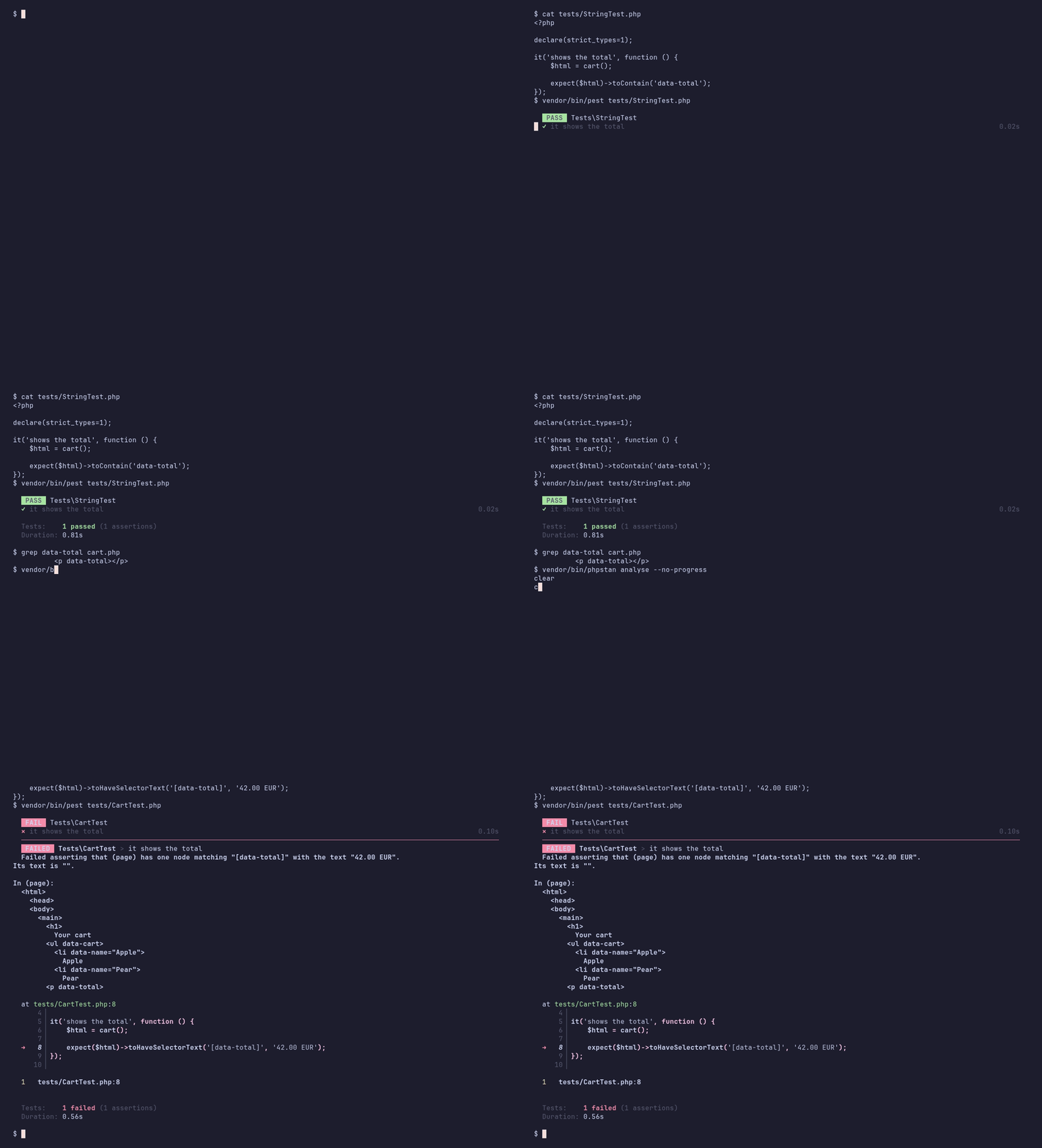
The total on the cart page is empty. A string check stays green, PHPStan reports it, and the check
by selector goes red at the line of the test and shows the HTML. The demo runs the app in
demo/, and the CI runs it on every change.
Why this exists
I hold my tests to one rule: green means the page works, red means it does not.
Tests that read HTML as a string break that rule in both directions. One of mine went red because
one more <span> wrapped a dot, and the page was fine. The other direction is worse:
// The total is empty on the page. The test stays green:
// it finds the marker, not the amount.
expect($html)->toContain('data-total');

// This one goes red and shows the region.
expect($html)->toHaveSelectorText('[data-total]', '42.00 EUR');
A string check also passes when its text sits only in an attribute or a script. Some string checks test nothing at all. Some are green by luck.
This matters more now than it used to. Coding agents produce code faster than anyone can click through it. Testing the UI by hand on every change costs too much, so in practice it does not happen. Browser tests are too slow and too heavy to cover every detail; they keep their job for JavaScript and CSS. That leaves the HTML the server renders, checked in a feature test. The agent writes these tests for almost nothing, and we need many of them. They only help if they are right.
In one of my Laravel apps, I counted 502 lines in 53 test files that checked the page as a string. The agent had not done anything wrong. It had used the tools it had. So I gave it better ones:
- before it writes, a skill gives it the rules;
- when it checks its work, PHPStan reports a check of markup as a string;
- when a test fails, the message shows the region as HTML, at the line of the test.
The same app now runs 591 checks by CSS selector, and PHPStan stops a new string check of markup before it lands.
I built this so I can trust a green test again. I hope it lets you trust yours.
Installation
composer require --dev sorge-it/phpunit-pest-html-assertions
Where Pest is installed, Composer registers the expectations. tests/Pest.php needs no line.
Quick start
Pest:
it('lists the items of the cart', function () {
    expect($this->get('/cart'))
        ->toHaveSelectorCount('[data-cart] li', 3)
        ->toHaveAnySelectorText('[data-cart] li', 'Apple');
});
PHPUnit:
use SorgeIt\PhpunitPestHtmlAssertions\PHPUnit\AssertsHtml;

final class CartTest extends TestCase
{
    use AssertsHtml;

    public function test_it_lists_the_items_of_the_cart(): void
    {
        $response = $this->get('/cart');

        self::assertHtmlSelectorCount($response, '[data-cart] li', 3);
        self::assertHtmlAnySelectorTextSame($response, '[data-cart] li', 'Apple');
    }
}
Every method of the trait starts with assertHtml. So the trait also works in a Symfony
WebTestCase, which has its own assertSelectorExists() and similar methods.
Compared with
| Tool | What it checks | The difference |
|---|---|---|
assertSee(), assertSeeHtml(), toContain() |
a string | passes on text in an attribute or a script, fails when the markup around the text changes |
Symfony's assertSelectorTextContains() and the other assertSelector…() methods |
CSS selectors | only in a WebTestCase, on the client's last response; no regions; the message shows no HTML |
sinnbeck/laravel-dom-assertions |
CSS selectors | Laravel's test responses, views and Livewire components; this package also reads Symfony, TYPO3 and PSR-7 responses and adds PHPStan rules |
| Laravel Dusk, Pest's browser tests | a real browser | for JavaScript, CSS and clicks; slower. This package checks the HTML the server renders, in a unit or feature test |
| HTML snapshots | the whole page | fail on every change; an update accepts the whole new page |
Requirements
- PHP 8.3, 8.4 or 8.5
- PHPUnit 12.5 or 13
- Pest 4 or 5, optional, for the expectations
- the PHP extensions
domandmbstring - Symfony DomCrawler and CssSelector 7.4 or 8.1
- Composer 2.1 or later
The CI tests three stacks: PHP 8.3 with PHPUnit 12, Pest 4, Laravel 12 and Symfony 7.4; PHP 8.4 with
the newest versions; PHP 8.5 with the versions of composer.lock.
Namespaces
| Namespace | What it holds |
|---|---|
SorgeIt\PhpunitPestHtmlAssertions\PHPUnit |
the constraints, Html (a page or a region of it) and the AssertsHtml trait |
SorgeIt\PhpunitPestHtmlAssertions\Pest |
the expectations and the function html() |
SorgeIt\PhpunitPestHtmlAssertions\PHPStan |
the rules html.markupAsString and html.classAsString, which report a check of markup or of a class as a string |
SorgeIt\PhpunitPestHtmlAssertions\Rector |
a rule that rewrites the mechanical forms of crawler code |
The guideline and the skill for coding agents lie in resources/boost/.
What a check reads
Each check takes one of these:
- a string of HTML;
- a Symfony
Crawler; - a Laravel
TestResponse(also a streamed one),TestVieworTestComponent; - a Livewire
Testable; - a PSR-7
ResponseInterface, for example in a TYPO3 functional test; - a Symfony
Response; - an
Htmlof this package.
The package tells the kinds apart by class. None of their frameworks is a dependency. Another value
stops the check with NotAPage, also under ->not: a negated check cannot pass on a wrong value.
A string is parsed as a whole page, the way a browser parses it. A fragment of a table without its
table loses its tags: <td>x</td> alone becomes the text x. Wrap such a fragment in <table>.
Checks
Text is compared with its white space collapsed and trimmed. The text of a script, style,
template, noscript or head inside a node does not count. A node asked for by name keeps its
own text. The Any… checks are for "some node".
Each row gives the call and the sentence of its message when it fails, after the path of the region.
| Expectation (Pest) | Method (PHPUnit trait) | Fails with: "Failed asserting that (page) …" |
|---|---|---|
toHaveSelector('[data-cart]') |
assertHtmlSelectorExists |
has a node matching "[data-cart]" |
| — | assertHtmlSelectorNotExists |
does not have a node matching "[data-cart]" |
toHaveSelectorCount('li', 3) |
assertHtmlSelectorCount |
has 3 nodes matching "li" |
toHaveSelectorCountAtLeast('li', 2) |
assertHtmlSelectorCountAtLeast |
has at least 2 nodes matching "li" |
toHaveSelectorText('h1', 'Orders') |
assertHtmlSelectorTextSame |
has one node matching "h1" with the text "Orders" |
toHaveSelectorTextContaining('h1', 'Ord') |
assertHtmlSelectorTextContains |
has one node matching "h1" whose text contains "Ord" |
toHaveAnySelectorText('li', 'Apple') |
assertHtmlAnySelectorTextSame |
has a node matching "li" with the text "Apple" |
toHaveAnySelectorTextContaining('li', 'App') |
assertHtmlAnySelectorTextContains |
has a node matching "li" whose text contains "App" |
toHaveSelectorAttribute('a', 'href', '/next') |
assertHtmlSelectorAttribute |
has one node matching "a" whose attribute "href" is "/next" |
toHaveSelectorAttribute('button', 'disabled') |
assertHtmlSelectorAttribute |
has one node matching "button" with the attribute "disabled" |
toHaveSelectorAttributeContaining('a', 'href', 'page=2') |
assertHtmlSelectorAttributeContains |
has one node matching "a" whose attribute "href" contains "page=2" |
toHaveSelectorAttributeNamed('main', 'wire:poll') |
assertHtmlSelectorAttributeNamed |
has one node matching "main" with an attribute whose name starts with "wire:poll" |
toHaveSelectorClass('[data-status]', 'bg-red-500') |
assertHtmlSelectorClass |
has one node matching "[data-status]" with the class "bg-red-500" |
toHaveText('Apple Pear') |
assertHtmlTextSame |
has the text "Apple Pear" |
toHaveTextContaining('Apple') |
assertHtmlTextContains |
has a text that contains "Apple" |
toHaveTextCount('Apple', 2) |
assertHtmlTextCount |
has the text "Apple" 2 times |
toAppearBefore('[data-head]', '[data-body]') |
assertHtmlSelectorBefore |
has the node matching "[data-head]" before the node matching "[data-body]" |
toHaveTitle('Orders') |
assertHtmlPageTitleSame |
has the title "Orders" |
toHaveInputValue('email', 'anna@example.com') |
assertHtmlInputValueSame |
has one field named "email" with the value "anna@example.com" |
toBeChecked('[data-agree]') |
assertHtmlCheckboxChecked |
has one checked box matching "[data-agree]" |
toHaveSelectedOption('[data-country]', 'de') |
assertHtmlSelectedOption |
has one select matching "[data-country]" with the option "de" chosen |
toBeDisabled('[data-send]') |
assertHtmlSelectorDisabled |
has one disabled node matching "[data-send]" |
toHaveLink('Next', '/page/2') |
assertHtmlLink |
has a link "Next" to "/page/2" |
toBeEmptyNode('[data-errors]') |
assertHtmlSelectorEmpty |
has one empty node matching "[data-errors]" |
What the checks read in detail:
- A field's value (
toHaveInputValue) is an input'svalue, a textarea's text, or a select's chosen option. - The chosen option is the last one marked
selected, else the first, as a browser does. - A node is disabled by itself, or by a disabled
fieldset, unless it stands in that fieldset's firstlegend. - A class check needs every class given, among others, in any order. An empty class list is refused.
toBeEmptyNodeis nottoBeEmpty: Pest has one of its own.
One node or none
A check of one node needs exactly one match. Zero or two matches throw NotOneNode, so a test never
reads the first of several by chance. ->not does not turn that around: not->toHaveSelectorText()
on a node that is not there stops with an error. It does not pass. To say that no node is there,
use not->toHaveSelector().
->not in Pest turns a check around. Pest then writes its own text, for example
Expecting … not to have selector '[data-cart]' 'The cart is empty after checkout.'. The text lists
each argument, also the message of the test, but not the region. assertHtmlNot() of the PHPUnit
trait keeps the text of this package, with the region. To give the reason and the region in Pest,
count zero nodes: toHaveSelectorCount('[data-cart]', 0, 'The cart is empty after checkout.').
within(), frame() and eachMatch() find the region that the checks after them, or in the
callback of eachMatch(), read. A missing region stops the test, also under ->not: within() and
frame() with NotOneNode, a frame without srcdoc with NotAPage, eachMatch() with NoMatch.
->not->eachMatch() stops with a LogicException: it would pass where one match fails. Turn the
checks in the callback around. After within() or frame(), Pest drops a ->not before the next
within() or frame(). Turn the check after them around.
The reason for a check
Each check takes a last, optional parameter string $message = '', as the checks of PHPUnit and
Pest do. Give the reason for the check. Only the test knows it. A failure shows it first, before the
text of this package:
expect($response)->toHaveSelectorCount('[data-cart] li', 3, 'The cart keeps the items of the last visit.');
self::assertHtmlSelectorCount($response, '[data-cart] li', 3, 'The cart keeps the items of the last visit.');
The cart keeps the items of the last visit.
Failed asserting that (page) has 3 nodes matching "[data-cart] li".
The selector "[data-cart] li" finds 2 nodes.
…
toHaveSelectorAttribute()andassertHtmlSelectorAttribute()have an optional$valuebefore the message. Give the message by name there:toHaveSelectorAttribute('button', 'disabled', message: 'The form waits for the consent.').NotOneNode,NotAPageandNoMatchshow the message first too.eachMatch($selector, $callback, $message)shows it where no node matches. Each check in the callback takes its own message.within()andframe()take no message. To give a reason, check the count first:toHaveSelectorCount($selector, 1, $message).- Under
->not, see One node or none.
Regions and values
html($value) turns a page into an Html. Pest passes a method it does not know to the object it
expects and keeps checking the result, so on an Html the methods below chain like expectations.
use function SorgeIt\PhpunitPestHtmlAssertions\Pest\html;

// A region: the page holds it exactly once, or the test stops with NotOneNode. Every check after it looks inside it.
expect(html($page))->within('[data-cart]')
    ->toHaveSelectorCount('li', 3)
    ->not->toHaveSelector('[data-errors]');

// The srcdoc of an iframe, as a page of its own.
expect(html($page))->frame('iframe[data-preview]')->toHaveSelectorText('p', 'Hello');

// Values, in the order of the page.
expect(html($page))->texts('[data-cart] [data-name]')->toBe(['Apple', 'Pear']);
expect(html($page))->rawTexts('[data-note]')->toBe(["Line one\nLine two"]);
expect(html($page))->attributes('[data-item]', 'data-id')->toBe(['1', '2']);

// The same checks on every match. No match stops the test with NoMatch: a loop over nothing would check nothing.
// `:scope` is the match itself.
expect($page)->eachMatch('[data-avatar]', fn ($avatar) => $avatar->toHaveSelectorClass(':scope', 'rounded-full'));

// Every attribute value of the region, whatever the name of the attribute.
expect(html($page)->attributeValues())->each->not->toContain('javascript:');
A negated check on a region that is not there would always pass. within() prevents that: a
missing region stops the test, also under ->not.
A region finds what lies below its element, as querySelectorAll of a browser does. The element
itself is not a match: in within('[data-cart]'), the selector [data-cart] finds nothing, and
body li still finds the items, because a selector is read against the whole page. :scope alone
names the element of the region. Symfony translates :scope by position, so :scope.x or
:scope > li would find the wrong nodes. Html refuses both.
A node inside a <template> matches no selector, as in a browser: the page shows it only when a
script copies it. The <template> element itself matches.
In plain PHP, Html has the same methods: Html::of($value)->within($selector), ->frame(),
->matches(), ->texts(), ->rawTexts(), ->attributes(), ->attributeValues(), ->count(),
->text().
When a check fails
The message gives the path of regions, what was asked, what was found, and the region itself as indented HTML, cut at 40 lines:
Failed asserting that (page) > [data-cart] has one node matching "[data-name="Pear"]" with the text "Pear, ripe".
Its text is "Pear".

In (page) > [data-cart]:
  <ul data-cart>
    <li data-name="Apple" class="rounded-lg bg-green-500">
      Apple
    <li data-name="Pear" class="rounded-lg">
      Pear
A check of one node that finds none or two says so, with the same region:
NotOneNode: (page) > [data-cart]: a check of one node needs exactly one match. The selector "[data-name]" finds 2 nodes.
dump() and dd() of Pest show the same path and region.
A failure points at the line of the test. The trace leaves out the frames of this package, as it
leaves out those of PHPUnit. For a bug report, run the test with HTML_ASSERTIONS_SHOW_FRAMES=1
set in the shell, not in phpunit.xml: the trace then keeps them.
Which selector
- The tag, its role,
aria-*, its label or its visible text. - A
data-*marker: the functional marker that the app (Alpine, scripts) and the tests share. A CSS class is for the look, not for a selector. - A class is a value to check (
toHaveSelectorClass('[data-status]', 'bg-red-500')), not the selector. Markup of a vendor such as Filament is the exception: its own classes (fi-ta-cell,fi-badge) are its functional hooks.
Escape a colon or a dot in an attribute name: [wire\:model="name"], [wire\:poll\.10s].
PHPStan
With phpstan/extension-installer, extension.neon loads automatically. Without it, include
vendor/sorge-it/phpunit-pest-html-assertions/extension.neon. Two rules read the files in a
directory named tests or Tests:
| Rule | Reports | Use instead |
|---|---|---|
html.markupAsString |
a check of markup as a string: assertSeeHtml('<b>'), toContain('<div') |
a check with a CSS selector |
html.classAsString |
a check that a string holds a class: toContain('lg:grid-cols-4') |
toHaveSelectorClass() or assertHtmlSelectorClass() |
Both rules read literals. PHPStan cannot know whether a string is HTML, so a rule reports a literal whose form is rare outside of HTML. The calls they read:
- the checks of Pest:
toContain,toBe(onlyhtml.markupAsString),toStartWith,toEndWith,toMatch; - the PHPUnit assertions of a string:
assertStringContainsStringandassertStringNotContainsStringwith theirIgnoringCaseforms,assertStringContainsStringIgnoringLineEndings,assertStringStartsWith,assertStringStartsNotWith,assertStringEndsWith,assertStringEndsNotWith,assertMatchesRegularExpression,assertDoesNotMatchRegularExpression; - the searches and cuts of Laravel's
StrandStringable:contains,containsAll,doesntContain,startsWith,endsWith,substrCount,match,matchAll,isMatch,test,after,afterLast,before,beforeLast,between,betweenFirst; - the functions of PHP:
preg_match,preg_match_all,str_contains,str_starts_with,str_ends_with,strpos,substr_countand theiriandmb_forms.
Markup as a string
html.markupAsString reports:
assertSeeHtml,assertDontSeeHtml,assertSeeHtmlInOrderandassertSeeInOrder, always;assertSeeandassertDontSeewith escaping off;- each call of the list above whose literal holds markup. A cut of
Stralso when its literal is a bracket of a tag alone:Str::betweenFirst($html, 'data-x', '>').
Markup is a tag (also in a regular expression, <div[^>]*>), an attribute of HTML with its value, or
the name of a data-* or wire: attribute. After [, it is a CSS selector and not reported.
A class as a string
html.classAsString reports a check that a string holds a class. Such a check passes when the class
is anywhere: on another element, inside a longer class, in a script or in a comment.
expect($html)->toContain('lg:grid-cols-4');                                // reported
expect(str_contains($html, 'lg:grid-cols-4'))->toBeTrue();                 // reported
expect($html)->toHaveSelectorClass('[data-highlights]', 'lg:grid-cols-4'); // the element has the class
It reports a check when all of these are true:
- The check searches a string, or checks the result of a search.
toBecompares the whole string and is not read. A search is read only as the value of a check:expect(substr_count($html, 'lg:flex'))->toBe(2),$this->assertTrue(Str::contains($html, 'lg:flex')). A search in anifor in a closure is not a check. A cut (Str::after) is not read: its result does not tell whether it found its text. - The check passes when the class is found. A negative check is not reported:
->not->toContain(),assertStringNotContainsString(),expect(str_contains(…))->toBeFalse(),assertSame(0, substr_count(…)),Str::doesntContain(). It fails when the class is anywhere, so it is stricter than a check of the DOM. A check that does not say found or absent is not reported either:toBeBool(),toBe($value),toBeTruthy()on a position, which is 0 at the start of the string, andtoEqual(0)orassertEquals(0, …), which also pass forfalse. - The searched value is a string, also
string|falsefromgetContent()or?string. An array, a collection ormixedis not reported. A call that reads the class attribute directly,$element->getAttribute('class'), is not reported. A variable, a cast or?? ''around it is reported. - Each word of the literal can be in a
classattribute, and one word is a utility of Tailwind: with a value in[ ](max-w-[90rem]), or after a variant (lg:grid-cols-4,hover:underline,group-hover/item:underline,data-[state=open]:block,@md:flex,lg:flex!). After a variant, the utility has a digit, a-, a/or[ ], or it is a known word such asflex. Soafter:today,first:nameandmailto:are not classes. A value of letters alone in[ ]is a key:errors-[name]. - The literal has no markup. A literal with markup is for
html.markupAsString.
The rule joins a literal with a variable before it reads it: "lg:grid-cols-{$n}" is a class,
"after:{$date}" is not. It reads a regular expression without its delimiters, toMatch('/lg:flex/').
A pattern with other syntax is not read: a character class, a group, an alternative, a quantifier,
an anchor or an escape such as \b.
A plain word (flex), kebab-case (header-grid) and a custom property (--row-bg: #fff) are not
reported. In tests, the first two are often a header value, a slug or text. For a custom property in
a style attribute, use toHaveSelectorAttributeContaining(): the rule cannot tell that attribute
from CSS text.
A project that writes its classes in camelCase (headerNav) can turn on that form. In other
projects, camelCase in a test is usually a name of JavaScript or PHP.
parameters:
    htmlAssertions:
        camelCaseClasses: true
Ignore a line on purpose
A check that compares a string on purpose gets an ignore comment on its line. Write the reason in parentheses. PHPStan reports the comment when the rule no longer reports the line:
expect($rewritten)->toBe($expected); // @phpstan-ignore html.markupAsString (the rewriter keeps every other byte)
expect($script)->toContain('lg:hidden'); // @phpstan-ignore html.classAsString (the script adds the class)
What the rules do not see
- A string in a variable:
$needle = 'lg:flex'; expect($html)->toContain($needle);. - A class without a variant or
[ ]:expect(mb_substr_count($html, 'bg-red-500'))->toBe(1). Neither rule reports it. - A search whose result goes into a variable first.
A project that does not check its tests with PHPStan can check them at level 0 for these rules.
Rector
SorgeIt\PhpunitPestHtmlAssertions\Rector\CrawlerToHtmlRector rewrites three forms of crawler code:
| Before | After |
|---|---|
new Crawler($x)->filter($s)->count() |
Html::of($x)->count($s) |
new Crawler($x)->filter($s)->each(fn (Crawler $n): string => $n->text()) |
Html::of($x)->texts($s) |
new Crawler($x)->filter($s)->each(fn (Crawler $n): ?string => $n->attr('a')) |
Html::of($x)->attributes($s, 'a') |
It rewrites only new Symfony\Component\DomCrawler\Crawler($x) where $x is a string. The texts
change slightly: texts() leaves out a script, a style or a template inside a node, and
Crawler::text() keeps them. Run the suite after the rewrite.
Add it to the rector.php of a project for a migration: ->withRules([CrawlerToHtmlRector::class]).
For coding agents
The package ships a skill in the Agent Skills format and a short guideline for Laravel Boost. With them, an agent writes these checks instead of string checks.
Laravel Boost lists the package on php artisan boost:install, also as a require-dev
dependency. Pick it in the list of third-party guidelines and skills, or add it to packages in
boost.json. Boost then writes the guideline into the guideline file of the agent, for example
CLAUDE.md, and installs the skill:
{
    "packages": ["sorge-it/phpunit-pest-html-assertions"]
}
Claude Code installs the skill as a plugin of this repository:
/plugin marketplace add sorge-it/phpunit-pest-html-assertions
/plugin install phpunit-pest-html-assertions@sorge-it
Other agents (Cursor, Codex, GitHub Copilot and more) install it with the
skills CLI:
npx skills add sorge-it/phpunit-pest-html-assertions
Not in scope
- CSS: whether a rule takes effect is a question for a browser test (
getComputedStyle). - Accessibility:
axe-corein a browser test. - HTML snapshots: see Compared with.
Development
A problem comes as a pull request that fixes it, not as an issue. How to run the checks of the package: CONTRIBUTING.md.
Security
Report a vulnerability privately through GitHub. See SECURITY.md.
License
MIT. See LICENSE.md.
About the author
Stefan Sorge · PHP expert, builder, agentic engineer. 25 years of PHP and tech for 40+ startups. I build tools that humans and AI agents read and act on the same way.
Related Packages
Stop AI coding agents from faking "done" in Laravel. ai:verify runs only the tes...
PHPStan extensions to infer Pest closure $this type from test file mappings.
Version History
| Version | Released | PHP | License |
|---|---|---|---|
| v1.4.2 | ^8.3 | MIT | |
| v1.4.1 | ^8.3 | MIT | |
| v1.4.0 | ^8.3 | MIT | |
| v1.3.0 | ^8.3 | MIT | |
| v1.2.0 | ^8.3 | MIT | |
| v1.1.0 | ^8.3 | MIT | |
| v1.0.0 | ^8.5 | MIT |