valcuandrei/pest-e2e
Write Pest tests. Run real browser E2E tests. Keep everything inside your Laravel test suite.
pestE2E is a Laravel-first bridge between Pest and JavaScript-native browser testing.
Laravel owns your test intent, state, authentication, fixtures, and assertions. JavaScript owns the browser. pestE2E connects the two and maps structured browser results back into normal Pest output.
No PHP browser DSL. No Playwright wrapper. No separate frontend-only testing workflow.
How It Works
- Write a Pest test in PHP.
- Pass authentication, parameters, and context to your JavaScript test runner.
- Run real browser tests with Playwright.
- Report structured results back into Pest.
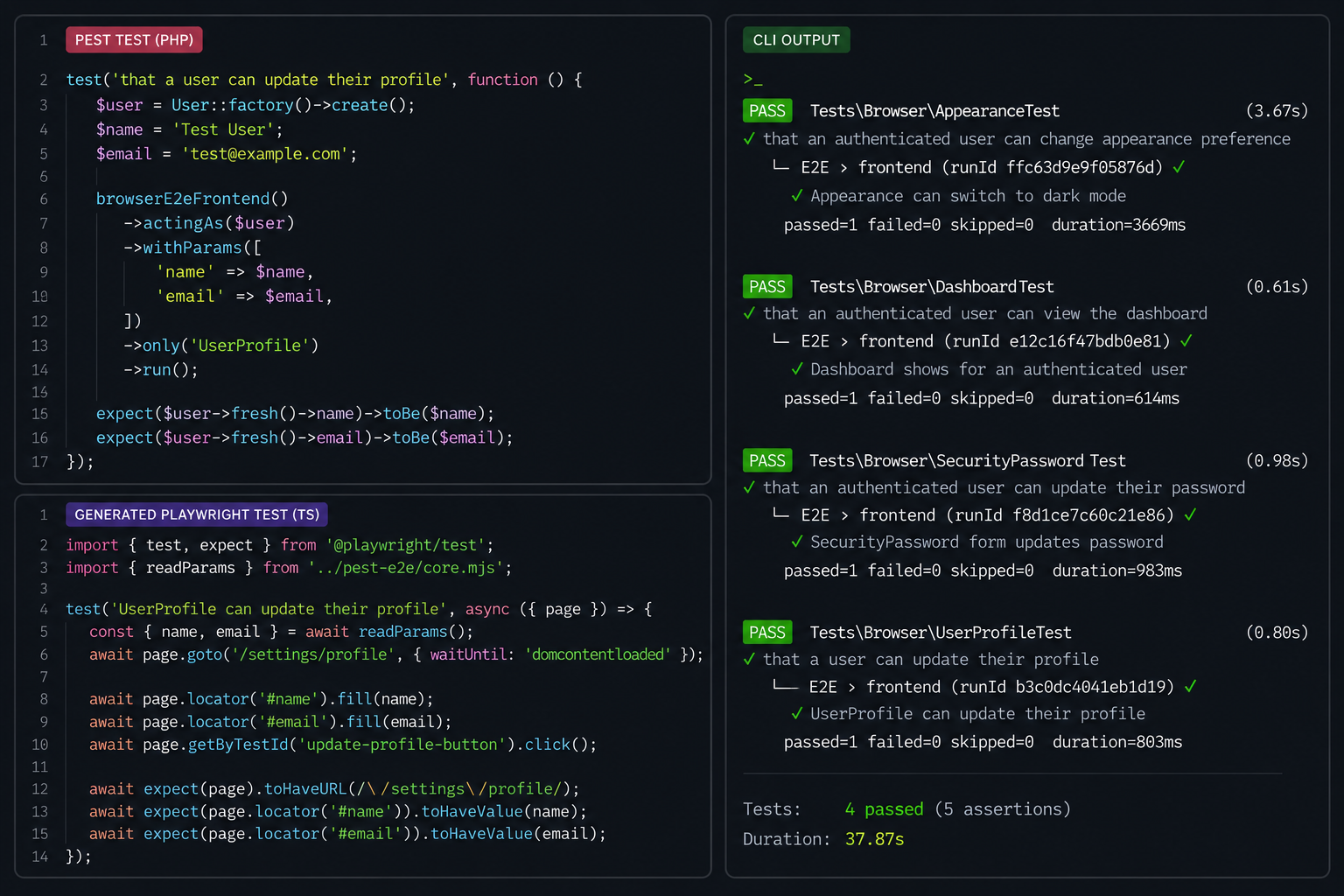
Pest test → Playwright/browser → JSON report → Pest output
Example
Pest
use App\Models\User;

test('that a user can update their profile', function () {
    $user = User::factory()->create();

    e2e('frontend')
        ->actingAs($user)
        ->withParams([
            'name' => 'Test User',
            'email' => 'test@example.com',
        ])
        ->runTest('UserProfile can update their profile');

    expect($user->fresh()->name)->toBe('Test User');
    expect($user->fresh()->email)->toBe('test@example.com');
});
Playwright
import { test, expect } from '@playwright/test';
import { readParams } from '../pest-e2e/core.mjs';

test('UserProfile can update their profile', async ({ page }) => {
    const { name, email } = await readParams();

    await page.goto('/settings/profile');
    await page.locator('#name').fill(name);
    await page.locator('#email').fill(email);
    await page.getByTestId('update-profile-button').click();

    await expect(page.getByText('Saved.')).toBeVisible();
});
Laravel controls state and authentication. JavaScript controls the browser.
Why pestE2E Exists
Pest is excellent for Laravel tests. Playwright is excellent for browser tests.
pestE2E lets you use both without pretending one is the other.
It is designed for applications where the browser matters:
- Vue, React, Inertia, Livewire, or SPA interfaces
- Drag-and-drop builders
- Layout editors
- Resizable UI systems
- CSS box-model assertions
- Transform-based positioning
- DOM measurement and layout calculations
- Frontend state inspection
pestE2E does not hide Playwright behind PHP methods. It lets Laravel orchestrate your browser suite while JavaScript keeps full ownership of browser automation.
Key Features
- Pest-native orchestration for JavaScript E2E tests
- Playwright by default
- Runner agnostic through worker contracts
- Laravel authentication using one-time auth tickets
- Managed Laravel testing server
- Isolated testing environment
- Parallel-safe worker ports and auth ticket keys
- JS test filtering via
only()andrunTest() - Structured JSON reporting contract:
pest-e2e.v1 - Agent / PAO JSON output for AI agents and CI parsers
- Headed and debug mode support
- Laravel Sail WSLg headed mode support
- PHPStan-compliant internals
What This Is Not
pestE2E is not:
- a browser abstraction
- a PHP wrapper around Playwright
- Dusk
- Selenium
- a PHP API for
visit(),click(), ortype()
All browser logic stays in JavaScript.
Status
Stable v1
The public PHP API, authentication contract, and JSON report schema are locked. Internal runner adapters may evolve.
Installation
Install the package:
composer require valcuandrei/pest-e2e --dev
Then run the installer:
php artisan pest-e2e:install
For unattended setup:
php artisan pest-e2e:install --yes
Alias:
php artisan pest-e2e:install --unattended
The installer can:
- update your
pest.phpto includeE2ETestCase - publish
config/pest-e2e.php - publish the base E2E test case
- publish the JS harness
- publish the Playwright integration
- install
@playwright/test - download Playwright browser binaries with
playwright install - create or update
.env.testingwith parallel-safe E2E overrides - create
database/testing.sqlitefor projects that intentionally use SQLite - configure
phpunit.xmlso.env.testingcontrols DB/cache values - ensure
phpunit.xmldefines aBrowsertestsuite fortests/Browser - merge the WSLg headed-mode block into Laravel Sail when Sail is detected
Each step is skipped if already done.
Installer Options
| Option | Description |
|---|---|
--yes |
Answer yes to all questions and perform full setup |
--unattended |
Alias for --yes |
--no |
Answer no to all questions |
--force |
Overwrite existing files when publishing |
--update-pest |
Update Pest config to include E2ETestCase |
--setup-env-testing |
Create .env.testing with parallel-safe E2E overrides |
--update-testing-env |
Patch an existing .env.testing with parallel-safe session/cache/queue settings |
--setup-testing-database |
Create database/testing.sqlite for projects that intentionally use SQLite |
--configure-phpunit |
Comment out DB/cache env values in phpunit.xml so .env.testing controls them |
--sail-wslg-headed |
Merge WSLg display/volume settings into the Sail laravel.test service |
--add-csrf-exclusion |
Add the pestE2E auth route to CSRF exclusions |
--publish-config |
Publish config |
--publish-base-test-case |
Publish E2ETestCase |
--publish-js-harness |
Publish JS harness |
--publish-js-playwright |
Publish Playwright adapter |
--publish-browser-tests |
Publish browser tests |
--publish-playwright-tests |
Publish Playwright tests |
--install-playwright |
Install @playwright/test and run playwright install |
--package-manager= |
Force the package manager used for E2E runs: npm, yarn, pnpm, or bun |
When publishing E2ETestCase, the installer resolves the package manager from tools found on your PATH in this priority order:
pnpm → yarn → bun → npm
If multiple tools are available, interactive installs prompt you to choose. With --yes / --unattended, the installer prefers a manager matching an existing lockfile, then falls back to the priority order. If none are found on PATH, it uses lockfile-only detection, then falls back to npm.
Pass --package-manager=pnpm, --package-manager=yarn, --package-manager=bun, or --package-manager=npm to force the value.
Testing Environment
pestE2E starts a managed Laravel server using:
--env=testing
If .env.testing exists, Laravel loads it automatically.
The installer can create this file with --setup-env-testing or update an existing one with --update-testing-env.
Recommended .env.testing values for Sail-compatible MySQL:
APP_ENV=testing
APP_URL=http://127.0.0.1

DB_CONNECTION=mysql
DB_HOST=mysql
DB_PORT=3306
DB_DATABASE=testing
DB_USERNAME=sail
DB_PASSWORD=password

SESSION_DRIVER=array
CACHE_STORE=array
QUEUE_CONNECTION=sync

PEST_E2E_AUTH_ROUTE_ENABLED=true
These values ensure:
- your development database is not modified
- auth routes are enabled only during testing
- the Pest process and managed server use the same database
- feature tests and browser tests do not share database-backed session/cache/queue state across workers
Your phpunit.xml should not override DB_CONNECTION, DB_DATABASE, CACHE_STORE, or SESSION_DRIVER. Let .env.testing control them.
The installer can comment those overrides out for you with:
php artisan pest-e2e:install --configure-phpunit
Parallel Testing
Browser tests that call e2e()->...->run() can run with Pest / Laravel parallel testing:
php artisan test --parallel --processes=4
For first-time database bootstrapping, run:
php artisan test --parallel --recreate-databases
Use a real test database such as MySQL or PostgreSQL. Laravel parallel testing creates one database per worker:
testing_test_1
testing_test_2
testing_test_3
testing_test_4
SQLite is not recommended for parallel browser testing because it does not provide the same per-worker database isolation model.
Each Pest worker gets:
- its own managed Laravel server
- a dedicated HTTP port
APP_URL/baseUrlmatching that port- worker-scoped auth ticket cache keys
- the same
DB_*/CACHE_PREFIXenv as the PHP worker
Default port formula when server.parallel_port_offset is enabled:
server.port + TEST_TOKEN
Example with base port 8800:
worker 1 → 8801
worker 4 → 8804
Serial runs keep using an ephemeral free port.
Configure the base port with:
PEST_E2E_SERVER_PORT=8800
Legacy env is also supported:
PEST_E2E_PARALLEL_BASE_PORT=8800
You can also configure this in config/pest-e2e.php under server.port.
Quick Start
Configure a target in tests/E2ETestCase.php inside setUp():
e2e()->target('frontend', fn ($p) => $p
    ->dir('resources/js/e2e')
    ->env(['APP_URL' => 'http://localhost'])
    ->params(['baseUrl' => 'http://localhost'])
);
Register targets in your base E2E test case, not inside individual test functions.
Run all tests for a target:
e2e('frontend')->run();
Run a specific JS test:
e2e('frontend')->runTest('UserProfile can update their profile');
Pass parameters:
e2e('frontend')
    ->withParams(['name' => 'Test User'])
    ->runTest('UserProfile can update their profile');
Authenticate as a Laravel user:
e2e('frontend')
    ->actingAs($user)
    ->runTest('Dashboard loads');
actingAs() and loginAs() are both supported.
Managed Testing Server
When you call:
e2e('frontend')->run();
pestE2E automatically:
- boots a temporary Laravel HTTP server
- forces it into
APP_ENV=testing - binds it to
127.0.0.1 - chooses a free port for serial runs, or a worker-specific port for parallel runs
- executes your JS runner against that server
- collects the JSON report
- shuts the server down
No manual php artisan serve required.
Running Tests
Local:
php artisan test
Laravel Sail:
sail artisan test
Parallel:
php artisan test --parallel --processes=4
Successful E2E detail output is shown in normal test runs.
In --compact and --parallel runs, passed E2E details are suppressed so Pest output stays readable. Failed E2E runs still print their details.
Agent / PAO Output
For AI agents and CI parsers, enable compact JSON output. This emits one line per e2e()->run():
PEST_E2E_AGENT_OUTPUT=1 php artisan test ./tests/Browser
You can also enable it with the CLI flag:
php artisan test ./tests/Browser --pest-e2e-agent-output
php artisan test ./tests/Browser --parallel --pest-e2e-agent-output
Agent output is also auto-detected when laravel/agent-detector is installed or common agent env vars are set, such as:
CURSOR_AGENT
Configure it with:
PEST_E2E_AGENT_OUTPUT=1
PAO_FORCE=1
Or in config/pest-e2e.php:
'agent_output' => true,
Disable it with:
PEST_E2E_AGENT_OUTPUT_DISABLE=1
PAO_DISABLE=1
In agent mode, human-readable Pest output is suppressed. Failed runs include:
php_testfailures- JS test name
- JS file
- message
- stack
report_dir
See .docs/API.md for the full JSON contract.
Debug & Headed Mode
php artisan test --browse
php artisan test --debug
php artisan test --run-using=yarn
--browse/--headedruns the browser in headed mode--debugenables debug mode and implies headed mode--run-using=npm|yarn|pnpm|bunuses a specific package manager for E2E runs
The default package manager is set in E2ETestCase::$e2ePackageManager during install.
Timing Instrumentation
Enable baseline timing markers:
PEST_E2E_TIMING=true
Markers are emitted to stderr with this prefix:
[pest-e2e:timing]
Each marker is a JSON payload with:
phaseatMs- optional
durationMs
Node Compile Cache
pestE2E runs your specs with the real Playwright Test CLI, one fresh playwright test process per run. That keeps every native feature and every run isolated, and it means each run loads Playwright's own JavaScript again, in the CLI process and in the worker it starts.
On Node 22.1 and newer, pestE2E lets Node reuse the compiled form of those modules between runs by setting NODE_COMPILE_CACHE for the Playwright process. Nothing else about the launch changes: same command, same arguments, same process model, same results.
Defaults
- Enabled automatically when the
nodeon yourPATHis 22.1 or newer. - On older Node versions the variable is not set and Playwright starts exactly as before.
Precedence
- A
NODE_COMPILE_CACHEyou define yourself always wins and is never changed. That applies to a value in your shell or.env.testingand to one passed with->env([...])on a target. The same goes forNODE_DISABLE_COMPILE_CACHE. - Otherwise
node_compile_cache.enableddecides whether pestE2E sets one.
To turn the automatic behaviour off:
PEST_E2E_NODE_COMPILE_CACHE=false
Turning it off never removes or overrides a NODE_COMPILE_CACHE you set yourself.
Location and lifecycle
- The cache lives in
<system temp dir>/pest-e2e-node-compile-cache-<uid>-<project hash>. The hash comes from the real path of the project root, so every Pest parallel worker of a project shares one cache and unrelated projects never do. - The directory is created once with owner-only permissions. pestE2E does not use a directory that is a symlink, belongs to another user, or is writable by others; in that case it prints one line to
stderrand runs without the cache. - Node manages the contents and keeps a separate subdirectory per Node version. Nothing is pruned per test. It is safe to delete the directory at any time; it is rebuilt on the next run.
- The cache is an optimisation only. Node ignores a cache directory it cannot use, and a run never fails because of it.
What to expect
The saving is a fixed amount of Node start-up work per run, so how much it matters depends on everything else a run does. These are measurements from one project, not guarantees:
| Conditions (Node 24.16, Playwright 1.63, 12 logical CPUs) | Cache off | Cache on |
|---|---|---|
| Isolated spec, no application: process start to first test callback | 1.61 s | 1.35 s |
| 17 real browser tests, serial: Playwright start to first test start (median of 51 runs) | 7.00 s | 6.77 s |
| Same tests, serial: whole Playwright process (median of 51) | 9.34 s | 8.95 s |
| Same tests, 4 parallel Pest workers: Playwright start to first test start (median of 51) | 10.35 s | 9.60 s |
| Same tests, 4 parallel Pest workers: whole Playwright process (median of 51) | 14.26 s | 13.10 s |
The cache directory for that project was about 2 MB. Memory use of the Playwright process was unchanged.
Headed Mode in Sail
If you run Pest inside Laravel Sail on Windows WSL2 and want headed browser mode, forward WSLg into the container by adding this to your laravel.test service:
environment:
  DISPLAY: ${DISPLAY}
  WAYLAND_DISPLAY: ${WAYLAND_DISPLAY}
  XDG_RUNTIME_DIR: ${XDG_RUNTIME_DIR}
  PULSE_SERVER: ${PULSE_SERVER}

volumes:
  - /mnt/wslg:/mnt/wslg
  - /tmp/.X11-unix:/tmp/.X11-unix
This is only required for headed browser mode inside Docker on WSL2. Headless mode works without additional configuration.
Authentication Contract
Default auth route:
/pest-e2e/auth/login
Configure it with:
config('pest-e2e.auth.route');
Security:
- disabled by default
- only enabled when
PEST_E2E_AUTH_ROUTE_ENABLED=true - requires a header, default:
X-Pest-E2E: 1 - tickets are single-use
- tickets are short-lived, counted from the moment the browser run is launched (time spent queued behind other parallel E2E runs does not count)
- a ticket that was never exchanged is revoked when its run ends
Reports & Artifacts
Playwright emits its JSON report to stdout. The PHP side parses it in memory and maps it to the canonical pest-e2e.v1 schema.
Playwright artifacts are written to a run-scoped directory:
{reports.base_dir}/{target}/{runId}
The default base directory is:
storage/framework/testing/pest-e2e
Configure it with:
config('pest-e2e.reports.base_dir');
Automatic pruning
Old run directories are removed automatically; there is no command to schedule.
- Before every Playwright launch pestE2E makes one cheap check (it reads a small timestamp file).
- At most once per
reports.prune.interval_minutes(default 15), one process takes a lock and sweeps old runs. Other Pest workers do not wait; they skip the sweep and launch. - A sweep that fails never fails a test. It is reported once on
stderrand tried again after the interval. - A large backlog is worked off in bounded passes rather than in one go.
What is kept
A run is deleted when it is older than keep_days (default 7) or it is not among the newest keep_runs runs (default 500). Either rule alone is enough, so a run older than keep_days is deleted even if fewer than keep_runs runs exist. Set a rule to 0 to turn it off.
Whatever those rules say:
- A run that is still in progress is never deleted. Each run holds a lock while it executes, in any Pest worker.
- A run younger than
grace_minutes(default 60) is never deleted, so the traces of a recent failure are still there when you look.
What pestE2E considers its own
Only runs pestE2E registered itself are deleted. The registry lives beside the reports, in {reports.base_dir}/.pest-e2e-state/, because Playwright empties its output directory at the start of every run. Symbolic links are never followed, and nothing outside the report directory is touched.
Directories in the report tree that pestE2E cannot prove it created are left alone. That includes run directories written by versions before this registry existed; see the command below.
Pruning by hand
php artisan pest-e2e:prune-reports --dry-run
| Option | Effect |
|---|---|
| (none) | Apply keep_days and keep_runs from config |
--dry-run |
List what would be deleted; delete nothing |
--unit=days --value=N |
Delete runs older than N days (replaces both configured rules) |
--unit=items --value=N |
Keep only the newest N runs (replaces both configured rules) |
--all |
Delete every registered run that is not in progress, including recent ones |
--legacy |
Also inspect unregistered directories and report which look like old runs |
--delete-unmarked-legacy-runs |
Delete the unregistered directories that pass validation |
The command works even when automatic pruning is disabled, and uses the same rules: it never deletes a run in progress, never follows links, and only works inside reports.base_dir. --all does not extend to unregistered directories.
An unregistered directory is only accepted as an old run when it sits at {base_dir}/{target}/{name}, is a real directory, is empty or contains Playwright's .last-run.json, contains no links, and has not been modified within the grace period. Run with --legacy --dry-run first.
Browser storage state
When a test uses actingAs(), the JS harness writes the session cookies to a Playwright storage-state file. That file is sensitive and is not a report:
- It is written to a private per-run directory,
{reports.base_dir}/.pest-e2e-state/{target}/{runId}/runtime/, passed to the JS process asPEST_E2E_RUNTIME_DIR. - It is deleted as soon as the run ends, whether it passed, failed or threw. It is never part of the retained report directory.
- If a process is killed mid-run, the leftover file is removed by the next sweep once the run's lock is gone.
It must not live inside your Playwright test directory. Playwright walks that whole directory on every invocation, so files left there by earlier runs make every later run slower.
Upgrading from an earlier version. The harness in resources/js/pest-e2e/ is a published copy. Republish it to get the new location:
php artisan vendor:publish --tag=pest-e2e-js-playwright --force
Until you do, pestE2E removes the file your older harness writes (<target dir>/.pest-e2e/<runId>/storageState.json) after each run, so nothing new accumulates. Directories already left there by earlier versions are not removed automatically. If <target dir>/.pest-e2e/ has grown large, deleting it while no tests are running restores normal discovery speed.
Configuration
Key config keys in config/pest-e2e.php:
| Key | Description |
|---|---|
auth.route |
Auth endpoint path. Default: /pest-e2e/auth/login |
auth.route_enabled |
Enable auth route. Default: false, set via PEST_E2E_AUTH_ROUTE_ENABLED |
auth.ttl_seconds |
Auth ticket TTL, measured from JS-runner launch (not from actingAs()). Default: 60 |
auth.header.name / auth.header.value |
Header required for auth requests. Default: X-Pest-E2E: 1 |
server.driver |
Server runner: artisan or php_builtin. Default: php_builtin |
server.host |
Bind address for the managed server. Default: 127.0.0.1 |
server.port |
Base HTTP port for parallel workers. Default: 8800 |
server.parallel_port_offset |
Parallel workers use server.port + TEST_TOKEN. Default: true |
reports.base_dir |
Base directory for Playwright artifacts. Default: storage/framework/testing/pest-e2e |
reports.prune.enabled |
Remove old run directories automatically. Default: true |
reports.prune.keep_runs |
Keep at most this many newest runs; 0 turns the rule off. Default: 500 |
reports.prune.keep_days |
Keep runs for at most this many days; 0 turns the rule off. Default: 7 |
reports.prune.grace_minutes |
Never delete a run younger than this. Default: 60 |
reports.prune.interval_minutes |
Minimum time between automatic sweeps, shared by all workers. Default: 15 |
timing.enabled |
Enable timing instrumentation. Default: false, set via PEST_E2E_TIMING |
node_compile_cache.enabled |
Let pestE2E point Node's module compile cache at a per-project temp directory (Node 22.1+). Default: true, set via PEST_E2E_NODE_COMPILE_CACHE |
js_runner.driver |
JS runner. Default: playwright |
package_manager |
Package manager for E2E runs: npm, yarn, pnpm, or bun |
parallel.base_port |
Deprecated alias for server.port |
agent_output |
Force agent JSON output. Default: from PEST_E2E_AGENT_OUTPUT / PAO_FORCE |
bindings |
Contract-to-implementation map for swapping the JS runner |
Runner Swapping
pestE2E uses contracts for the JavaScript worker and JSON parser.
The default bindings use Playwright, but you can override them in config/pest-e2e.php to integrate another runner, such as Cypress or Puppeteer.
The important boundary stays the same:
Laravel/Pest owns orchestration.
JavaScript owns browser execution.
JSON owns the report contract.
Final Positioning
pestE2E is not “browser testing for Laravel.”
It is a contract-driven bridge between Laravel and JavaScript-native E2E systems.
If you are building advanced frontend applications and want Laravel to orchestrate while JavaScript owns the browser, this package is for you.
Related Packages
Version History
| Version | Released | PHP | Laravel | License |
|---|---|---|---|---|
| v1.3.0 | ^8.4 | ^13.0 | MIT | |
| v1.2.0 | ^8.4 | ^13.0 | MIT | |
| v1.1.0 | ^8.4 | ^13.0 | MIT | |
| v1.0.0 | ^8.4 | ^13.0 | MIT |