xelqun/panels
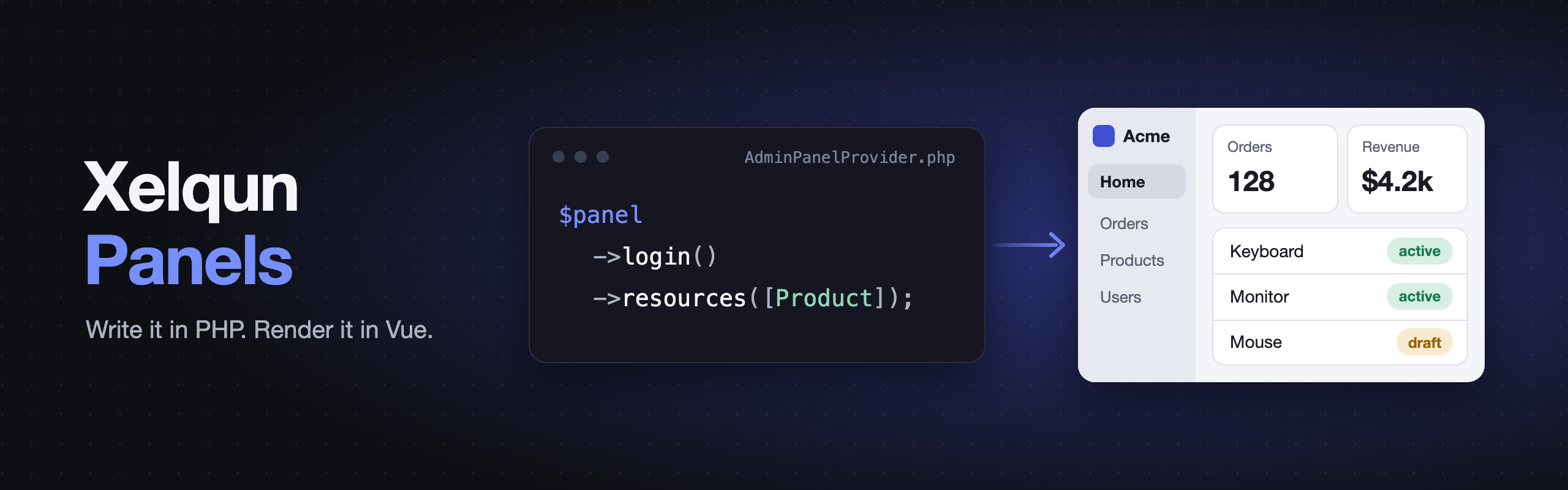


Describe an admin panel in PHP and generic Vue components render it, with navigation, authentication, CRUD pages and dashboards. Normal panels need no Vue at all.
Pre-alpha: the API will change. Requires Laravel 13, Inertia 3, Vue 3.5, Tailwind 4,
xelqun/formsandxelqun/tables.
Example
class AdminPanelProvider extends PanelProvider
{
    public function panel(Panel $panel): Panel
    {
        return $panel
            ->id('admin')
            ->path('admin')
            ->brandName('Acme')
            ->colors(['primary' => Color::Blue])
            ->login()
            ->passwordReset()
            ->profile()
            ->resources([ProductResource::class])
            ->pages([Dashboard::class])
            ->widgets([OrderStats::class])
            ->navigationGroups(['Catalog', 'Sales']);
    }
}

class ProductResource extends Resource
{
    protected static string $model = Product::class;
    protected static ?string $recordTitleAttribute = 'name';
    protected static ?string $navigationIcon = 'package';
    protected static ?string $navigationGroup = 'Catalog';

    public static function form(): array
    {
        return [
            TextInput::make('name')->required(),
            TextInput::make('price')->numeric()->required(),
        ];
    }

    public static function columns(): array
    {
        return [
            TextColumn::make('name')->searchable()->sortable(),
            TextColumn::make('price')->money('USD')->sortable(),
        ];
    }
}
That's a signed-in admin with a dashboard and list, create, edit and view pages for products.
Features
- Write PHP, not Vue. Normal panels need no frontend code, and you can add your own Vue page when you want one.
- One class per model. A resource gives you CRUD pages, filters, actions, soft deletes, CSV export and import, relation managers and nested resources.
- Closed by default. Nobody gets in until
canAccessPanel()says so, and with no policy the answer is no. The check runs on every request, so taking away access works at once, even on an open page. - Authentication built in. Login, registration, password reset, email verification and profiles, plus two-factor by authenticator app or email. Fortify isn't needed.
- Multi-tenancy. Split a panel between teams or shops. Records stay in their tenant for every query, and the tenant never comes from the browser.
- Dashboards. Stats, lists, tiles, tables and line, bar and doughnut charts, with no chart library. Widgets load after the page, so it paints at once.
- Global search and notifications. ⌘K finds pages and records, and a bell shows database notifications, by polling or broadcast.
- Theming. Pick from Tailwind's palettes with
Color, in light and dark themes, and text stays readable whatever you choose. Animations are on by default, and anyone can turn them off. - Made to extend. Plugins, render hooks, custom pages and translations.
Installation
Panels is built on forms and tables, and its installer sets up all three:
composer require xelqun/panels
php artisan xelqun-panels:install
php artisan make:xelqun-panel Admin
The installer adds the matching npm package, two small page files in resources/js/pages/xelqun, the styles, and panelsPlugin() in your Inertia entry file. The new panel has a login page and a dashboard at /admin.
Then add PanelUser to your user model, as shown under Access. Nobody can sign in until you do.
Usage
php artisan make:xelqun-resource Product
This creates a resource and a policy for the model. A panel made with make:xelqun-panel picks the resource up by itself, and it joins the sidebar and the New button. Set $recordTitleAttribute to add it to search. Fill in form() and columns(), then the policy, because a resource shows nothing until the policy allows it.
make:xelqun-page, make:xelqun-widget and make:xelqun-relation-manager create the other pieces.
Access
Nobody gets in until you say so. Put PanelUser on your user model:
class User extends Authenticatable implements PanelUser
{
    public function canAccessPanel(Panel $panel): bool
    {
        return $this->is_admin;
    }
}
A user model without it can't enter any panel, in any environment. The check runs on every page and on the endpoints forms and tables use, so taking away access takes effect at once, even on a page that's already open.
Authentication
Auth is built in, per panel, on Laravel's own Auth, Password and RateLimiter. Fortify isn't needed. Turn on what you want:
| Method | Gives you |
|---|---|
login() |
A login page, limited to 5 tries a minute. Without it, guests are refused. |
passwordReset() |
Emailed reset links. The answer never says whether an address has an account. |
registration() |
Sign up. Off by default, and a new user still has to pass canAccessPanel(). |
emailVerification() |
Holds users at a prompt until they verify. The user model needs MustVerifyEmail. |
profile() |
A page for users to change their name, email and password. |
Each one takes a form class, so login(MyLoginForm::class) swaps the form. Use authGuard() to give a panel its own session guard, and authPasswordBroker() for its own broker.
Two-factor authentication
$panel->multiFactorAuthentication();                    // optional for each user
$panel->multiFactorAuthentication(isRequired: true);    // nobody gets past the profile page without it
Add the columns with php artisan vendor:publish --tag=xelqun-panels-mfa, then put HasAppAuthentication and the InteractsWithAppAuthentication trait on your user model. People turn it on from the profile page.
It's the standard 30 second, 6 digit TOTP that any authenticator app reads, with 8 recovery codes. A code works once, guesses are limited to 5 a minute, and the right password alone never gets anyone in. It's checked on every page and token of the panel, so signing in through your app's own login can't get around it, and a remember-me login is asked for a code again in a new session. Secrets are encrypted, and only hashes of recovery codes are kept.
Setup gives a link and a key to type, with no QR code, because that would need a new dependency.
emailAuthentication() also lets people get a 6 digit code by email at sign in. Add HasEmailAuthentication to the user model, and the same trait covers it. The code is kept only as a hash, works once, and ends with the 5 minute challenge. It's weaker than an authenticator, because anyone in the mailbox can read it.
On HTTPS, the browser's history is encrypted and cleared on sign out, so Back can't show records afterwards. Behind a proxy, set up trusted proxies, or Laravel won't see the request as secure.
Resources
One class manages one model, and gets list, create, edit and view pages:
class ProductResource extends Resource
{
    protected static string $model = Product::class;
    protected static ?string $recordTitleAttribute = 'name';
    protected static ?string $navigationIcon = 'package';
    protected static ?string $navigationGroup = 'Catalog';

    public static function form(): array
    {
        return [TextInput::make('name')->required()];
    }

    public static function columns(): array
    {
        return [TextColumn::make('name')->searchable()->sortable()];
    }
}
php artisan make:xelqun-resource Product creates this and a policy. A panel made with make:xelqun-panel picks it up by itself, through discoverResources(in: app_path('Xelqun/Admin/Resources'), for: 'App\\Xelqun\\Admin\\Resources'). Otherwise, add it to resources().
Access goes through the model's policy: viewAny, view, create, update and delete. With no policy, or no such method, the answer is no. This differs from Filament, which allows by default.
getEloquentQuery() is the security boundary. A record it leaves out is a 404 on every page, table action and form request.
Override filters(), recordActions(), bulkActions(), configureTable() and the hooks mutateBeforeSave(), beforeCreate(), afterCreate(), beforeSave() and afterSave(). To change a page, extend ListRecords, CreateRecord, EditRecord or ViewRecord and return it from getPages().
The sidebar's New button lists every resource with a create page that the user may create.
Actions
recordActions() starts with edit and delete. Build your own list from the same parts, which take labels, modals and policies from the resource:
public static function recordActions(): array
{
    return [
        ViewAction::for(static::class),
        EditAction::for(static::class),
        ReplicateAction::for(static::class)->excludeAttributes(['slug']),
        DeleteAction::for(static::class),
    ];
}
Each takes the usual action methods, such as ->label() or ->visible(). ReplicateAction needs replicate in the policy.
Export and import
public static function getHeaderActions(): array
{
    return [ExportAction::for(static::class), ImportAction::for(static::class)];
}
Export downloads the list as CSV, inside getEloquentQuery() and the current tab, using the table's columns. Override getExportColumns() to change them. Any cell that a spreadsheet would run as a formula is kept as text.
Import reads a CSV whose first row names the columns. Each row goes through the resource's form, so it gets the same validation, hooks and tenant as a record typed in, and bad rows are counted and skipped. Only columns from getImportColumns() are read. It runs in the request and stops at 1,000 rows.
One record, no list
For settings and the like, return only ManageSingleRecord from getPages(). It edits what getSingularRecord() returns, which by default is the first record, or a new one until it's saved.
Soft deletes
A model with SoftDeletes gets this by itself: deleted records leave the list, a filter brings them back, and RestoreAction, ForceDeleteAction and their bulk versions appear. They need restore and forceDelete in the policy. If you override filters(), add TrashedFilter::make('trashed').
Relation managers
A table of a relationship, under a record's edit and view pages, with create, edit and delete in modals:
class OrdersRelationManager extends RelationManager
{
    protected static string $relationship = 'orders';

    public static function form(): array { return [TextInput::make('number')->required()]; }
    public static function columns(): array { return [TextColumn::make('number')->searchable()]; }
}
Return it from getRelations() on the resource, or run php artisan make:xelqun-relation-manager Customer orders. Set $relatedResource to reuse a resource's form, columns and filters instead.
To link records that already exist, add AttachAction and DetachAction for a many-to-many, or AssociateAction and DissociateAction for a has-many:
public static function headerActions(Model $owner): array
{
    return [...parent::headerActions($owner), AttachAction::for(static::class, $owner)];
}
Access goes through the related model's policy and the parent's view. Changing anything also takes the parent's update, and the view page is read-only. It works for has-many, morph-many and many-to-many, where a new record is attached to the parent.
With two or more, the tables sit on tabs under the record.
Nested resources
When related records need pages of their own, nest the resource under its parent, as in /posts/1/comments/5/edit:
class CommentResource extends Resource
{
    protected static string $model = Comment::class;
    protected static ?string $parentResource = PostResource::class;
    protected static ?string $parentRelationship = 'comments'; // the default is this model's plural
}
It leaves the sidebar, the New menu and search, and only reaches the parent's related records. A parent out of reach is a 404 for everything under it, and new records join the parent whatever the browser sends. To get there, point a relation manager's $relatedResource at it, and its rows and New button link to the nested pages.
getRecordSubNavigation() on a resource adds tabs across a record's pages.
One-page resources
For a model with a few fields, keep everything on the list page, with create and edit in modals. make:xelqun-resource Tag --simple sets this up:
public static function getPages(): array
{
    return ['index' => ManageRecords::class];
}
List tabs
public static function getTabs(): array
{
    return [
        'all' => Tab::make(),
        'active' => Tab::make('Live')
            ->badge(fn () => Product::where('status', 'active')->count())
            ->modifyQueryUsing(fn (Builder $query) => $query->where('status', 'active')),
    ];
}
The first tab is the default. A tab always stays inside getEloquentQuery(), even with an orWhere, and so does everything on that table.
Infolists
Give the view page real values instead of a disabled form. Entries take the same options as table columns, and sit in any of forms' layouts. Besides the ones below there are ColorEntry, CodeEntry, KeyValueEntry, and RepeatableEntry with its own schema():
public static function infolist(): array
{
    return [
        Section::make('Product')->columns(2)->schema([
            TextEntry::make('name'),
            TextEntry::make('category.name')->label('Category'),
            TextEntry::make('status')->badge()->color('success'),
            TextEntry::make('price')->money('USD'),
            IconEntry::make('is_featured')->boolean(),
            ImageEntry::make('image')->disk('public'),
        ]),
    ];
}
Global search
⌘K finds pages and records. A resource with $recordTitleAttribute is searched on that column, so if the title is an accessor, or you want more columns, override this:
public static function getGloballySearchableAttributes(): array
{
    return ['name', 'sku', 'category.name'];
}

public static function getGlobalSearchResultDetails(Model $record): array
{
    return ['SKU' => $record->sku];
}
Return [] to keep a resource out. Search runs through getEloquentQuery(), skips a resource the user can't viewAny, and checks view on each record, showing up to 5 per resource. Results link to the view page. A policy that refuses more than the first 20 matches can hide later ones.
Tenancy
Split a panel between teams, shops or companies. Every page moves under /admin/{tenant}:
$panel->tenant(Team::class, slugAttribute: 'slug');
Say who belongs where on your user model:
class User extends Authenticatable implements HasTenants, PanelUser
{
    public function getTenants(Panel $panel): Collection
    {
        return $this->teams;
    }

    public function canAccessTenant(Model $tenant): bool
    {
        return $this->teams()->whereKey($tenant)->exists();
    }
}
Each resource's model needs a relationship to the tenant, named after it (team()) unless you pass ownershipRelationship, or set $tenantOwnershipRelationship on the resource. It can be a belongs-to or a many-to-many. Set $isScopedToTenant = false on a resource that isn't owned by a tenant.
Inside a tenant, those models stay in it for every query of the request: tables, search, Select options, widgets, scopedUnique(), scopedExists() and your own code. New records join the tenant on their own, and it never comes from the browser. A tenant the user isn't in is a 404, and taking someone out takes effect at once, even on an open page.
A switcher moves between tenants, in the sidebar or, with topNavigation(), the top bar. Notifications belong to the user, not the tenant.
tenantRegistration(RegisterTeam::class) lets a user start a tenant, and is where someone with no tenants lands. tenantProfile(EditTeam::class) adds a page to change one, which needs update in the tenant's policy. Both take a Form class. The registration form has to add the user in its afterSave().
Notifications
databaseNotifications() adds a bell to the top bar, which checks every 30 seconds. Change that with databaseNotificationsPolling('60s'), or pass null to check only on page load. It needs Laravel's table, from php artisan make:notifications-table, and Notifiable on your user model.
use Xelqun\Panels\Notifications\DatabaseNotification;

DatabaseNotification::make()
    ->title('Order paid')
    ->body('Order 1001 is ready to ship.')
    ->success()
    ->url(OrderResource::getUrl('view', ['record' => $order]))
    ->sendToDatabase($user);
Navigation
Clusters put several pages and resources behind one sidebar link, with tabs between them. Extend Cluster, then set protected static ?string $cluster = Settings::class; on each member. The link goes to the first member the user can reach.
The user menu takes more links: userMenuItems([NavigationItem::make('Billing')->url(fn () => route('billing'))]).
Add broadcastNotifications() and send with ->broadcast($user) for an instant update. It uses your app's window.Echo on the user's private channel, and only sends a signal, so the bell fetches the content itself. Without Echo the bell keeps polling.
Pages
class Reports extends Page
{
    protected static ?string $navigationIcon = 'chart-column';

    public function headerActions(): array
    {
        return [Action::make('export')->authorize('export')->action(fn () => /* ... */)];
    }

    public function content(): array
    {
        return [ReportsTable::make()];
    }
}
content() takes tables, action sets and FormContent. Override getComponent() to render your own Vue page, and use XqPanelLayout as its layout to stay inside the panel.
Dashboards
Dashboard shows the widgets from Panel::widgets(). It paints at once, and the widgets arrive after with skeletons in their place.
| Widget | For |
|---|---|
StatsOverview |
A row of numbers, with Stat::make(). |
ListWidget |
Rows with an icon, a title, detail, and actions, a progress bar or a link. It's a table underneath, so actions are checked on the server and query() limits what it reaches. |
TileWidget |
A grid of small cards with a status. |
TableWidget |
A full table. |
ChartWidget |
Line, bar and doughnut charts, drawn with no chart library. |
Widget |
Your own, with a Vue component registered in createXelqunForms({ components }). |
Set $columnSpan (out of 12), $sort and $heading, and override canView() to hide one. getHeaderWidgets() on a resource shows widgets above its list, and getRecordWidgets() above a record, where a widget reads it from $this->record.
class OrdersChart extends ChartWidget
{
    protected static ?string $heading = 'Orders';

    protected function getType(): string
    {
        return 'line'; // or 'bar' or 'doughnut'
    }

    protected function getData(): array
    {
        return [
            'labels' => ['Jan', 'Feb', 'Mar'],
            'datasets' => [['label' => 'Orders', 'data' => [12, 19, 8]]],
        ];
    }
}
Theming
Set a panel's colors the way Filament does, with Color or a hex value:
use Xelqun\Panels\Support\Colors\Color;

$panel->colors([
    'primary' => Color::Amber,
    'danger' => Color::Rose,
    'gray' => Color::Slate,
]);
Color holds Tailwind's 26 palettes. Any color you leave out keeps its default: danger Red, gray Zinc, info Blue, success Green, warning Amber, and a blue primary. Those match Filament's, apart from the primary.
Text stays readable whatever you choose. A button keeps white text, and its fill deepens just enough for white to clear WCAG AA's 4.5:1, so Emerald stays green and doesn't get black text. Yellow, Amber and Lime turn brown that way, so those go bright, with dark text in their own hue. A hex value gets the same treatment. Colored text is adjusted on its own for each theme.
To let people choose, pass a closure, which runs on every request:
$panel->colors(fn (): array => ['primary' => Color::fromName(auth()->user()?->theme) ?? Color::Blue]);
Color::options() gives a Select its choices. Anything that isn't a color is refused, because these end up in a style attribute.
font('DM Sans') picks a family from Bunny Fonts, loaded after the page so a slow font host can't hold it back. Everything else is a --xq-* token, set under :root[data-xq-panel].
brandLogo(), darkModeBrandLogo(), brandLogoHeight() and favicon() set the brand. maxContentWidth('full') sets how wide pages get. darkMode(false) removes the dark theme, darkMode(isForced: true) makes it the only one, and defaultThemeMode('dark') picks the theme until someone chooses. globalSearch(false) and breadcrumbs(false) remove those.
Animations are on by default. Anyone can turn them off for themselves in the user menu, and the choice stays in their browser. animations(false) starts a panel with them off, and a system set to reduced motion always wins. To change the feel, override the --xq-duration-*, --xq-stagger and --xq-ease-* tokens.
topNavigation() moves the navigation across the top, in place of the sidebar. Phones keep the drawer.
Icons in PHP are names. The panels plugin adds common sidebar icons to the forms set, and createXelqunForms({ icons }) adds your own.
Extending a panel
Plugins bundle resources, pages and settings. Implement Plugin, then add it with $panel->plugin(new BlogPlugin). register() runs as the panel is declared, and boot() once the app has booted.
Render hooks put your own Vue component in the shell:
$panel->renderHook(RenderHook::TopbarEnd, 'acme/credits', fn (): array => ['left' => auth()->user()->credits]);
Register the component in createXelqunForms({ components }). The places are SidebarStart, SidebarEnd, TopbarStart, TopbarEnd, ContentStart, ContentEnd, AuthFormBefore and AuthFormAfter. Only the two auth ones run for guests.
Translations. All text comes from language files. Run php artisan vendor:publish --tag=xelqun-panels-lang to change it or add a language. In shell.php each key is the English text.
Testing
InteractsWithPanels adds actingInPanel($user, 'admin'), which signs in on the panel's guard, and enterPanel('admin', $tenant), for building a table or form to test. Forms' and tables' own test helpers work the same way on panel pages.
Before going to production
- Check
canAccessPanel(). It decides who gets in, in every environment. - Write a policy for every model. With no policy, or no such method, the answer is no, and a method that returns
truelets everyone with panel access through. - Scope
getEloquentQuery()to what the viewer may see. Every page, action and form request stays inside it, so this is your main line of defence. - Give each action its own
authorize(). An action does nothing without one. - Set up trusted proxies behind a proxy. Otherwise Laravel doesn't see the request as secure, and the browser's history isn't encrypted.
- Schedule
php artisan xelqun-forms:prune-uploads. Temporary uploads stay on disk until it runs.
Current limits
%and_in a search act as wildcards.discoverResources()walks its folder on every request.- Export ignores table filters, and only follows the tab.
- Signing out of one panel signs out of the others in that session.
- A queued verification email gets Laravel's route, not the panel's.
- Changing a password ends "remember me" on other devices, but not their open sessions. Add Laravel's
AuthenticateSessionmiddleware for that. - SSR isn't tested.
See how Xelqun compares with Filament, page by page.
Developing
To test against unreleased sibling changes, make a gitignored composer.local.json with path repositories for ../forms and ../tables, then run COMPOSER=composer.local.json composer install.
Inspiration
Xelqun Panels is heavily inspired by Filament. I'm a big fan of Filament and have built several packages for it, and this project brings its PHP-first way of building admin panels to Inertia and Vue.
License
MIT
Related Packages
An Inertia + Vue admin panel framework for Laravel: resources, tables, forms, in...
The open-source admin panel framework for Laravel, built for Inertia and Vue. De...
Version History
| Version | Released | PHP | Laravel | License |
|---|---|---|---|---|
| v0.1.0 | ^8.4 | ^13.0 | MIT |