muhammadsadeeq/laravel-activitylog-ui
| Install | |
|---|---|
composer require muhammadsadeeq/laravel-activitylog-ui |
|
| Latest Version: | v3.0.0 |
| PHP: | ^8.4 |
| License: | MIT |
| Last Updated: | Aug 22, 2026 |
| Links: | GitHub · Packagist |
Laravel Activity Log UI
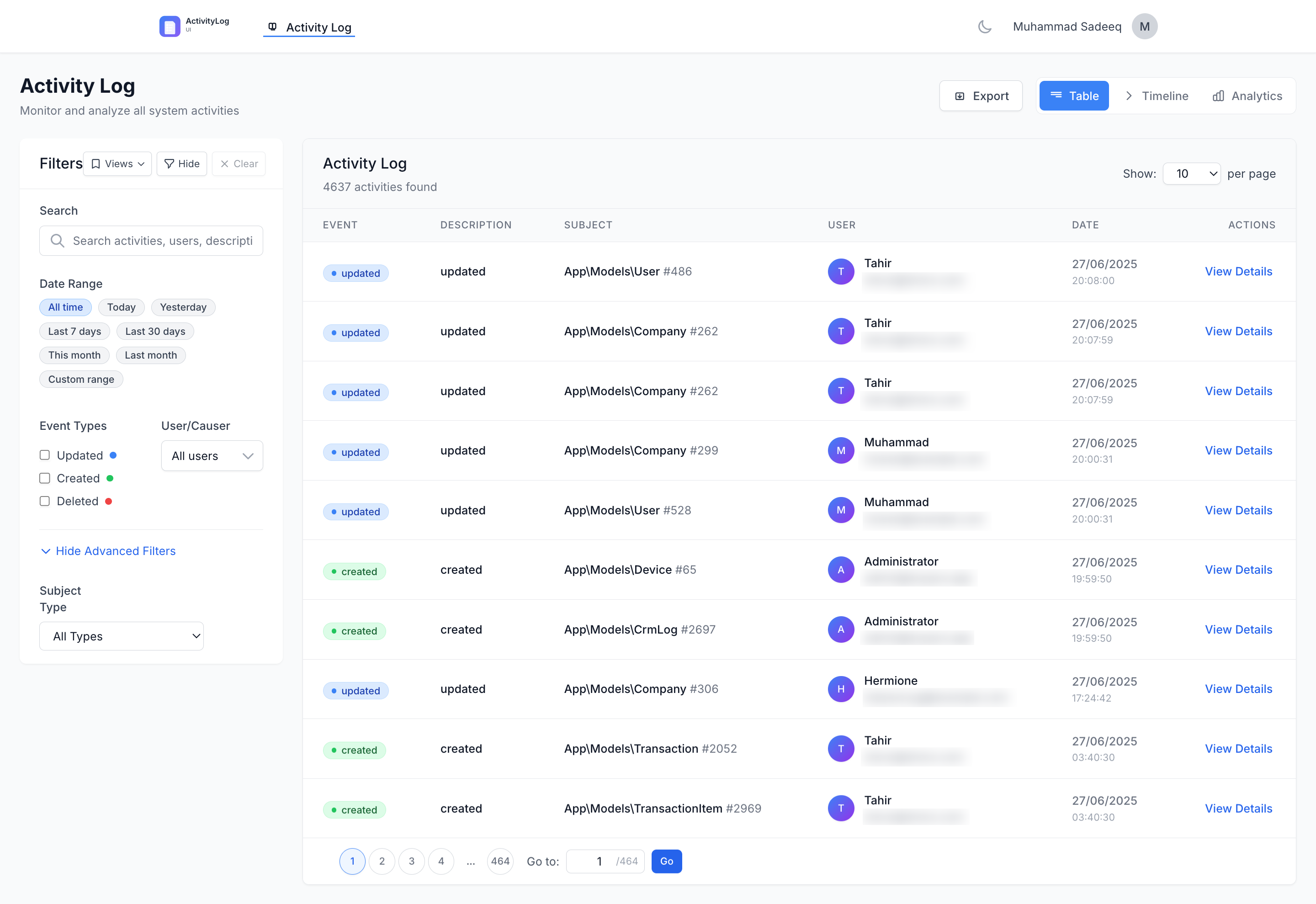
Beautiful, modern UI for Spatie's Activity Log
Important: This package assumes you already have Spatie's Activity Log installed and configured in your Laravel application. It does not replace the logging package—only provides a powerful UI for viewing and analyzing the stored activities.
📖 Documentation
📚 Complete Documentation - Comprehensive guide with advanced features, customization options, and troubleshooting.
⬆️ Upgrading from v1.x
v3.0 is a breaking release: the UI now requires authentication by default, exports are scoped to whoever created them, and unusable parameters are refused rather than quietly reinterpreted. v2.0 before it moved to Spatie laravel-activitylog v5. See UPGRADING.md for both paths.
✨ Features
- Table, Timeline & Analytics dashboards
- Powerful filter panel (date presets, events, users, subjects, search)
- Saved views, per-page & sorting preferences
- Export to CSV / Excel / PDF / JSON
* Optional Excel & PDF exports require additional packages (see below) - Real-time count & pagination powered by Laravel cache
- Authorization gate, middleware & granular access lists
- Tailwind CSS & Alpine.js – no build step required
🗒️ Requirements
- PHP ≥ 8.4
- Laravel 12 | 13
- spatie/laravel-activitylog ≥ 5.0 (already logging your activities)
- Database table
activity_logwith Spatie v5’s schema (includesattribute_changescolumn)
On Laravel 12 Composer resolves
spatie/laravel-activitylogto 5.0.0, because 5.1.0 requiresilluminate/* ^13.0. The schema and everything in this package behave the same on both; you are simply pinned to 5.0.x until you move to Laravel 13. Verified against Laravel 12.66 / Spatie 5.0.0 and Laravel 13.25 / Spatie 5.1.0.
Optional (for export)
| Feature | Package | Version |
|---|---|---|
| Excel (XLSX) | maatwebsite/excel |
^3.1 |
barryvdh/laravel-dompdf |
^2.0 |
Add them when you need those formats:
composer require maatwebsite/excel barryvdh/laravel-dompdf
🚀 Installation
- Install the package
composer require muhammadsadeeq/laravel-activitylog-ui - (Optional) Publish resources
# Config file (config/activitylog-ui.php) php artisan vendor:publish --provider="MuhammadSadeeq\ActivitylogUi\ActivitylogUiServiceProvider" --tag="activitylog-ui-config" # Blade views (if you want to customise) php artisan vendor:publish --provider="MuhammadSadeeq\ActivitylogUi\ActivitylogUiServiceProvider" --tag="activitylog-ui-views" # Public assets (logo, js, css) php artisan vendor:publish --provider="MuhammadSadeeq\ActivitylogUi\ActivitylogUiServiceProvider" --tag="activitylog-ui-assets" - Run migrations
Ensure you have already run Spatie’s migrations so theactivity_logtable exists:php artisan vendor:publish --provider="Spatie\Activitylog\ActivitylogServiceProvider" --tag="activitylog-migrations" php artisan migrate - (Recommended on a large log) Add the UI’s indexes
Spatie indexes the log for lookups by subject and causer. This UI lists everything newest first, which nothing indexes — on a log of 200,000 rows MySQL answers a single page by reading every row and sorting the lot.
Measured on 204,963 activities, this took the first page from 350 ms to 21 ms and let the analytics queries read an index instead of the table. It is a separate step becausephp artisan vendor:publish --provider="MuhammadSadeeq\ActivitylogUi\ActivitylogUiServiceProvider" --tag="activitylog-ui-migrations" php artisan migrateactivity_logis Spatie’s table and because building an index on an established log locks it while it runs — about a second at that size, longer on a bigger one. - Visit the UI
/activitylog-ui # default route prefix
⚙️ Configuration Overview
A full configuration file is published to config/activitylog-ui.php. Below is a quick reference:
return [
    'route' => [
        'prefix' => 'activitylog-ui', // URL prefix
        'middleware' => null,         // Auto-detected or custom array
    ],

    'authorization' => [
        'enabled' => true,            // false => the UI is fully public
        'gate'    => 'viewActivityLogUi',
    ],

    'access' => [
        'allowed_users' => [],        // user email whitelist
        'allowed_roles' => [],        // role names (Spatie Permission, etc.)
    ],

    'features' => [
        'analytics' => true,
        'exports'   => true,
        'saved_views' => true,
    ],

    'exports' => [
        'enabled_formats' => ['csv', 'xlsx', 'pdf', 'json'],
        'max_records'     => 10000,
        'queue' => [
            'enabled'   => false,
            'threshold' => 1000,
            'queue_name'=> 'exports',
        ],
    ],
];
Refer to the inline comments in the file for every available option.
🗄️ Custom Table or Connection
Spatie v5 removed the activitylog.table_name and activitylog.database_connection
settings. The supported way to move the log is a custom Activity model:
use Spatie\Activitylog\Models\Activity as BaseActivity;

class Activity extends BaseActivity
{
    protected $table = 'my_activity_log';
    protected $connection = 'my_connection';
}
// config/activitylog.php
'activity_model' => \App\Models\Activity::class,
This UI reads that model's table and connection, so it follows the log wherever you put it — no additional configuration here. Note it reads the location, not the model itself: scopes, casts and accessors you add to your model are not used by the UI's queries.
🔐 Authorization & Access Control
Access is decided in this order:
authorization.enabled(defaulttrue, orACTIVITYLOG_UI_AUTHORIZATION) — requires a logged-in user, then the gate below. Turning it off removes the login requirement.access.allowed_users/access.allowed_roles— if either is non-empty it is enforced regardless of step 1, so an allow-list still requires a matching logged-in user even with authorization disabled.- With authorization off and both lists empty, the UI is fully public: anyone who can reach the URL can read who did what, when, and to which record. That combination is for local development only.
Notes:
- Gate:
viewActivityLogUiis auto-registered (seeActivitylogUiServiceProvider). By default it allows any authenticated user and narrows to the lists above once you set them. Define your own to replace that logic. - Roles use
hasAnyRole()orhasRole()if your user model provides them (Spatie Permission and similar). Without either method, a user cannot match a role and is denied. route.middlewarereplaces the base stack (['web']) only. Authentication and the access middleware are appended afterwards and cannot be removed by it.- Requires a named
loginroute when authorization is on and a guest opens the UI in a browser — that is Laravel'sauthmiddleware redirect. Apps without auth scaffolding should configureredirectGuestsTo()or leave authorization off. JSON requests get a401instead.
📤 Exports
- CSV & JSON work out-of-the-box.
- Excel (XLSX) requires
maatwebsite/excel– otherwise we gracefully fall back to CSV. - PDF requires
barryvdh/laravel-dompdf– otherwise we fall back to JSON. - Large exports can be queued; enable
exports.queue.enabled.
📈 Analytics Dashboard
Enable/disable with features.analytics. Caches stats for analytics.cache_duration seconds (default 1 h).
🤝 Contributing
PRs and issues are welcome!
📝 License
The MIT License (MIT). See LICENSE for details.


Related Packages
A Tailwind CSS powered UI for the Spatie/laravel-activitylog package that we all...
The semantic activity timeline for Filament. Turn technical activity logs into c...
Enterprise Laravel Livewire CRUD generator with advanced analytics, calendar man...
Universal change history and audit log for Laravel. Tracks who changed what and...
Version History
| Version | Released | PHP | Laravel | License |
|---|---|---|---|---|
| v3.0.0 | ^8.4 | ^12.0| | MIT | |
| v2.0.1 | ^8.4 | ^12.0| | MIT | |
| v2.0.0 | ^8.4 | ^12.0| | MIT | |
| v1.3.1 | ^8.1 | ^10.0| | MIT | |
| v1.3.0 | ^8.1 | ^10.0| | MIT | |
| v1.2.0 | ^8.1 | ^10.0| | MIT | |
| v1.1.0 | ^8.1 | ^10.0| | MIT | |
| v1.0.0 | ^8.1 | ^10.0| | MIT |