spaanproductions/laravel-ai-usage
| Install | |
|---|---|
composer require spaanproductions/laravel-ai-usage |
|
| Latest Version: | v0.1.3 |
| PHP: | ^8.4 |
| Laravel: | 12 · 13 |
| License: | Apache-2.0 |
| Last Updated: | Oct 12, 2026 |
| Links: | GitHub · Packagist |
Laravel AI Usage

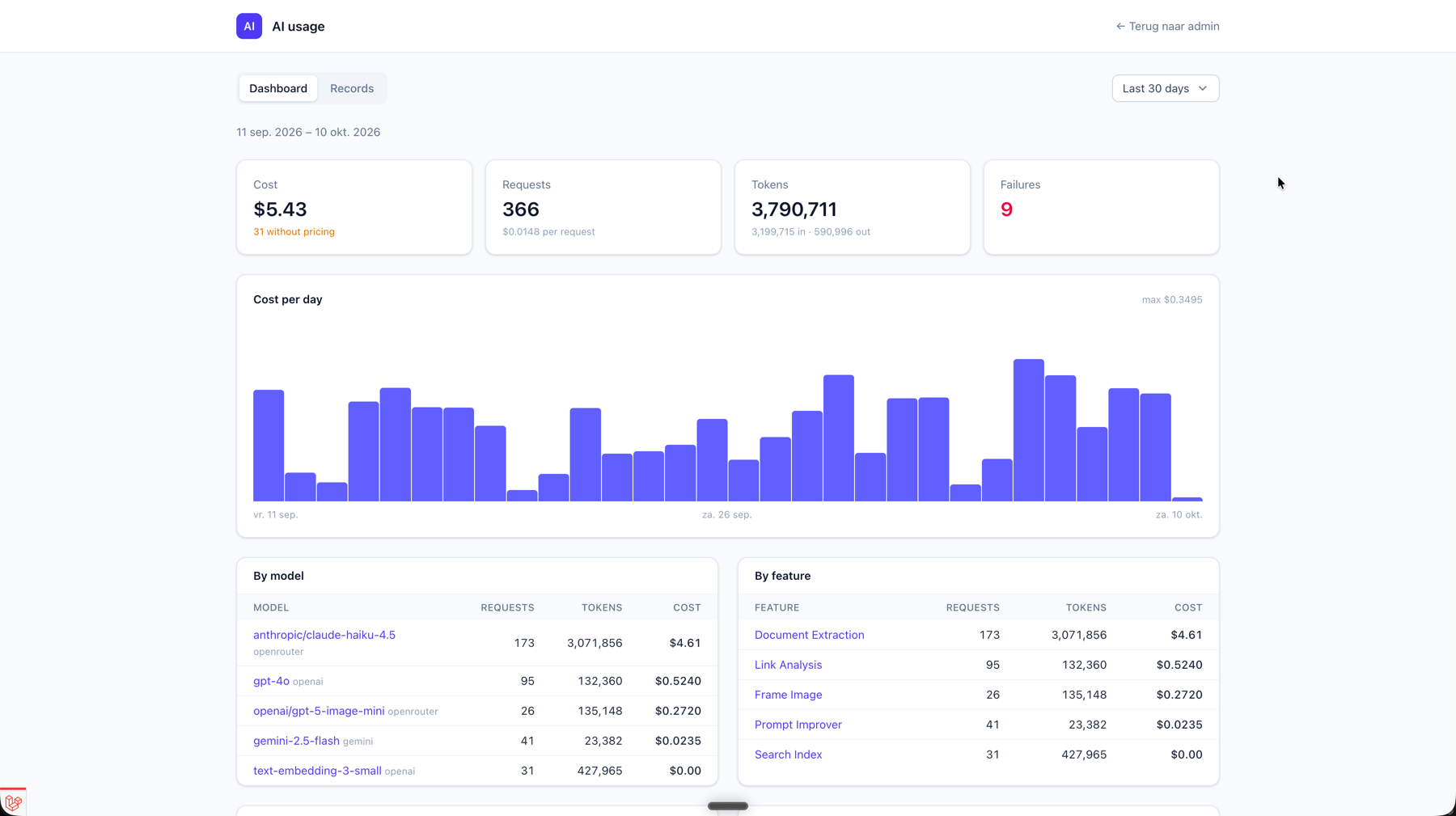
Tracks the tokens and cost of every laravel/ai call in your application and shows them on a filterable dashboard. Usage is recorded automatically from the laravel/ai events, priced with a model price list synced from OpenRouter, and attributed to a feature, a subject (any Eloquent model) and a user. The pages are standalone Livewire pages that ship their own compiled CSS, so they work without your application's Tailwind build.
- Records agent prompts and streams, embeddings, images, transcriptions, reranking and failovers.
- Prices every call when it is recorded (input, cached input, cache write and output tokens) and keeps the rates used.
- A dashboard with a chart of cost, tokens or requests (per hour, day or month) and breakdowns, a record list with filters, sorting and CSV export, a detail page per call, and a model list with a sync button.
- Budgets per day, week or month, with an event and an optional mail.
- Prompt and response text are not stored unless you enable it.
Requirements
- PHP 8.4+
- Laravel 12 or 13, Livewire 4
laravel/ai0.9 or newer, including 1.x
Installation
composer require spaanproductions/laravel-ai-usage
Publish the migrations and run them. The ai_models table (the price list) has its own tag, so skip it if your application already has that table:
php artisan vendor:publish --tag=ai-usage-migrations
php artisan vendor:publish --tag=ai-usage-models-migrations
php artisan migrate
If one of the table names (ai_models, ai_usage_records, ai_usage_budget_alerts) is already taken in your application, publish the config (php artisan vendor:publish --tag=ai-usage-config) and change tables before running the migrations. The migrations and the models both read these names:
'tables' => [
    'models' => 'ai_models',
    'records' => 'ai_usage_records',
    'budget_alerts' => 'ai_usage_budget_alerts',
],
Sync the AI models and their prices. Every provider with an API key in config/ai.php is synced, plus the public OpenRouter catalogue, which is always included:
php artisan ai-usage:sync-models
Allow access to the pages by defining the gate, for example in AppServiceProvider::boot(). Until you do, the package denies everyone:
use Illuminate\Support\Facades\Gate;

Gate::define('viewAiUsage', fn ($user): bool => $user->isAdmin());
The dashboard is now available at /ai-usage.
Schedule the price sync and, if you configure a retention period, the pruning, in routes/console.php:
use Illuminate\Support\Facades\Schedule;
use SpaanProductions\LaravelAiUsage\Models\AiUsageRecord;
use SpaanProductions\LaravelAiUsage\Console\Commands\SyncAiModelsCommand;

Schedule::command(SyncAiModelsCommand::class)->weekly();
Schedule::command('model:prune', ['--model' => [AiUsageRecord::class]])->daily();
Configuration
php artisan vendor:publish --tag=ai-usage-config
| Key | Default | |
|---|---|---|
enabled |
true |
Record usage (AI_USAGE_ENABLED). |
store_content |
false |
Also store the prompt and response text, truncated to content_limit characters. |
user_model |
App\Models\User |
The model user_id points to. |
currency |
USD |
The currency of the prices (OpenRouter prices are USD). |
retention_days |
null |
Rows older than this are deleted by model:prune. null keeps everything. |
budgets |
[] |
See Budgets. |
routes.enabled |
true |
Register the pages. |
routes.prefix |
ai-usage |
URL prefix of the pages. |
routes.middleware |
['web', 'auth'] |
Middleware of the pages; the gate is added to it. |
gate |
viewAiUsage |
The gate that allows access to the pages. |
layout |
ai-usage::layout |
Layout of the pages, see Pages. |
back_link |
label, route, url |
A link back to your application in the standalone header. |
Attributing usage
Every laravel/ai call is recorded without any code. To know what the cost belongs to, give your agents a feature and link calls to the record they were made for.
Implement ProvidesAiUsageContext on an agent to set its feature. Without it, the agent's class name in snake_case is used:
use Illuminate\Database\Eloquent\Model;
use SpaanProductions\LaravelAiUsage\Contracts\ProvidesAiUsageContext;

class InvoiceReader implements Agent, ProvidesAiUsageContext
{
    use Promptable;

    public function aiUsageFeature(): string
    {
        return 'invoice_reading';
    }

    public function aiUsageSubject(): ?Model
    {
        return null;
    }
}
Wrap a call in AiUsage::context() to link it to a subject, override the feature or user, or add metadata. Contexts can be nested, with the inner values winning, and the callback's return value is passed through:
use SpaanProductions\LaravelAiUsage\Facades\AiUsage;

$response = AiUsage::context(
    fn () => (new InvoiceReader())->prompt($text),
    subject: $invoice,
);

AiUsage::context(fn () => $this->importAll(), feature: 'bulk_import', user: $user, metadata: ['batch' => 7]);
The user defaults to the authenticated user. In queued jobs there is none, so pass it to the context when it matters.
Add the HasAiUsage trait to a subject model to get its usage and cost:
use SpaanProductions\LaravelAiUsage\Concerns\HasAiUsage;

class Invoice extends Model
{
    use HasAiUsage;
}

$invoice->aiUsage;          // AiUsageRecord collection
$invoice->aiUsageCost();    // total cost

Invoice::query()->withSum('aiUsage', 'total_cost')->get(); // no N+1 in lists
If the subject has an aiUsageUrl(): ?string method, the record detail page links to it.
Pricing
Costs are calculated when a call is recorded, using the prices (per 1M tokens) of the matching row in ai_models. Input, cache-read, cache-write and output tokens are each charged at their own rate. The token counts are read the same way from laravel/ai 0.x and 1.x, even though 1.x includes the cached tokens in inputTokens. The rates used are stored on the record. A model is matched on provider and model id, then on the id without a date or -latest suffix, then on its OpenRouter id. Calls to a model without a price are recorded with a cost of 0 and flagged as "without pricing".
After the prices change, or once a missing model has been synced, recalculate the old rows:
php artisan ai-usage:reprice --missing-only --dry-run
php artisan ai-usage:reprice --missing-only
php artisan ai-usage:reprice --from=2026-10-01 --to=2026-10-31
Budgets
'budgets' => [
    'monthly' => [
        'period' => 'month',        // day, week or month
        'limit' => 50,              // in the configured currency
        'thresholds' => [0.8, 1.0], // fractions of the limit
        'feature' => null,          // or limit the budget to one feature
        'mail' => ['admin@example.com'],
    ],
],
When the spend in a period crosses a threshold, BudgetThresholdReached fires once for that budget, period and threshold, and the addresses are mailed. AiUsageRecorded fires after every recorded call.
Pages
| Route | Path | |
|---|---|---|
ai-usage.dashboard |
/ai-usage |
Totals, a cost, tokens or requests chart and breakdowns by model, feature, provider and subject. |
ai-usage.records.index |
/ai-usage/records |
Filterable, sortable list with CSV export. |
ai-usage.records.show |
/ai-usage/records/{record} |
Tokens, cost, price snapshot, subject, metadata and content of one call. |
ai-usage.models.index |
/ai-usage/models |
The synced models with their modalities, context and prices, and a button that runs ai-usage:sync-models. |
The pages use a standalone layout with the package's own stylesheet. To show them in your application's layout instead, set layout to your layout component (e.g. layouts::app). Then add the package views to your Tailwind sources:
@source "../../vendor/spaanproductions/laravel-ai-usage/resources/views";
To change the views, publish them. To serve the stylesheet as a static file instead of through a route, publish the assets:
php artisan vendor:publish --tag=ai-usage-views
php artisan vendor:publish --tag=ai-usage-assets
Testing
The package factories make test data easy:
use SpaanProductions\LaravelAiUsage\Models\AiModel;
use SpaanProductions\LaravelAiUsage\Models\AiUsageRecord;

AiModel::factory()->withPricing(input: 2, output: 10, cachedInput: 0.5)->create(['model_id' => 'gpt-4o']);
AiUsageRecord::factory()->create(['feature' => 'invoice_reading', 'total_cost' => 1.25]);
AiUsageRecord::factory()->failed()->create();
laravel/ai fakes (Agent::fake()) are recorded too, but with zero tokens.
For three months of demo data, run the seeder. Running it again replaces the earlier demo rows:
php artisan db:seed --class="SpaanProductions\LaravelAiUsage\Database\Seeders\AiUsageDemoSeeder"
AI assistants
The package ships a Laravel Boost skill, ai-usage-development. Select it when you run php artisan boost:install.
Development
composer test       # PHPUnit via Orchestra Testbench
composer analyse    # PHPStan (Larastan), level 5
composer format     # php-cs-fixer (PSR-12, tabs)
After changing a view, rebuild the stylesheet and commit dist/ai-usage.css:
npm install
npm run build
License
Licensed under the Apache License, Version 2.0 © Spaan Productions.
Related Packages
Enterprise AI spend-governance for Laravel: cross-provider metering, budgets, po...
A beautiful AI chat widget plugin for Filament v3 with OpenAI integration
Claude Code agents for the TALL stack, powered by Laravel Boost
Agent Orchestration in your web app. Bring Claude Code into your Laravel app — n...
AI Agent templates for Laravel development - Skills, Agents, and Workflows for e...
Version History
| Version | Released | PHP | Laravel | License |
|---|---|---|---|---|
| v0.1.3 | ^8.4 | ^12.0| | Apache-2.0 | |
| v0.1.2 | ^8.4 | ^12.0| | Apache-2.0 | |
| v0.1.1 | ^8.4 | ^12.0| | Apache-2.0 | |
| v0.1.0 | ^8.4 | ^12.0| | Apache-2.0 |